
 Facebook
 Whatsapp
 LinkedIn
 Pinterest
On Demand Medicine Delivery App Development: A Complete Guide
Introduction
As digital healthcare adoption accelerates, pharmacies and healthcare providers are under growing pressure to modernize medicine access without compromising compliance or operational control. In this context, On Demand Medicine Delivery App Development has evolved from a convenience-driven idea into a strategic digital capability. For pharmacy chains, healthcare startups, and hospital groups, these platforms enable faster fulfillment, broader reach, and better continuity of care while meeting regulatory and data security requirements. This guide explores what it takes to build a scalable, compliant medicine delivery platform.
Why On-Demand Medicine Delivery App Development Is a Strategic Priority for Healthcare Businesses
Healthcare businesses are increasingly viewing medicine delivery platforms as an extension of their digital care ecosystem rather than a standalone logistics solution. Changing patient expectations, remote care models, and competitive pressure from digital-first pharmacies have made timely medicine access a baseline requirement. Investing in on-demand medicine delivery app development allows pharmacies and providers to retain customer trust, optimize fulfillment workflows, and scale services across regions. More importantly, it enables tighter control over prescriptions, inventory, and compliance.
How On-Demand Medicine Delivery Apps Enable Digital Pharmacy Operations
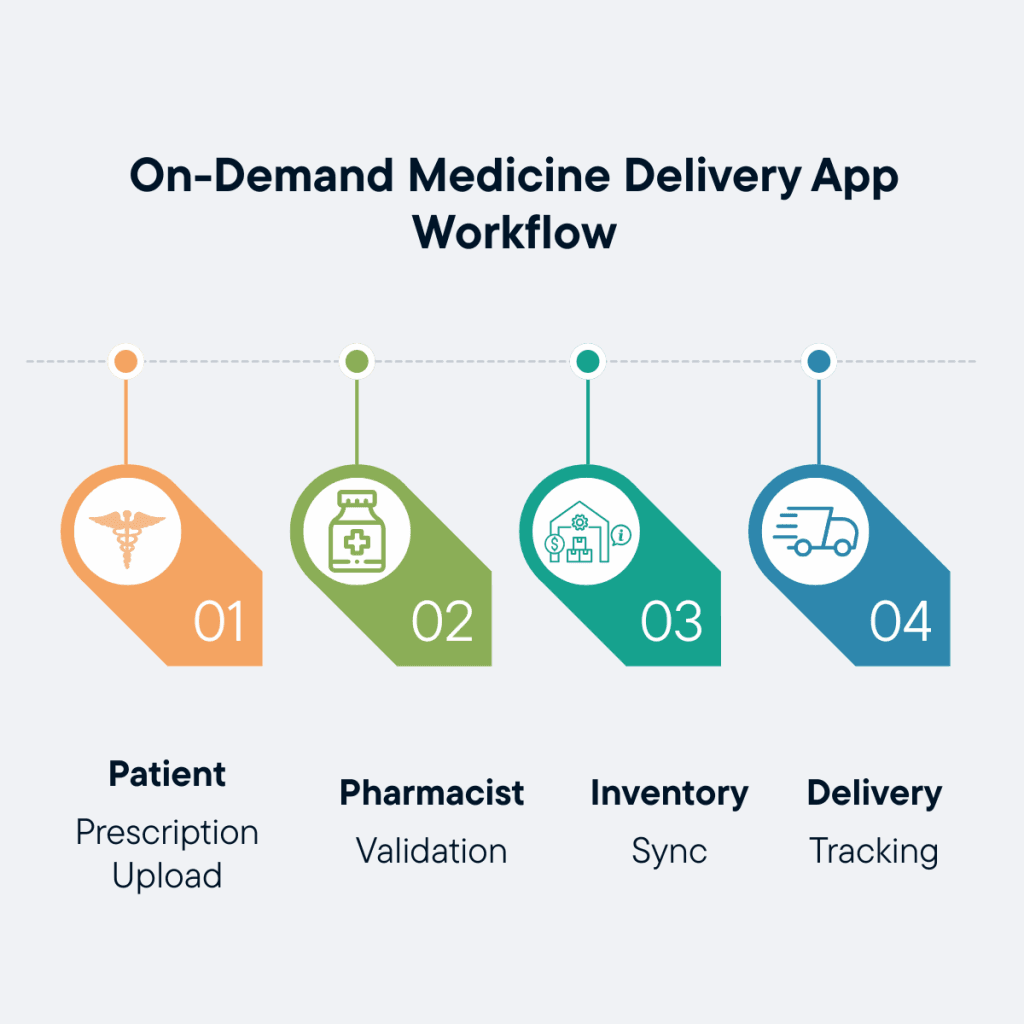
Unlike generic delivery apps, medicine delivery platforms are designed around regulated pharmacy workflows. These applications connect patients, pharmacists, and delivery partners within a controlled digital environment. Prescriptions are uploaded or integrated electronically, verified by licensed pharmacists, and fulfilled based on real-time inventory availability. The platform also supports order tracking, refill management, and operational reporting. By digitizing these processes, healthcare businesses can streamline pharmacy operations, reduce manual intervention, and ensure consistent service delivery across multiple locations while maintaining oversight and compliance.
This diagram above illustrates how an on-demand medicine delivery app connects patients, pharmacists, and delivery partners, showing key steps like prescription upload, validation, inventory management, and order tracking.
Core Functional Capabilities of an On-Demand Medicine Delivery App
A robust medicine delivery platform must balance user convenience with clinical and operational rigor. Core capabilities typically include:
- Secure Patient Onboarding: Easy registration, profile management, and verification.
- Prescription Upload & Verification: Patients upload prescriptions; pharmacists validate before fulfillment.
- Order Management & Tracking: Real-time order status, refill reminders, and notifications.
- Pharmacy Inventory Management: Automated updates, low-stock alerts, and order prioritization.
- Payment & Notification Integration: Implementation of multi-gateway payment processing combined with automated notifications and delivery tracking alerts.
- Analytics & Reporting: Usage dashboards, delivery metrics, and compliance logs.
- Multi-Location & Scalability Support: Ability to manage multiple branches or regions efficiently.
Together, these capabilities ensure the app supports both patient experience and backend efficiency without compromising regulatory control.
Compliance, Security, and Regulatory Considerations in Medicine Delivery App Development

Compliance is a defining factor in medicine delivery app development. Platforms must enforce prescription validation workflows, restrict access to sensitive data, and maintain detailed audit logs. Data security measures such as encryption, secure authentication, and role-based access control are essential to protect patient and prescription information.
Healthcare businesses must also account for regional regulatory requirements governing e-prescriptions, controlled substances, and data privacy. In markets such as the US, Australia, and Singapore, adherence to healthcare data protection standards and pharmacy regulations is critical. A compliance-first architecture not only reduces legal risk but also builds trust with patients, providers, and regulators, making it a foundational requirement rather than an optional feature.
Cost of On-Demand Medicine Delivery App Development: Key Factors That Influence Pricing
The cost of building a medicine delivery platform varies based on scope and complexity. Key cost drivers include feature depth, compliance requirements, system integrations, and scalability needs. Apps that support multi-pharmacy operations, advanced reporting, or regional expansion require more sophisticated architecture and testing.
Regulatory compliance and security implementation also add to the development effort compared to standard e-commerce or delivery apps. Additionally, integration with existing pharmacy systems or healthcare platforms can influence timelines and cost. Rather than focusing on a fixed price, healthcare businesses should evaluate development cost in terms of long-term operational value, compliance readiness, and scalability.
Build vs Buy: Choosing the Right Approach for Medicine Delivery Platforms
| Criteria | Off-the-Shelf Solutions | Custom Development |
| Compliance flexibility | Limited to vendor updates | Built to regional regulations |
| Workflow customization | Minimal | Fully aligned to pharmacy operations |
| Scalability | Constrained | Designed for growth |
| Integration capability | Restricted | Tailored to existing systems |
| Long-term cost control | Vendor-dependent | Higher upfront, better ROI |
For businesses treating medicine delivery as a long-term digital capability rather than a short-term experiment, custom development provides greater control, compliance assurance, and future-proofing.
What to Look for in an On-Demand Medicine Delivery App Development Partner
The success of a project depends heavily on partnering with the right development team. Healthcare businesses should prioritize partners with proven experience in regulated healthcare systems, strong security practices, and integration capabilities. The partner should understand pharmacy workflows, compliance obligations, and scalability challenges. Ongoing support, post-launch optimization, and the ability to evolve the platform as regulations or business needs change are equally important evaluation criteria.
How Fortunesoft Supports Secure and Scalable Medicine Delivery App Development?
With 16+ years of healthcare technology experience, Fortunesoft delivers trusted On Demand Medicine Delivery App Development Services that build secure, compliant, and scalable platforms tailored to pharmacy operations. Our solutions integrate AI-powered prescription management, inventory tracking, and order fulfillment to streamline workflows and reduce errors. With agile development and dedicated support, we ensure your medicine delivery platform is reliable, efficient, and designed for long-term growth, helping healthcare businesses deliver better patient outcomes.
Conclusion
Successful on-demand medicine delivery app development requires more than fast delivery features. It demands a clear understanding of healthcare workflows, regulatory responsibilities, and scalable system design. For pharmacies and healthcare providers, investing in the right platform and development partner enables reliable medicine access while maintaining compliance and operational control. A strategic, compliance-first approach ensures long-term value rather than short-term convenience.
FAQs
How long does it take to build a medicine delivery app?
Timelines vary based on feature scope, compliance needs, and integrations, but most platforms take several months from discovery to launch.
Is medicine delivery app development legally allowed everywhere?
Regulations differ by region. Compliance with local pharmacy and data protection laws is mandatory.
Can medicine delivery apps integrate with existing pharmacy systems?
Yes. Well-architected platforms are designed to integrate with inventory, prescription, and healthcare systems.
What is the process of on demand medicine delivery app development?
The process involves understanding healthcare workflows, designing secure prescription management and inventory systems, integrating delivery and payment solutions, and ensuring compliance with regulations like HIPAA or GDPR. Development typically follows an agile approach, including discovery, design, development, testing, and deployment, to deliver a reliable, scalable, and efficient medicine delivery platform.
Author Bio





Related Blog






 Start Chat