
Electronic Health Record (EHR) systems are not one-size-fits-all. From cloud-based platforms to on-premises deployments, each type is designed to meet different clinical, operational, and security needs. Understanding the different types of EHR systems can help healthcare organizations choose a solution that supports efficient workflows, regulatory compliance, and long-term growth.
60-Second TL; DR
There are six main types of EHR systems: cloud-based, on-premises, hybrid, physician-hosted, remotely hosted, and specialty-specific. The right choice depends on your organization's budget, security requirements, scalability goals, and interoperability needs. While cloud-based EHRs are often the preferred option for growing healthcare organizations, every deployment model has distinct advantages based on clinical workflows and IT infrastructure.
Electronic Health Record (EHR) systems have become the backbone of modern healthcare. Understanding the different types helps providers choose a solution that improves patient care, streamlines operations, and supports future growth.
What Are the Different Types of EHR Systems?
The types of EHR systems are primarily categorized by how they're deployed, hosted, and managed. Each type offers different levels of control, cost, security, and flexibility.
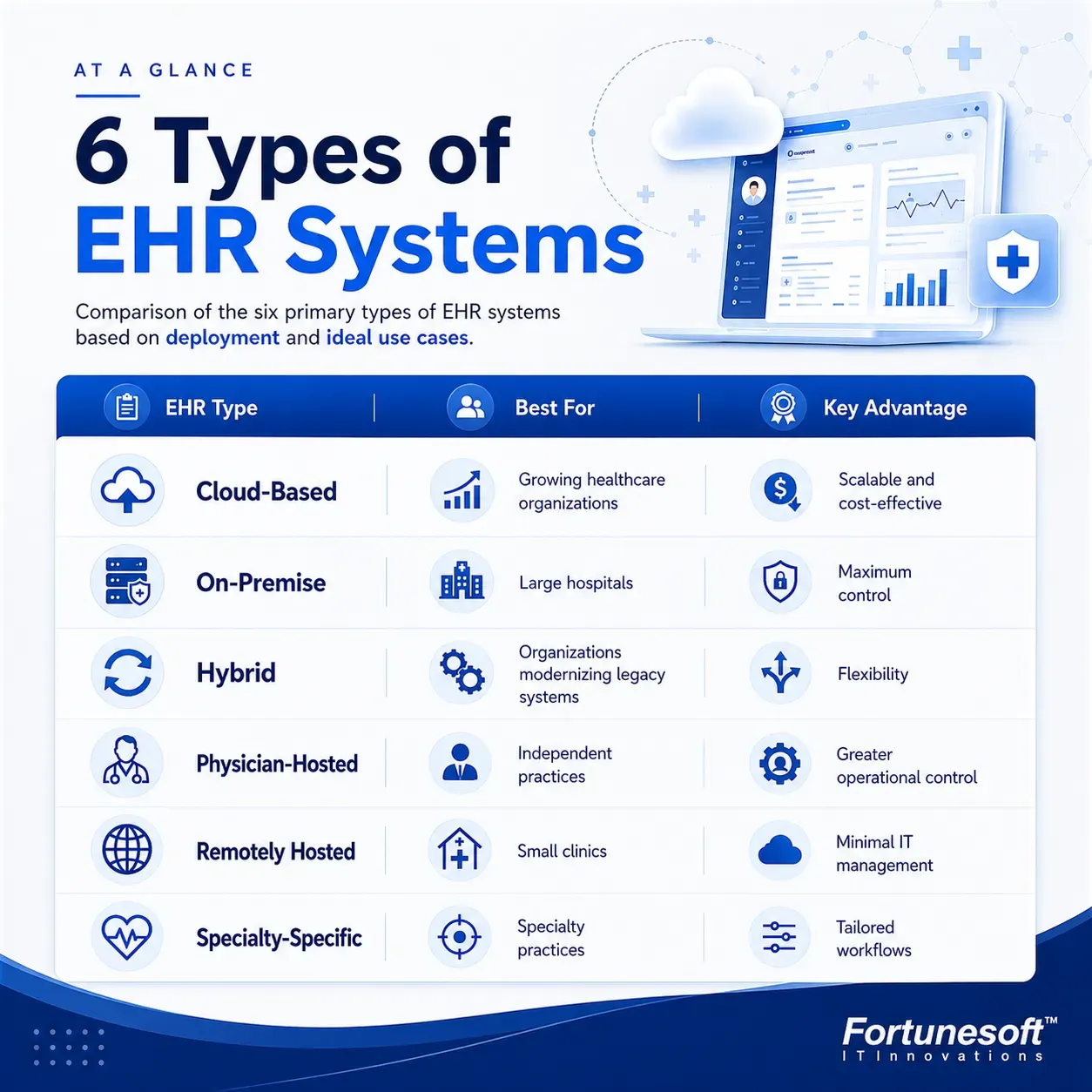
1. Cloud-Based EHR Systems
Cloud-based EHRs store patient data on secure remote servers and are accessed through the internet.
Best for:
Growing healthcare organizations
Multi-location practices
Healthcare startups
Key benefits:
Lower upfront infrastructure costs
Automatic software updates
Easy remote access and scalability
2. On-Premise EHR Systems
On-premise EHRs are installed and managed on an organization's own servers, giving complete control over infrastructure and data.
Best for:
Large hospitals
Organizations with strict internal IT policies
Key benefits:
Greater infrastructure control
Extensive customization
Internal data management
3. Hybrid EHR Systems
Hybrid EHRs combine on-premise infrastructure with cloud capabilities, balancing flexibility and control.
Best for:
Healthcare organizations modernizing legacy systems
Enterprises with phased cloud adoption
Key benefits:
Flexible deployment
Improved business continuity
Easier modernization
4. Physician-Hosted EHR Systems
In this model, physicians purchase and maintain the EHR while hosting it through their own infrastructure or contracted services.
Best for:
Independent practices
Small physician groups
Key benefits:
Greater operational control
Custom workflow configuration
Direct system management
5. Remotely Hosted EHR Systems
A third-party vendor hosts and manages the EHR infrastructure while healthcare providers access the platform remotely.
Best for:
Organizations with limited IT resources
Clinics seeking managed services
Key benefits:
Reduced maintenance burden
Vendor-managed infrastructure
Faster deployment
6. Specialty-Specific EHR Systems
These EHR solutions are designed for specialties such as cardiology, oncology, pediatrics, behavioral health, or dermatology.
Best for:
Specialty practices
Healthcare organizations with unique documentation needs
Key benefits:
Specialty-focused workflows
Customized templates
Improved clinical efficiency
How Do the Different Types of EHR Systems Compare?
EHR Type | Cost | Scalability | Maintenance | Best For |
Cloud-Based | Low upfront | High | Vendor | Growing organizations |
On-Premise | High upfront | Moderate | Internal IT | Large hospitals |
Hybrid | Moderate | High | Shared | Enterprise modernization |
Physician-Hosted | Moderate | Moderate | Practice-managed | Independent physicians |
Remotely Hosted | Subscription | High | Vendor | Small clinics |
Specialty-Specific | Varies | Varies | Vendor/Internal | Specialty healthcare providers |
How Do You Choose the Right Type of EHR System?
The best EHR system depends on your organization's operational and technical requirements rather than a single deployment model.
When evaluating options, consider:
Organization size and future growth
Budget and total cost of ownership
Data security and regulatory requirements
Integration with existing healthcare systems
Interoperability using standards like FHIR and HL7
Vendor support, scalability, and customization

Healthcare organizations planning for long-term digital transformation should prioritize solutions that can integrate with evolving technologies, support data exchange, and adapt to changing clinical workflows.
Why Choose Fortunesoft for EHR Development?
Choosing the right deployment model is only one part of building a successful EHR solution. The implementation partner also plays a critical role in ensuring security, interoperability, scalability, and long-term performance.
At Fortunesoft, we provide EHR software development services tailored to healthcare organizations' unique workflows. Our team specializes in cloud-native healthcare applications, FHIR and HL7 interoperability, AI-powered healthcare solutions, legacy modernization, and seamless integration with existing clinical systems. Whether you're building a new EHR platform or modernizing an existing one, we help deliver secure, scalable, and future-ready healthcare software.