The rise of telemedicine in Singapore reflects the country's continued investment in digital health, stronger regulatory frameworks, and growing demand for convenient access to medical care.
Telemedicine enables licensed healthcare providers to deliver remote consultations while complying with Singapore's evolving regulatory framework. Healthcare organisations offering telemedicine services must adhere to requirements under the Healthcare Services Act (HCSA), protect patient information in accordance with the Personal Data Protection Act (PDPA), and follow professional standards issued by the Ministry of Health (MOH).
As healthcare organisations continue their digital transformation initiatives, telemedicine has become an important investment area. For healthcare leaders, success depends on more than offering virtual consultations. It requires regulatory compliance, secure technology, and integration with existing clinical workflows.
TL; DR
- Telemedicine in Singapore enables healthcare providers to deliver remote consultations under a regulated healthcare framework.
- Growing demand for accessible healthcare, an ageing population, and national digital health initiatives continue to drive adoption.
- Healthcare organisations should prioritise compliance, cybersecurity, interoperability, and patient experience when implementing telemedicine platforms.
- Partnering with an experienced healthcare technology provider can help organisations build secure, scalable, and future-ready telemedicine solutions.
What Is Telemedicine in Singapore?
Telemedicine refers to the remote delivery of clinical healthcare services using secure digital communication technologies. It enables licensed healthcare professionals to consult, diagnose, treat, monitor, and follow up with patients remotely when clinically appropriate.
For healthcare providers, telemedicine improves access to care, supports continuity of treatment, and helps optimise clinical resources while maintaining high standards of patient care.
Although the terms are often used interchangeably, telemedicine focuses on remote clinical services, while telehealth has a broader scope that also includes remote patient monitoring, health education, wellness programmes, and other non-clinical healthcare services.
Depending on the provider and clinical setting, telemedicine services in Singapore commonly include:
- Virtual doctor consultations
- Follow-up appointments
- Chronic disease management
- Mental health consultations
- Electronic prescriptions
- Remote patient monitoring
As demand for virtual care continues to grow, many healthcare organisations are investing in telemedicine app development to deliver secure, compliant, and patient-centric digital care experiences.
Why Is Telemedicine Growing in Singapore?
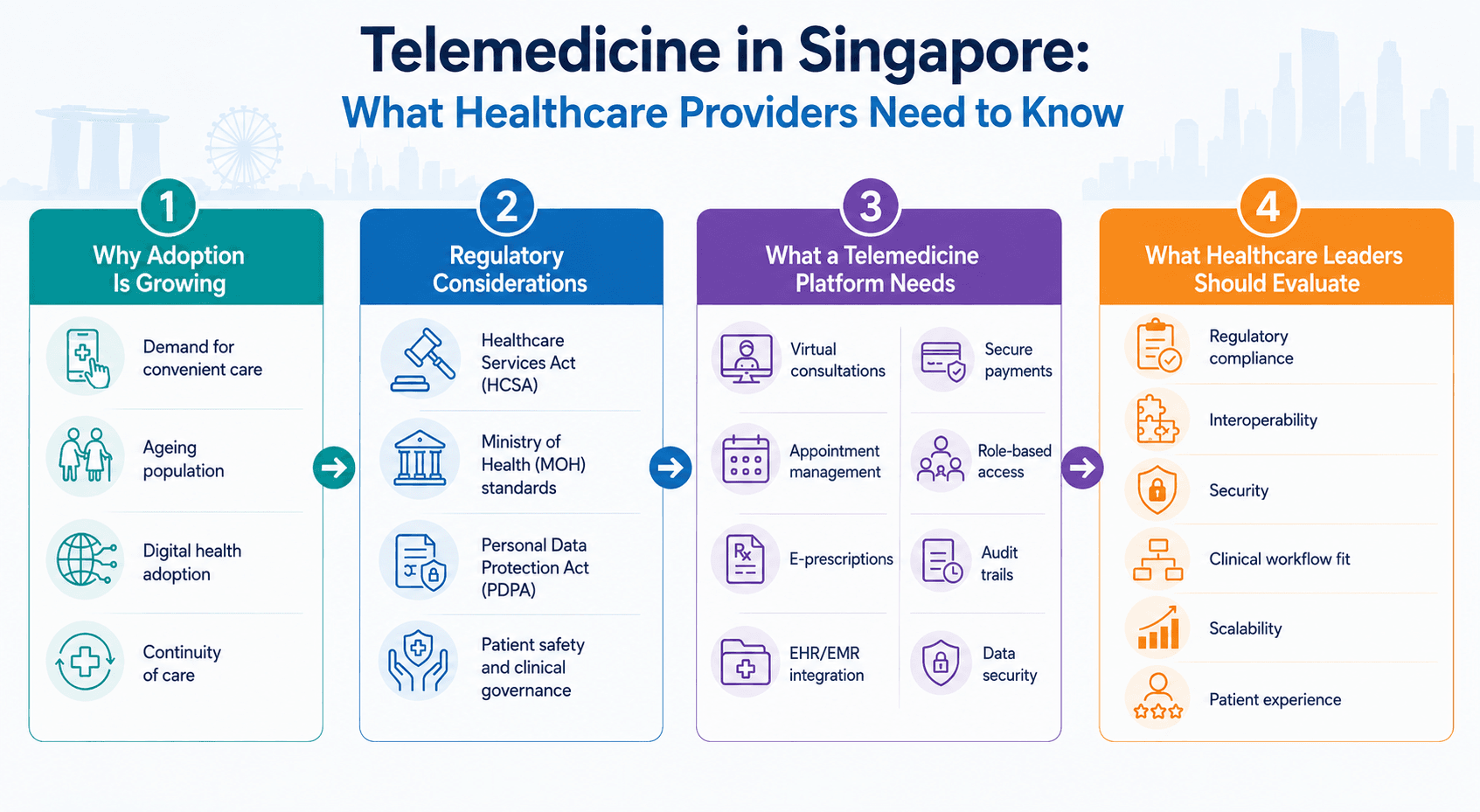
Telemedicine in Singapore continues to experience strong adoption as healthcare providers expand digital care services across the country. Several structural and demographic trends are accelerating telemedicine adoption across Singapore.
Increased demand for convenient healthcare
Patients increasingly expect healthcare services that fit around their daily schedules. Virtual consultations reduce travel time, minimise waiting periods, and improve access for patients with mobility challenges or those managing long-term conditions.
Digital transformation across healthcare
Singapore continues to strengthen its digital healthcare ecosystem through initiatives such as Healthier SG that encourage technology adoption across public and private healthcare providers. Healthcare organisations are investing in digital platforms that improve continuity of care while supporting operational efficiency.
An ageing population
Singapore's ageing population is increasing demand for chronic disease management and ongoing follow-up care. By 2030, around one in four Singapore citizens will be aged 65 and above, increasing the need for accessible and continuous healthcare services. Telemedicine enables clinicians to monitor suitable patients remotely while reducing unnecessary physical visits.
How Is Telemedicine Regulated in Singapore?
Telemedicine in Singapore operates within a mature regulatory framework designed to protect patient safety while supporting innovation.
The Healthcare Services Act (HCSA) regulates healthcare services using a services-based licensing framework. Healthcare providers delivering remote outpatient medical services must hold the appropriate licences and comply with applicable regulatory requirements.
The Ministry of Health (MOH) also provides professional standards for telemedicine services covering areas such as:
- Clinical governance
- Patient safety
- Appropriate use of remote consultations
- Documentation requirements
- Advertising standards for telemedicine services
Healthcare providers must also protect patient information in accordance with Singapore's Personal Data Protection Act (PDPA) and implement appropriate cybersecurity measures when handling sensitive health data.
What Should Healthcare Providers Consider Before Investing in Telemedicine?
Choosing the right telemedicine platform involves more than adding video consultations.
Healthcare organisations should evaluate whether a solution supports:
- Secure video consultations
- Appointment scheduling and patient management
- Electronic medical record (EMR/EHR) integration
- Electronic prescriptions
- Secure payment processing
- Role-based access controls
- Audit trails and reporting
- Data encryption
- Scalable cloud infrastructure
If the platform includes software that performs medical functions, organisations should also determine whether it falls within the Health Sciences Authority's regulatory requirements for digital health products and software medical devices.
How Fortunesoft Helps Build Secure Telemedicine Solutions?
Building a successful telemedicine platform requires expertise in healthcare regulations, interoperability, cybersecurity, and user-centred design.
Fortunesoft designs and develops custom telemedicine applications that align with Singapore's regulatory requirements and clinical workflows. From secure virtual consultations and e-prescriptions to EMR integration and cloud-native architectures, our Telemedicine App Development Services in Singapore help healthcare providers deliver reliable digital care.
For organisations building solutions specifically for medical practitioners, our Physician Telemedicine App Development Services support workflows tailored to clinicians. We also develop broader Telehealth App Development Services that include remote patient monitoring, wellness programmes, and patient engagement beyond virtual consultations.
Conclusion
Telemedicine in Singapore has become an important part of modern healthcare delivery. As telemedicine Singapore continues to mature, healthcare organisations that invest in compliant, scalable platforms will be better positioned to meet evolving patient expectations and deliver high-quality virtual care.
For organisations planning to implement or enhance telemedicine capabilities, success depends on selecting technology that aligns with regulatory requirements, integrates with existing healthcare systems, and supports long-term digital transformation goals.
Sources
https://www.hsa.gov.sg/medical-devices/digital-health/
https://www.moh.gov.sg/ageing-well/ageing-in-the-community/
https://www.population.gov.sg/our-population/population-trends/longevity/