
Healthcare app development in the UAE requires more than a strong mobile experience. Healthcare providers and digital health businesses must also consider regulatory requirements, patient data security, healthcare integrations, digital health standards, and the expectations of patients, clinicians, and healthcare organizations.
The applicable requirements can vary by the app's purpose, healthcare service, operating emirate, organization behind it, and whether the app supports regulated clinical activity. MOHAP plays a federal role in regulating and overseeing parts of the UAE healthcare sector, while DHA regulates healthcare services in Dubai. Abu Dhabi has its own Department of Health (DoH) requirements.
This guide explains what businesses should know before starting healthcare app development in the UAE, including MOHAP and DHA considerations, DoH requirements, essential features, development costs, security, integrations, implementation steps, and how to choose the right development partner.
Do I Need MOHAP or DHA Approval to Launch a Healthcare App in the UAE?
Not every healthcare app follows the same approval or compliance pathway. The requirements can depend on the healthcare service, app functionality, provider, location, business model, and how the application collects, stores, processes, and shares healthcare information.
An app that supports clinical services, telemedicine, medical records, prescriptions, diagnosis, treatment, remote monitoring, or other regulated healthcare activities may require additional regulatory consideration. A wellness, appointment-booking, or administrative app may follow a different pathway.
Before development begins, define:
- The healthcare service the app will provide
- The emirate or emirates where it will operate
- Whether licensed healthcare professionals will use it
- Whether it will store or exchange patient health information
- Whether it will connect to hospitals, laboratories, pharmacies, insurers, or government platforms
- Whether it will support diagnosis, treatment, prescriptions, or telemedicine
Regulatory requirements should be confirmed with the relevant authority and qualified legal or compliance professionals. This guide provides planning information, not legal advice or a substitute for official approval.
When Does MOHAP Apply to a Healthcare App?
MOHAP, or the Ministry of Health and Prevention, has a federal role in developing healthcare policies and legislation and regulating healthcare services, professionals, and medical products within its mandate.
If your healthcare application supports services that fall under MOHAP's regulatory scope, the business should identify the applicable requirements before development and launch. The exact obligations may depend on the service model, healthcare provider, location, and role of the application.
When Does DHA Apply in Dubai?
The Dubai Health Authority (DHA) oversees the regulation and governance of healthcare in Dubai. Its responsibilities include developing healthcare standards, licensing healthcare facilities and professionals, and governing health informatics.
Healthcare apps supporting regulated services in Dubai should therefore be planned around the applicable DHA requirements. This may include requirements related to telehealth, licensed providers, patient information, clinical workflows, health information systems, and data security.
What About Healthcare Apps Operating in Abu Dhabi?
Abu Dhabi has its own healthcare regulator, the Department of Health – Abu Dhabi (DoH).
DoH regulates the healthcare sector in Abu Dhabi and maintains standards covering areas such as healthcare information exchange, data governance, cybersecurity, and telemedicine.
Businesses should identify the relevant emirate-specific requirements before finalizing their healthcare app architecture, data flows, integration strategy, and operating model.
What Does MOHAP Mean in the UAE?
MOHAP stands for the Ministry of Health and Prevention. It is a federal UAE health authority responsible for developing healthcare policies and legislation, managing public healthcare programs, and regulating healthcare services within its scope.
What Does MOHAP Do?
MOHAP's responsibilities include healthcare regulation, licensing and monitoring activities, public health programs, healthcare policies, and digital healthcare infrastructure.
Its role does not mean that every healthcare application automatically requires the same MOHAP approval. The applicable pathway depends on the app's purpose, the healthcare service, the organization operating it, and the emirate or jurisdiction involved.
Why Does MOHAP Matter for Healthcare App Development?
MOHAP's focus on digital health and health information systems makes regulatory planning important when developing healthcare applications.
The ministry has also operated digital healthcare services, including telemedicine and patient-facing digital platforms. There are platforms provides services such as patient records, notifications, e-payment, live chat, and laboratory results.
For developers, this means healthcare apps should be designed with secure data handling, appropriate integrations, clear user permissions, auditability, and the intended healthcare workflow in mind.
MOHAP vs DHA: What’s the Difference?
MOHAP and DHA both regulate aspects of healthcare in the UAE, but they operate within different regulatory scopes.
| Factor | MOHAP | DHA |
Authority | Ministry of Health and Prevention | Dubai Health Authority |
Scope | Federal healthcare responsibilities within its mandate | Healthcare sector in Dubai |
Key role | Healthcare policy, regulation, licensing and public health | Healthcare regulation, licensing, standards and health informatics in Dubai |
App relevance | Depends on the healthcare service and operating model | Depends on the healthcare service and Dubai operations |
Planning focus | Confirm federal scope, service requirements, and applicable approvals | Confirm Dubai-specific standards, licensing, telehealth, and informatics requirements |
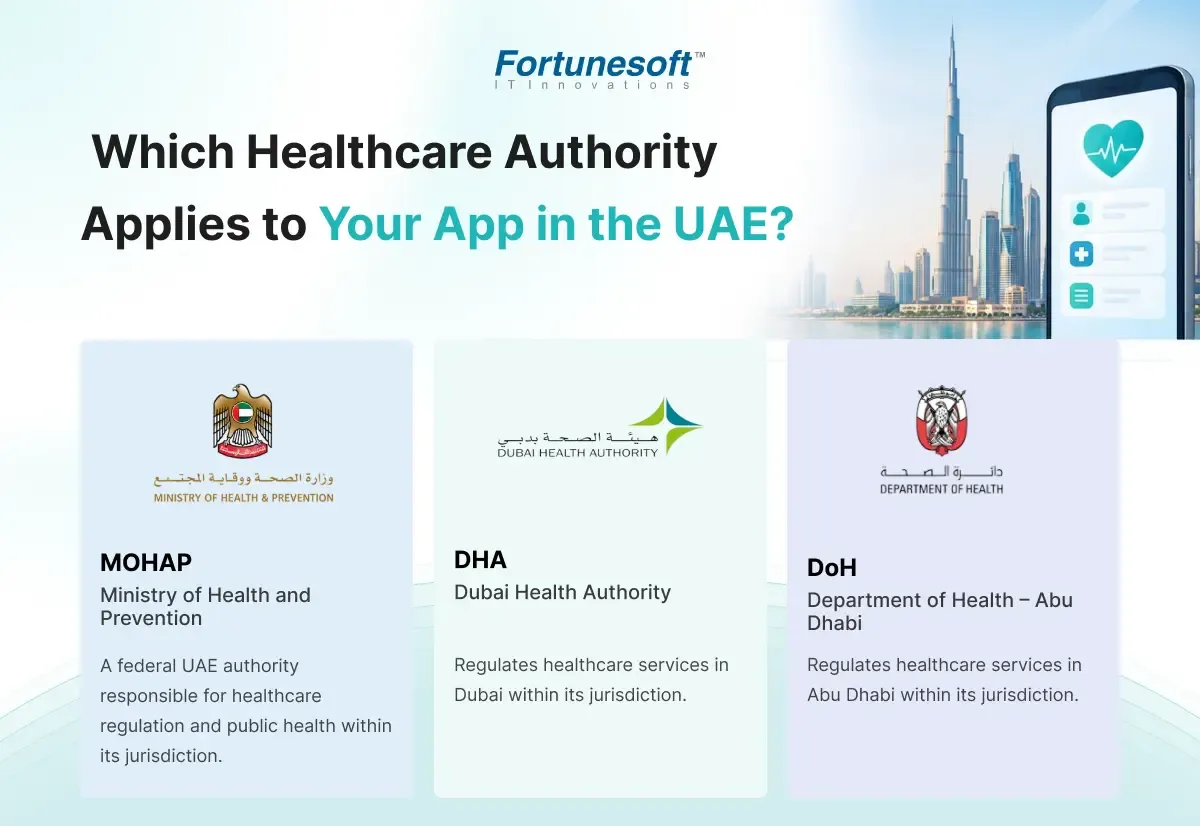
MOHAP, DHA and DoH have different healthcare regulatory responsibilities across the UAE. Applicable requirements depend on the service and operating model.
MOHAP for Federal Healthcare Requirements
MOHAP develops healthcare policies and legislation and regulates healthcare services within its federal mandate.
If your app supports a healthcare service within that mandate, assess the relevant requirements during the discovery and solution-design stages rather than waiting until the product is ready to launch.
DHA for Healthcare Services in Dubai
DHA regulates healthcare facilities and professionals in Dubai and establishes standards for healthcare services and health informatics.
A Dubai healthcare app may need to account for the licensing status of participating providers, telehealth requirements, patient data handling, clinical documentation, and integrations with existing healthcare systems.
The important point is that MOHAP vs DHA is not simply a technology decision. The applicable authority depends on where and how the healthcare service operates.
What Compliance Does a Healthcare App in the UAE Need?
Compliance requirements vary by use case, but healthcare app development should account for several core areas.
Patient Data Privacy and Security
Healthcare applications can handle highly sensitive patient information. Build security into the architecture from the beginning rather than treating it as a post-launch feature.
Use appropriate encryption in transit and at rest, secure storage, access controls, monitoring, vulnerability management, backup procedures, incident response processes, and data-handling practices.
The product should also define:
- What patient information is collected
- Why the information is collected
- Where it is stored
- Who can access it
- How long it is retained
- How it is shared with providers or third parties
- How users can exercise applicable privacy rights
Secure Authentication and Access Control
Patient, doctor, administrator, caregiver, pharmacist, and other user roles should have appropriate access permissions.
Multi-factor authentication, role-based access control, secure sessions, device management, password policies, consent records, and audit logs can help protect sensitive healthcare information.
Access should follow the principle of least privilege. A user should only be able to view or modify the information required for their role and workflow.
Healthcare Data and System Integrations
Many healthcare applications need to exchange information with EHR, EMR, laboratory, pharmacy, payment, insurance, or hospital systems.
For Abu Dhabi healthcare providers, DoH currently mandates specific health information exchange standards and data classification protocols for information transmitted through the Malaffi exchange.
Integration planning should cover:
- Data formats and interoperability standards
- API authentication and authorization
- Patient identity matching
- Consent and data-sharing rules
- Error handling and reconciliation
- Audit trails
- Availability and performance
- Vendor and third-party responsibilities
Do not assume that an integration is available simply because a healthcare system has an API. Confirm technical access, commercial terms, security requirements, testing procedures, and approval responsibilities before committing to the architecture.
Telemedicine and Digital Health Requirements
Telemedicine introduces additional clinical, operational, and regulatory considerations.
DHA has published current standards for telehealth services in Dubai, while DoH Abu Dhabi maintains standards covering telemedicine services.
A telemedicine product may need to address:
- Provider licensing and eligibility
- Patient identity verification
- Informed consent
- Clinical documentation
- Appointment and triage workflows
- Secure audio and video communication
- Prescription and referral processes
- Emergency escalation
- Follow-up care
- Recording and retention policies
- Service availability and technical support
Consent, Records, and Auditability
Healthcare apps should provide clear consent and notice flows where required. The system should record relevant consent events, changes to permissions, access to patient records, clinical actions, and administrative activity.
Audit logs should be protected from unauthorized modification and made available for investigation, compliance reviews, and operational troubleshooting.
Accessibility and Localization
A UAE healthcare app may serve users with different languages, technical abilities, and accessibility needs. Consider Arabic and English support, readable interfaces, right-to-left layouts where appropriate, accessible forms, and clear error messages experiences.
Localization should cover more than translated labels. It should also account for date formats, phone numbers, currency, address fields, consent language, notifications, and healthcare terminology.
What Features Should a Healthcare App in the UAE Include?
The right features depend on the healthcare workflow and target users. Common healthcare app features include:
- Patient registration and profiles
- Arabic and English language support
- Appointment scheduling and reminders
- Provider search and availability
- Telemedicine and video consultations
- Secure patient communication
- EHR and EMR integrations
- Medical records and document management
- E-prescriptions and medication management
- Online payments and invoices
- Insurance and eligibility workflows
- Push notifications
- Doctor and provider dashboards
- Admin and analytics dashboards
- Consent management
- Role-based access control
- Audit logs
- Customer support and issue reporting
For a telemedicine application, video consultations, secure communication, patient records, appointment management, and appropriate clinical workflows become especially important.
For a patient portal, records, appointments, test results, payments, prescriptions, notifications, and secure messaging may be the priority.
For a provider or hospital platform, scheduling, clinical documentation, staff workflows, billing, interoperability, analytics, and administrative controls may require greater attention.
Avoid adding features simply because they are common in other healthcare apps. Prioritize features based on the clinical workflow, user needs, regulatory obligations, integration dependencies, and measurable business outcomes.
How to Build a Healthcare App in the UAE
A structured development process can reduce compliance risks, rework, and unexpected integration costs.
1. Define the Healthcare Use Case
Document the target users, healthcare service, operating emirate, business model, clinical responsibilities, and expected outcomes.
2. Map the Regulatory and Data Requirements
Identify the relevant authority, licensing considerations, privacy obligations, data flows, consent requirements, retention rules, and third-party responsibilities.
3. Design the User Experience and Clinical Workflow
Create user journeys for patients, providers, administrators, and support teams. Validate the workflow with healthcare stakeholders before development.
4. Plan the Technical Architecture
Choose the application platforms, backend architecture, hosting approach, identity model, database structure, integration layer, monitoring tools, and disaster-recovery strategy.
5. Build and Integrate the MVP
Start with the workflows that deliver the most value while keeping security, auditability, and future scalability in the architecture.
6. Test Security, Performance, and Usability
Test authentication, authorization, data protection, integrations, notifications, video quality, accessibility, device compatibility, performance, and failure recovery.
7. Complete Compliance and Launch Readiness Reviews
Confirm that the product, operating procedures, provider workflows, contracts, support processes, and documentation are ready for the intended launch.
8. Monitor and Improve After Launch
Healthcare apps require ongoing maintenance, security updates, integration monitoring, performance optimization, user support, and changes when regulations or healthcare workflows evolve.
How Much Does It Cost to Build a Healthcare App in the UAE?
The cost of healthcare app development in the UAE depends on the application's complexity, platforms, integrations, security requirements, features, team location, testing scope, and post-launch support.
A basic patient-facing application will generally require a different investment from an enterprise healthcare platform with telemedicine, multiple integrations, AI, and complex provider workflows.
What Affects Healthcare App Development Cost?
Major cost factors include:
- UI/UX complexity
- Arabic and English localization
- iOS and Android development
- Backend and cloud architecture
- Telemedicine functionality
- EHR/EMR integrations
- Payment, insurance, laboratory, and third-party API integrations
- AI-powered features
- Security and compliance requirements
- Consent and audit systems
- Admin dashboards
- Provider workflows
- Testing and quality assurance
- App-store and launch support
- Post-launch maintenance
The most reliable way to estimate cost is to complete a discovery phase that defines the user roles, workflows, integrations, compliance scope, technical architecture, MVP features, and support requirements.
How Can You Reduce Healthcare App Development Costs?
Businesses can control costs by:
- Defining a focused MVP
- Validating workflows before development
- Prioritizing integrations
- Reusing secure and tested components
- Designing the architecture for future expansion
- Testing high-risk workflows early
- Avoiding unnecessary custom features
- Planning maintenance and compliance updates from the beginning
Reducing cost should not mean removing essential security, privacy, testing, or clinical safeguards.
How to Choose a Healthcare App Development Company in Dubai
Choosing the right healthcare app development company can affect the application's security, scalability, compliance readiness, and long-term cost.
Look for Healthcare Domain Expertise
Choose a development partner that understands healthcare workflows, patient-facing applications, telemedicine, healthcare data, and clinical integrations.
Ask for examples of relevant work, but also ask what the team learned from those projects, how it handled sensitive data, and how it managed changes in healthcare requirements.
Check UAE Compliance and Integration Experience
Ask whether the development team understands the regulatory environment relevant to your target emirate and has experience integrating healthcare systems and APIs.
A capable partner should be able to explain what it can handle directly, what requires specialist compliance advice, and what must be confirmed with MOHAP, DHA, DoH, or another relevant authority.
Evaluate Security, Scalability and Post-Launch Support
Healthcare applications need more than a successful launch. Evaluate the partner's approach to security testing, cloud architecture, performance, maintenance, updates, monitoring, incident response, and ongoing support.
Review the Delivery Model and Commercial Terms
Clarify who owns the source code, data, cloud accounts, design files, documentation, and third-party subscriptions. Confirm the development methodology, milestones, acceptance criteria, change-request process, warranty, support response times, and maintenance costs.
Planning healthcare app development in the UAE? Partner with a team that understands healthcare technology, integrations, security, and scalable application architecture. Talk to Fortunesoft's healthcare app development team to discuss your requirements.
Sources