Healthcare data management is the process of collecting, organizing, integrating, securing, and governing healthcare information throughout its lifecycle. It helps healthcare organizations improve patient care, maintain compliance, enable interoperability, and make data-driven decisions.
TL; DR
- Healthcare data management ensures healthcare information remains accurate, secure, and accessible.
- It combines data integration, governance, security, interoperability, and analytics.
- Effective management improves clinical decision-making and operational efficiency.
- AI and interoperability standards like FHIR are transforming healthcare data usage.
- A strong data strategy helps organizations build scalable digital healthcare ecosystems.
Healthcare organizations generate enormous volumes of data every day, including electronic health records (EHRs), medical images, laboratory reports, insurance information, and patient-generated data from connected devices.
However, collecting data is only the first step. Without proper management, healthcare data can become fragmented, difficult to access, and challenging to use effectively.
A structured healthcare data management approach helps organizations transform complex information into meaningful insights while improving patient outcomes and operational performance.
What is Healthcare Data Management?
Healthcare data management refers to the processes, technologies, and policies used to collect, store, integrate, protect, and analyze healthcare information.
The goal is to ensure that accurate healthcare data is available to the right people at the right time while maintaining privacy, security, and regulatory compliance.
Healthcare data management includes:
- Electronic Health Records (EHRs) and Electronic Medical Records (EMRs)
- Patient information and clinical records
- Medical imaging and laboratory data
- Claims and billing information
- Research and population health data
- Patient-generated data from wearable devices
Modern healthcare organizations increasingly rely on healthcare software development services to build secure platforms that connect these different data sources and improve healthcare workflows.
Why is Healthcare Data Management Important?
Healthcare decisions depend on accurate and accessible information. When healthcare data is poorly managed, organizations may face duplicate records, inefficient workflows, delayed decisions, and increased compliance risks.
Effective healthcare data management helps organizations:
- Improve patient care through better access to medical information
- Reduce errors caused by incomplete or inconsistent data
- Enable seamless communication between healthcare systems
- Strengthen data privacy and regulatory compliance
- Support advanced analytics and AI adoption
- Improve operational efficiency
By creating a unified view of healthcare information, organizations can provide more connected and personalized patient experiences.
Key Components of Healthcare Data Management?
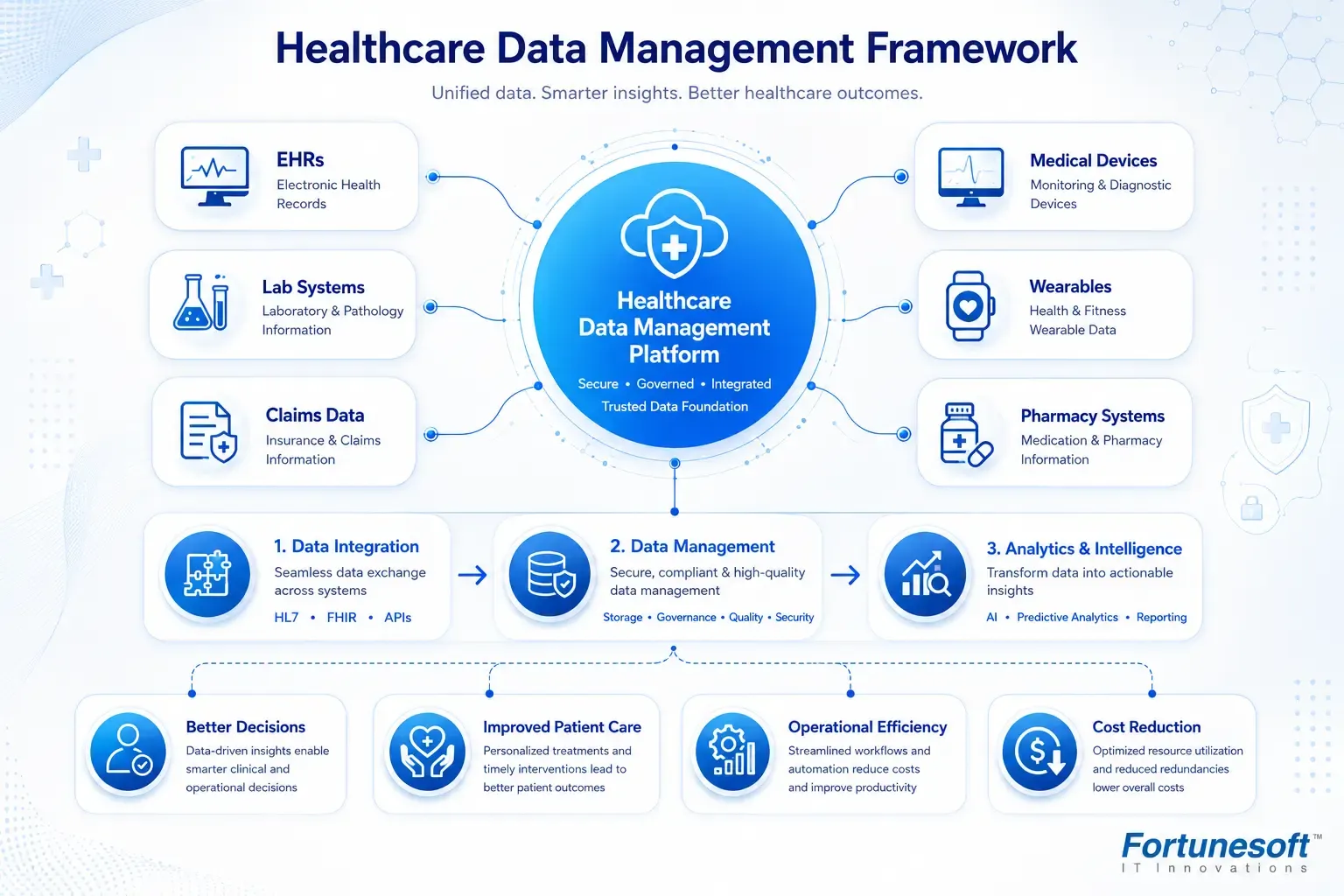
A successful healthcare data management strategy combines multiple capabilities:
Data Integration
Healthcare organizations often use multiple systems, including EHR platforms, laboratory systems, imaging solutions, and third-party applications. Data integration connects these systems to create a complete and accessible view of patient information.
Data Governance
Healthcare data governance establishes policies, standards, and processes to maintain data accuracy, consistency, ownership, and quality throughout the data lifecycle.
Data Security
Since healthcare data includes sensitive patient information and Protected Health Information (PHI), organizations must implement strong security practices to maintain privacy and comply with regulations.
Such as HIPAA, GDPR, and applicable healthcare data protection standards. Encryption, authentication, access controls, and continuous monitoring help safeguard healthcare information. Encryption, authentication, access controls, and continuous monitoring help protect healthcare information from unauthorized access.
Interoperability
Interoperability enables different healthcare systems and applications to exchange information securely. Standards such as Fast Healthcare Interoperability Resources (FHIR) help organizations achieve seamless data exchange.
Organizations can use FHIR integration services to connect healthcare applications, improve data accessibility, and support connected digital health ecosystems.
Healthcare Data Analytics
Healthcare analytics transforms raw information into actionable insights. It helps organizations identify trends, improve resource planning, optimize workflows, and support better clinical decisions.
What Challenges Do Organizations Face with Healthcare Data Management?
Healthcare organizations often face several data management challenges, including:
- Disconnected legacy systems
- Inconsistent data quality
- Data privacy and security risks
- Regulatory compliance requirements
- Limited interoperability between applications
- Growing volumes of structured and unstructured healthcare data
Addressing these challenges requires both modern technology and well-defined governance processes.
What Are the Emerging Trends Shaping Healthcare Data Management?
Healthcare data management is evolving rapidly as organizations adopt advanced technologies to improve accessibility, security, and decision-making.
Artificial Intelligence and Predictive Analytics
AI-powered healthcare solutions helps healthcare organizations analyze large datasets, identify patterns, automate workflows, and support predictive decision-making.
Real-Time Healthcare Data Integration
Modern healthcare platforms increasingly connect EHRs, medical devices, and patient monitoring systems to enable real-time access to healthcare information.
Cloud-Based Healthcare Data Platforms
Cloud infrastructure enables healthcare organizations to securely store, manage, and scale large volumes of healthcare data while supporting accessibility and collaboration.
Interoperability Standards
Standards such as FHIR and HL7 are becoming essential for enabling secure data exchange between healthcare applications.
What are the Best Practices for Effective Healthcare Data Management?
Healthcare organizations can improve their data strategies by following these practices:
- Establish clear data governance policies
- Maintain consistent data standards
- Prioritize interoperability between systems
- Implement strong security controls
- Regularly monitor data quality
- Adopt scalable cloud-based infrastructure
- Ensure compliance with healthcare regulations
A well-designed approach helps organizations manage growing data volumes while preparing for future healthcare innovation.
Why Choose Fortunesoft for Healthcare Data Management Solutions?
Managing healthcare data requires more than storing information. Organizations need secure platforms, seamless interoperability, AI capabilities, and scalable technology solutions to maximize the value of healthcare data.
Fortunesoft helps healthcare organizations build secure and scalable digital ecosystems by combining healthcare expertise with modern engineering capabilities.
Our healthcare technology expertise includes:
- Building secure healthcare applications and platforms
- Connecting healthcare systems through interoperability solutions
- Implementing AI-driven healthcare capabilities
- Developing scalable cloud-based healthcare solutions
- Supporting digital transformation initiatives
Through digital healthcare solutions, Fortunesoft helps healthcare providers, healthtech companies, and organizations create connected platforms that improve efficiency, enhance patient experiences, and support future innovation.
Conclusion
Healthcare data management is the foundation for modern, connected healthcare. By combining secure data practices, interoperability, analytics, and AI capabilities, organizations can transform healthcare information into meaningful insights and better patient outcomes.
As healthcare continues to become more digital and data-driven, investing in scalable data management strategies will be essential for long-term success.