After the COVID pandemic, many healthcare organizations and hospitals started to adopt healthcare IT solutions to provide better quality of care and enhance patient outcomes. One of the significant challenges faced by hospitals is managing and streamlining the healthcare ecosystem. This is where the hospital management software comes into the picture. Hospital Management Software (HMS) is a comprehensive solution designed to streamline the administrative and operational processes within healthcare institutions
Hospital Management Software (HMS) has revolutionized how healthcare organizations manage their operations. From streamlining administrative tasks to improving patient care, a well-designed HMS can make a significant difference in the workflow of a hospital. However, designing and developing hospital management software can be a hectic task.
On the flip side, creating HMS enables healthcare providers to focus more on delivering quality patient care while improving overall efficiency and productivity. Creating this type of healthcare product requires careful planning, feature integration, QA testing, and execution with the guidance of an experienced software development team.
In this blog, we explore seven tips for successful hospital management software development and its importance. Let us dive into…
What is Hospital Management Software (HMS) development?
Hospital Management Software development involves the creation of a customized HSM solution tailored to the specific needs and requirements of a hospital or clinic. Designing a user-friendly interface and ensuring scalability and flexibility are crucial aspects of HMS development.
Integration with existing systems, such as Electronic Health Records (EHR) and billing software, is essential for seamless workflow management. Security and compliance with healthcare regulations, such as HIPAA, are prioritized to safeguard patient data in the HMS development process.
Leveraging the first-class hospital management software development service leads you to build a user-friendly and scalable software platform that enhances the operational efficiency of hospitals. Besides, developing hospital management software helps you manage all patient information, automated billing, appointment scheduling, regulatory compliance, and other essential aspects easily in one place.
Understanding the importance of Hospital management software
The importance of hospital management software cannot be overstated in today’s healthcare landscape.
Here are some key reasons why HMS is essential:
1. Improved efficiency
This software can automate routine management tasks, such as appointment scheduling, online billing, and inventory management. So, it reduces the burden on healthcare staff and improves overall efficiency.
2. Enhanced patient care
By centralizing patient records and streamlining workflows, HMS enables healthcare providers to deliver more personalized and timely care to patients.
3. Cost savings
A well-implemented hospital management software solution can lead to cost savings by reducing paperwork, minimizing errors, and optimizing resource utilization.
4. Better decision making
HMS provides valuable insights and analytics that enable healthcare administrators to make informed decisions and optimize operational processes.
5. Compliance and security
With built-in security features and compliance measures, hospital management software helps healthcare organizations adhere to regulatory requirements and safeguard patient data.
These factors showcase how essential developing HMS is for your hospital or clinic. Next, let us see.
7 Tips to Develop a Hospital Management Software (HMS)
Creating hospital management software requires careful planning, attention to detail, and collaboration between various stakeholders.
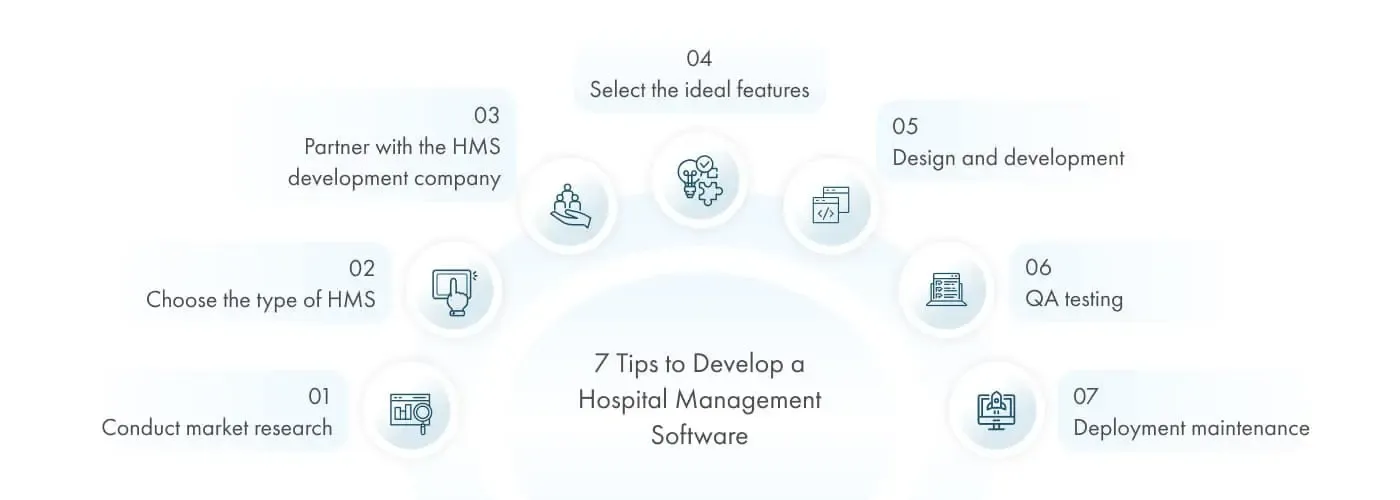
Here are seven tips to build a successful hospital management software.
1. Conduct market research
Firstly, you need to analyze and understand the market. It is a fundamental step that you need to pay attention to before developing hospital management software. Besides, it is imperative to conduct comprehensive market research. As the owner of a healthcare organization, you need to understand the current trends, challenges, and demands within the healthcare sector.
In addition, identify the specific needs of the hospital or clinic that your HMS aims to address. You can also engage with healthcare professionals, administrators, and IT experts to gain insights into their pain points and requirements.
Analyzing the market will help you identify gaps in existing hospital management software solutions, potential competitors, and areas where innovation is needed. It will also enable you to optimize your software to meet the needs of your target audience.
2. Choose the type of HMS
Hospital Management Software encompasses a wide range of functionalities, including patient registration, appointment scheduling, billing, electronic health records (EHR), inventory management, and more. Depending on the requirements of your users and the scale of operations, you can focus on specific modules.
Consider factors such as scalability, interoperability with existing systems, and regulatory compliance when choosing the type of HMS to develop. Whether you’re catering to small clinics or large multi-specialty hospitals, align the features and capabilities of your software with the diverse needs of healthcare providers.
3. Partner with HMS development company
Collaborating with a top HMS development company can significantly enhance the success of your project. Look for a well-experienced healthcare software development firm with a proven track record in crafting AI-powered healthcare IT solutions. You can evaluate the expertise, technical capabilities, domain knowledge, and client testimonials before deciding on the company.
A reliable development partner will help you build a robust HMS and provide valuable insights, guidance, and support throughout the development lifecycle. Ensure clear communication, establish realistic timelines, and define project milestones to keep the development process on track.
4. Select the ideal features
The success of your HMS hinges on its features and functionalities. Work closely with healthcare professionals to prioritize and define the essential features required for efficient hospital management. Some key features to consider include patient management, appointment scheduling, online billing and invoicing, payment tracking, EHR integration, pharmacy and inventory management, reporting and analytics.
Customize your hospital management software to meet the specific needs of different departments within a hospital. By doing so, it ensures seamless integration and workflow optimization.
5. Design and development
The design and development phase is where your vision for the HMS starts taking shape. Focus your hired software design & development team on creating a user-friendly interface with
intuitive navigation, ensuring accessibility for healthcare professionals and administrative staff. Adopt best practices in UI/UX design to enhance usability and productivity.
Follow agile development methodologies to build and test different components of the HMS. Collaborate closely with developers, designers, and domain experts to ensure alignment with the project objectives and requirements.
6. QA Testing
Quality Assurance (QA) testing is essential to identify and rectify any defects or inconsistencies in the HMS before deployment. QA testing is an iterative process aimed at delivering a robust and reliable HMS that meets the highest quality standards.
Conduct comprehensive testing across various scenarios, including usability, functionality, performance, security, and interoperability.
Implement automated testing tools and manual testing processes to ensure in-depth coverage. Engage end-users and stakeholders in the testing process to gather feedback and validate the software against real-world usage scenarios.
7. Deployment and Maintenance
Once the HMS has undergone rigorous testing and validation, it’s time for deployment. Plan a seamless rollout strategy. Provide training and support to users to familiarize them with the software and maximize adoption.
Monitor the performance and usage of the HMS, proactively addressing any issues or optimization opportunities. Stay abreast of emerging technologies and regulatory changes to ensure compliance and relevance in the dynamic healthcare landscape.
By following the seven tips outlined above and partnering with a trusted provider like Fortunesoft, you can create a robust and efficient HMS that enhances patient care, improves operational efficiency, and drives better outcomes.

Why Select Fortunesoft for Hospital Management Software Development?
Choosing the right and experienced technical partner for Hospital Management Software development is crucial for the success of your project. Fortunesoft is a leading digital healthcare and life science solutions provider globally with extensive experience in developing custom healthcare products, including hospital management software. We have a team of experienced developers with deep domain expertise in crafting healthcare IT solutions.
Our team can understand the unique challenges of the healthcare industry and develop tailored solutions that address your specific needs. In addition, we specialize in delivering customized life science and digital transformation solutions that align with your business objectives and requirements. Our experts will work closely with you to understand your vision and goals, ensuring that the final product meets your expectations.
Fortunesoft is committed to delivering projects on time and within budget. Also, we leverage agile methodologies and efficient project management practices to ensure timely delivery without compromising quality. We provide comprehensive support and maintenance services to ensure the smooth operation of the HMS post-deployment.