Your devices work. But do they work together? That’s the unspoken gap in modern healthcare delivery.
From infusion pumps to vitals monitors and ventilators, each device captures critical data. But without seamless integration, that data remains isolated in separate systems, slowing down clinical decisions, increasing manual errors, and affecting patient outcomes.
Healthcare organizations are now realizing: interoperability isn’t optional – it’s essential.
At Fortunesoft, we understand the complexity of integrating disparate medical devices into a unified ecosystem. Whether you’re planning to connect devices with EHRs, ensure HL7/FHIR compliance, or enable real-time remote monitoring, we’ve done it. Securely. At scale. And always with regulatory alignment.
In this blog, we break down the best practices for medical device integration from technical architectures and data standards to cybersecurity and compliance. You’ll also get visual frameworks, real-world implementation tips, and proven strategies tailored for providers, MedTech companies, and digital health innovators.
What Is Medical Device Integration? A Simple Overview
Medical device integration (MDI) is the process of connecting medical devices—such as patient monitors, ventilators, and wearables—with electronic health records (EHRs) and hospital systems. The goal is to automatically capture and share patient data in real time, without the need for manual entry.
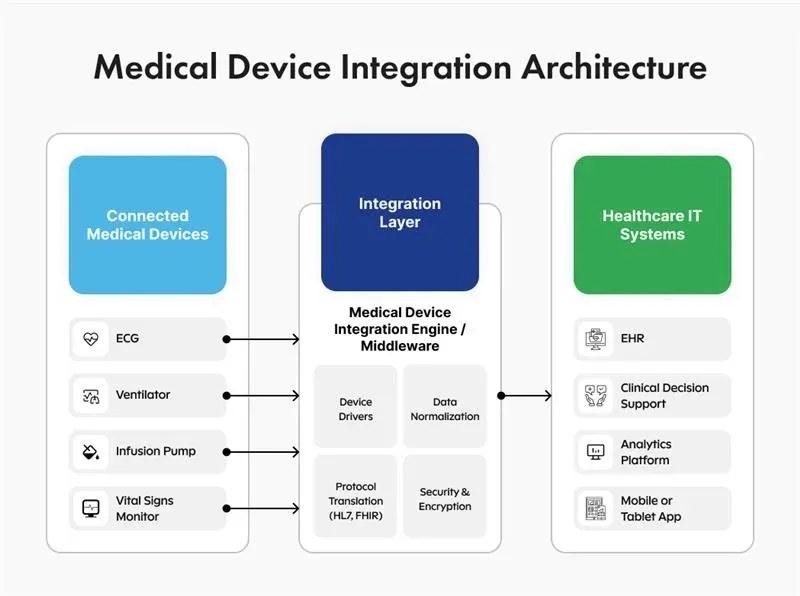
Think of MDI as a bridge: devices send data → a secure integration layer (middleware or gateway) processes and standardizes it → the information flows directly into EHRs or cloud platforms. This ensures clinicians have accurate, up-to-date insights at the point of care.
As shown in the figure below, integration works through a middleware or gateway: devices feed data into this layer, which then normalizes and securely transmits it to EHRs, hospital information systems, or analytics platforms.
Without integration:
- Nurses waste time manually charting vitals
- Clinicians lack up-to-date data during critical decisions
- Device data remains underutilized, fragmented, or lost
With integration:
- Patient vitals auto-sync with EHRs
- Alerts and data streams support real-time decisions
- Compliance and reporting workflows become faster and more accurate
Pros and Cons of Medical Device Integration in Healthcare
Medical device integration (MDI) offers powerful benefits, but it’s not without challenges. For healthcare leaders, understanding both is essential before investing.
Pros
- Unified Patient View: Connected devices stream real-time data into EHRs, giving clinicians a 360° view of vitals, history, and diagnostics, reducing errors and supporting faster decisions.
- Efficiency & Productivity: Automated data capture eliminates manual entry, reducing clinician burnout and freeing up time for patient care.
- Faster Response: Real-time alerts from integrated monitors enable quick interventions, crucial in ICU and emergency settings.
- Compliance Ready: Integration supports HIPAA/FDA compliance through structured logs, secure data transfer, and audit-ready trails.
- AI-Ready Insights: MDI feeds AI models for early detection (e.g., sepsis, ICU decline), helping hospitals move toward predictive care.
Cons
- Cost & Complexity: Upfront costs, especially for legacy systems, can be high. HL7/FHIR interfaces and device upgrades require planning.
- Interoperability Gaps: Devices often use incompatible protocols, slowing seamless integration.
- Cybersecurity Threats: More endpoints mean more vulnerabilities if not secured with encryption and access controls.
- Workflow Disruptions: Transitioning requires retraining and process changes, risking initial delays.
- Data Overload: Without intelligent filtering, raw device data can overwhelm rather than assist clinicians.
MDI must be implemented with both strategic foresight and intelligent data layering to deliver true clinical value.
Best Practices for Integrating Medical Devices
A successful MDI implementation isn’t just about connecting hardware—it’s about enabling intelligent, compliant, and future-ready ecosystems. Here’s how healthcare organizations can do it right.
1. Build Interoperability with HL7, FHIR, and APIs
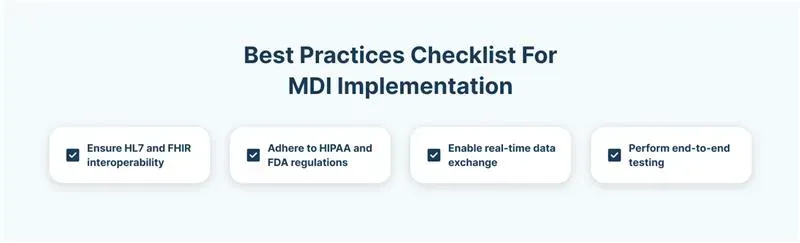
Legacy systems, fragmented protocols, and vendor-locked devices often block seamless data flow. Adopting interoperability standards like HL7 v2, FHIR, and custom APIs ensures devices can “speak the same language.” These standards facilitate secure, structured data exchange between bedside monitors, EHRs, cloud platforms, and AI analytics engines.
2. Prioritize Security and Regulatory Compliance (HIPAA, FDA)
Integrated systems create more data endpoints, each a potential security risk. Incorporate HIPAA-compliant encryption, role-based access controls, and FDA software validation from the outset. Building security into the architecture ensures audit-readiness, protects PHI, and mitigates legal risk.
3. Plan for Real-Time Data Flow and Device Testing
Real-time data integration only adds value if it’s accurate, timely, and actionable. Ensure rigorous device compatibility testing, latency monitoring, and fail-safe redundancy. Pilot test integrations with clinical teams to ensure the new workflows support, not interrupt patient care.
Choosing the Right Medical Device Integration Partner
Choosing a tech partner for MDI isn’t just an IT decision, it’s a clinical one. Look for:
- Proven healthcare experience in integrating diverse devices and EHRs
- Deep understanding of compliance, security, and interoperability
- A partner who offers post-deployment support and scalability as your needs evolve
The right partner ensures that your investment translates into safer care, faster decisions, and long-term ROI.
How Fortunesoft Helps with Secure, Scalable Integration
At Fortunesoft, we engineer custom medical device integration solutions tailored to your infrastructure, device ecosystem, and compliance needs. Our deep expertise in EHR integration enables seamless connectivity between devices and healthcare systems, while our remote patient monitoring solutions empower providers to capture, transmit, and analyze patient data in real time. Our teams specialize in:
- Interoperability with HL7/FHIR and EHRs
- Security-first architecture that’s HIPAA and FDA aligned
- Real-time data engineering that enables AI-readiness
With 16+ years of track record in digital health, remote monitoring, and IoMT healthcare IT experience, we focus on delivering robust, secure, and scalable integration services that reduce manual workloads, improve care coordination, and enhance patient outcomes.
Conclusion
Medical device integration is no longer optional; it’s foundational to modern, data-driven care. But to gain real value, integration must be secure, standards-compliant, and tailored to clinical workflows. With the right strategy and partner, your healthcare system can unlock the full potential of connected care.
So, the real question is, are you ready to turn your fragmented systems into a truly connected, patient-centric healthcare network?
Contact us today to start building your integration roadmap with our healthcare technology experts.