Wearables in healthcare are connected medical devices that continuously monitor patient health, enabling preventive care, remote patient monitoring, and earlier clinical intervention. In Australia, healthcare providers are increasingly adopting wearables in healthcare to reduce hospital readmissions, support virtual wards, and improve patient outcomes.
For healthcare organisations, however, deploying wearable devices is only one part of the equation. The real value comes from integrating wearable data with AI, Electronic Medical Records (EMRs), and clinical workflows to deliver actionable insights that improve patient care and operational efficiency.
If you're planning to move beyond evaluating wearable technology and build a scalable solution, explore our Wearable App Development Services in Australia to learn how we design, integrate, and deploy secure wearable platforms for healthcare organisations.
60-Second Summary
If you only have a minute, here's what you need to know.
Wearables in healthcare help clinicians monitor patients continuously instead of relying only on hospital visits. Combined with AI, they enable earlier intervention, support preventive care, and improve operational efficiency.
Healthcare organisations across Australia are using wearable technology to:
- Reduce hospital readmissions
- Support remote patient monitoring
- Expand virtual wards
- Improve chronic disease management
- Detect patient deterioration earlier
- Reduce clinician workload using AI
- Improve patient engagement
- Generate real-time clinical insights
The biggest success factor isn't the wearable device itself. It's integrating wearable data securely into existing healthcare systems and clinical workflows.
What Are Wearables in Healthcare?
Wearables in healthcare are connected medical devices that continuously collect patient health data outside traditional clinical settings. Unlike consumer fitness trackers, medical wearables provide real-time clinical insights that support preventive care, remote patient monitoring, and earlier intervention.
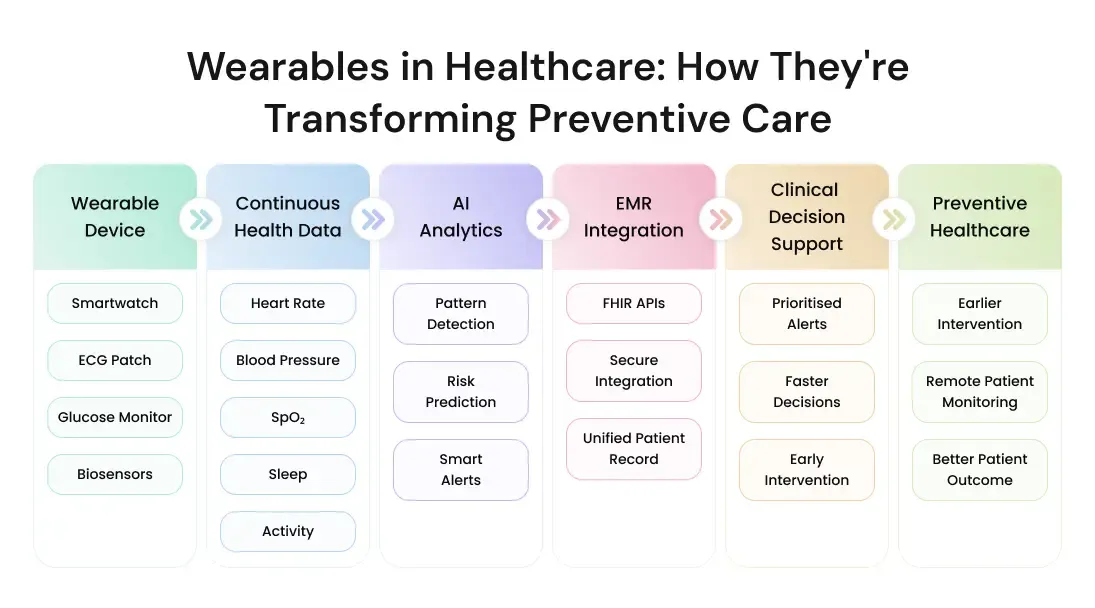
Figure: Wearables in Healthcare: How They're Transforming Preventive Care
Healthcare providers use wearable devices to monitor:
- Heart rate
- Blood pressure
- Oxygen saturation (SpO₂)
- Respiratory rate
- Sleep quality
- Physical activity
- Cardiac rhythm
- Blood glucose (for supported devices)
When integrated with EMRs and AI-powered analytics, this continuous data helps clinicians make faster, more informed decisions.
Why Are Wearables in Healthcare Becoming a Strategic Priority in Australia?
Australia's healthcare system is shifting from reactive treatment to preventive, data-driven care. Wearables play a key role in this transition by enabling continuous patient monitoring beyond hospitals and clinics.
1. Rising chronic disease burden
Cardiovascular disease, diabetes, respiratory conditions -these require continuous monitoring, not episodic appointments. Wearables provide the missing layer of day-to-day clinical visibility.
2. Ageing population + aged-care strain
As more Australians enter aged care, providers need low-touch, always-on monitoring to manage falls risk, medication adherence, sleep patterns, and mobility.
3. Virtual care and remote monitoring are accelerating
State health services are scaling virtual wards to reduce hospital bed demand. Wearables form the clinical backbone of these programs.
4. Workforce shortages demand automation
Clinicians cannot manually monitor every patient. Wearables + AI triage reduce manual review and surface only the signals that matter.
5. Increasing adoption of digital health technologies
Wearables support early intervention, lifestyle modification, and population-level insights -aligning with government prevention strategies.
In short: wearables help leaders move from reactive care to predictive, preventative, continuous care.
What Are the Benefits of Wearables in Healthcare?
Healthcare wearables improve both clinical outcomes and operational efficiency. Rather than relying on periodic appointments, clinicians receive continuous health data that supports faster intervention and more personalised care.
Key benefits include:
- Earlier detection of patient deterioration
- Reduced hospital admissions and readmissions
- Better chronic disease management
- Improved patient engagement
- Continuous remote patient monitoring
- AI-assisted clinical decision support
- Lower clinician workload
- Better population health insights
For Australian providers, these benefits align closely with the expansion of virtual care and preventive healthcare initiatives.
Traditional Healthcare | Wearables in Healthcare |
| Periodic appointments | Continuous monitoring |
| Reactive treatment | Preventive care |
| Manual follow-up | Automated alerts |
| Limited patient visibility | Real-time patient data |
| Hospital-based care | Remote patient monitoring |
| Delayed intervention | Early intervention |
How Does AI Improve Wearables in Healthcare?
AI transforms the continuous stream of data generated by wearable devices into actionable clinical insights. Instead of requiring clinicians to review thousands of data points, AI identifies patterns, prioritises alerts, and predicts patient deterioration before symptoms become severe.
AI helps healthcare organisations:
- Predict patient deterioration
- Reduce alert fatigue
- Identify long-term health trends
- Generate automated clinical summaries
- Prioritise high-risk patients
- Personalise care recommendations
Without AI, wearable devices generate data. With AI, they generate actionable clinical intelligence.
Looking to build AI-powered wearable healthcare solutions? Explore our Wearable App Development Services in Australia to learn how we help healthcare organisations integrate wearable devices with AI, EMRs, and clinical workflows to build secure, scalable digital health platforms.
How Are Wearables Used in Healthcare?
Wearables in healthcare are used to monitor patients remotely, detect health deterioration earlier, manage chronic diseases, support virtual care, and improve clinical decision-making. Across Australia, healthcare organisations are increasingly using wearable devices to deliver more proactive, data-driven care.
Some of the most common use cases include:
1. Remote cardiac and respiratory monitoring
Continuous monitoring helps clinicians detect deterioration earlier, reducing the risk of emergency admissions and hospital readmissions.
2. Virtual wards
Wearables allow eligible patients to recover safely at home while clinicians receive real-time health updates and automated alerts.
3. Aged care and fall-risk detection
Motion sensors monitor gait, balance, and mobility changes, helping providers identify fall risks before serious incidents occur.
4. Post-operative recovery
Wearable devices track vital signs and recovery trends, allowing clinicians to identify complications sooner.
5. Chronic disease management
Patients with diabetes, COPD, hypertension, and cardiovascular conditions benefit from continuous monitoring instead of relying solely on periodic appointments.
6. Population health analytics
Aggregated wearable data helps healthcare organisations identify trends, allocate resources, and improve preventive care strategies across different communities.
As wearable technology matures, these use cases are moving from pilot programs to routine clinical practice across Australia's healthcare system.
What Are the Biggest Challenges of Implementing Wearables in Healthcare?
While the benefits of wearables in healthcare are significant, implementing them at scale isn't without challenges. Healthcare organisations need more than connected devices, they need secure integrations, reliable data, and workflows that support clinicians rather than overwhelm them. Common implementation challenges include:
- Fragmented device ecosystems – Many wearable vendors use different standards, making interoperability difficult.
- Data quality and validation – Consumer-grade devices may not provide the clinical accuracy required for healthcare.
- EMR integration complexity – Connecting wearable data with existing clinical systems often requires custom integration.
- Alert fatigue – Continuous monitoring can overwhelm clinicians unless AI filters and prioritises meaningful alerts.
- Privacy and regulatory compliance – Patient data must be securely collected, stored, and managed in line with Australian healthcare regulations.
- Scaling across patient cohorts – Different clinical pathways require different devices, workflows, and escalation protocols.
Many of these challenges can be addressed by building wearables as part of a broader Healthcare App Development strategy that prioritises interoperability, secure data exchange, and scalable clinical workflows.
Why Choose Fortunesoft for Wearable Healthcare Solutions?
Building a successful wearable healthcare platform requires more than choosing the right device. It requires secure integrations, scalable architecture, AI-powered analytics, and clinical workflows that fit how healthcare teams work.
Fortunesoft helps healthcare organisations build wearable ecosystems through:
1. Multi-device integration across complex ecosystems
Support for multiple vendors, device types, and cohort-specific requirements.
2. Robust EMR and interoperability frameworks
FHIR-based, API-driven integration that plugs wearable data into EMRs, virtual ward systems, or clinical dashboards.
3. AI-powered triage workflows
Custom AI models that prioritise signals, reduce alert fatigue, and generate actionable summaries.
4. Scalable, secure architecture
Cloud-native, compliant, high-volume data ingestion designed for large patient populations.
5. Clinical governance alignment
Protocols, workflows, and safeguards aligned with the needs of public and private health providers.
6. Proven experience across healthcare digital transformation
Fortunesoft has delivered platforms, integrations, and AI-enabled systems for healthcare organisations globally -and brings that expertise to Australian providers.
Whether you're launching a remote patient monitoring platform or expanding virtual care, our Wearable App Development Services in Australia help healthcare organisations design scalable, AI-enabled wearable ecosystems tailored to Australian healthcare requirements.
Key Takeaways
Wearables in healthcare enable continuous patient monitoring.
- AI transforms wearable data into actionable clinical insights.
- Successful implementation depends on EMR integration, interoperability, and secure workflows.
- Australian healthcare providers are increasingly adopting wearables to support virtual care, aged care, and chronic disease management.
- The greatest value comes from combining wearable technology with AI and clinician-friendly workflows.
Conclusion
Wearables in healthcare are changing how clinicians monitor, predict, and manage patient health. By enabling continuous monitoring, earlier intervention, and AI-powered decision support, they help healthcare organisations deliver more proactive, efficient, and patient-centred care.
For Australian healthcare providers, the opportunity extends beyond adopting wearable devices. The real value lies in integrating wearables with AI, EMRs, and clinical workflows to build connected healthcare ecosystems that improve outcomes at scale.
As demand for virtual care and preventive healthcare continues to grow, organisations that invest in scalable wearable healthcare solutions today will be better positioned to deliver the next generation of digital healthcare.
Sources
https://www.sciencedirect.com/science/article/abs/pii/S0263224125012977
https://www.mdpi.com/2079-6374/14/11/560