The global AI in healthcare market is projected to surpass $187 billion by 2030, and organizations driving that growth are moving beyond experimentation. Across markets such as the UAE, healthcare providers are deploying AI in healthcare to improve patient outcomes, optimize operational costs, and streamline clinical workflows.
Standing at one of the peak times of AI, the question is which use cases of AI in healthcare are proving their worth, and how organizations are implementing them successfully. And how AI is creating measurable, real-world improvements across healthcare delivery and operations.
This blog explores the AI applications delivering the strongest value across clinical workflows and healthcare operations, backed by outcome-driven examples and practical considerations for moving AI initiatives from experimentation to long-term adoption.
Why AI Use Cases in Healthcare Are Moving from Pilot to Production
For years, AI in healthcare was synonymous with pilots, promising proofs of concept that rarely survived the transition to enterprise scale. That dynamic has fundamentally shifted.
Three major shifts are accelerating the transition of AI initiatives from early trials into scalable healthcare solutions:
- Mature data infrastructure: The widespread adoption of EHR systems has created the large, structured datasets AI models need to perform reliably. FHIR and HL7 interoperability standards now make it possible to unify data across disparate systems.
- Regulatory clarity: FDA frameworks for AI/ML-based Software as a Medical Device (SaMD), combined with clearer UAE PDPL and healthcare regulatory requirements, have given healthcare organizations a compliance roadmap that was missing just three years ago.
- Proven ROI signals: Early adopters are publishing outcome data. Health systems that deployed predictive analytics, AI-assisted diagnostics, and workflow automation are reporting measurable reductions in costs and readmissions, giving CFOs and CMOs the evidence they need to expand investments.
As a result, AI healthcare outcomes are now being measured in boardrooms, not just in research papers anymore.
AI Use Cases in Healthcare That Are Driving Measurable Outcomes
Here are five AI use cases in healthcare that have moved beyond theory and are demonstrating real-world impact across providers, payers, and biopharma organizations.
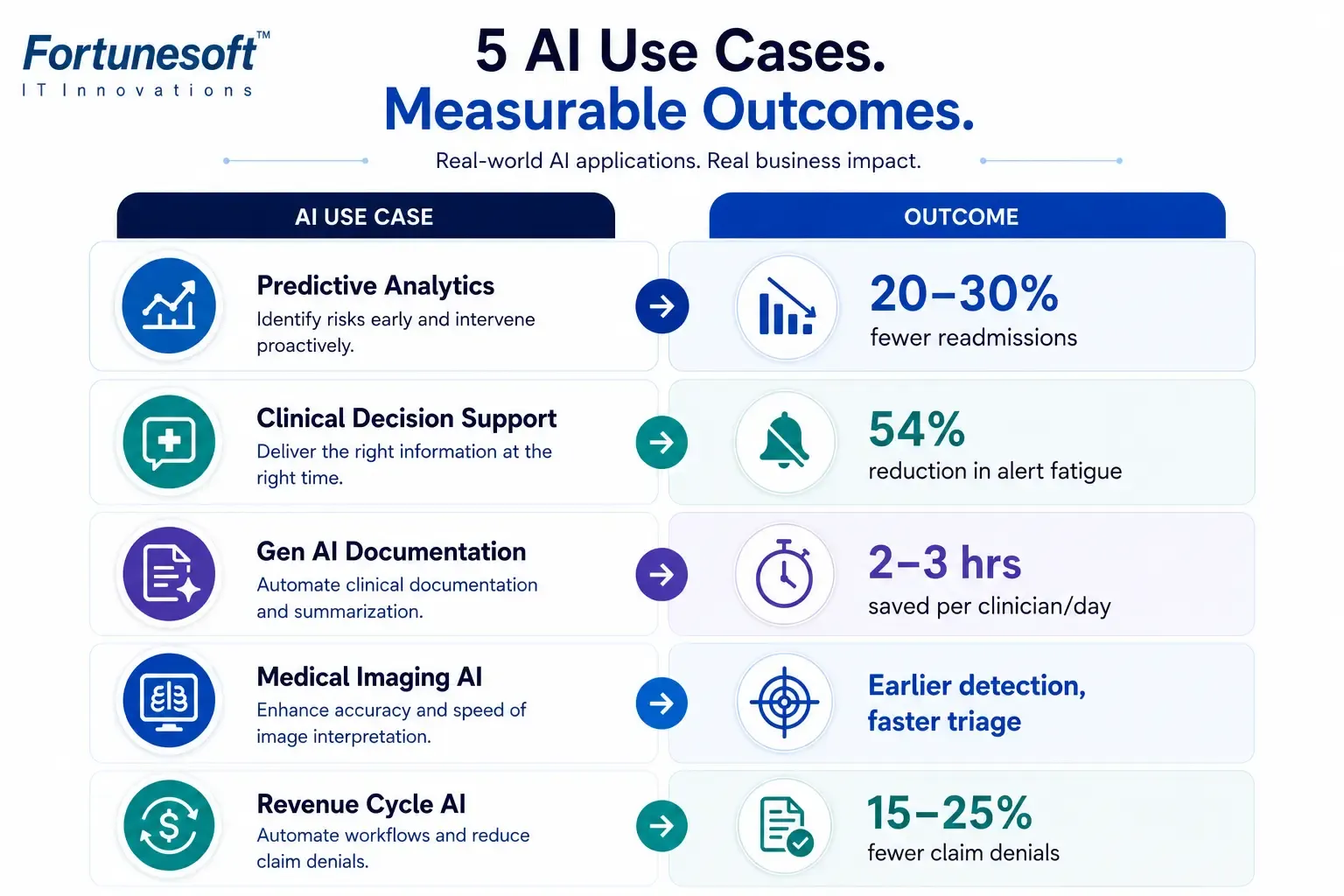
Figure: AI Use Cases in Healthcare and Their Measurable Impact
1. Predictive Analytics for Early Intervention
Predictive analytics uses machine learning to analyze patient history, vitals, lab results, and social determinants of health to identify who is at risk before a crisis occurs. Outcome impact: Health systems using AI-driven early warning systems have reported 20–30% reductions in hospital readmissions and significant improvements in ICU triage accuracy. For payers, predictive models identifying high-risk members are enabling proactive care management that reduces costly emergency utilization.
Why it matters: Readmission penalties and value-based care contracts make early intervention a direct financial lever, not just a clinical one.
2. AI in Clinical Decision Support
AI in clinical decision support (CDS) assists physicians and care teams at the point of care, surfacing drug interaction alerts, evidence-based treatment pathways, and differential diagnosis recommendations in real time within the EHR workflow.
Unlike rule-based CDS systems that generate alert fatigue, modern AI-powered CDS is context-aware. It learns from patient-specific data and adjusts recommendations accordingly, reducing irrelevant alerts by up to 54% in some implementations.
Outcome impact: Faster time-to-diagnosis, reduction in preventable adverse drug events, and improved adherence to clinical guidelines, particularly in complex cases involving comorbidities.
3. Generative AI Use Cases in Healthcare
Generative AI use cases in healthcare are among the fastest-growing and highest-impact applications right now, particularly in clinical documentation and administrative automation.
The most immediate applications include:
- Ambient clinical documentation: Gen AI listens to patient-provider conversations and auto-generates structured clinical notes, reducing documentation time by 2–3 hours per clinician per day.
- Prior authorization automation: Gen AI drafts prior authorization submissions by pulling relevant clinical evidence from the EHR, cutting turnaround times from days to hours.
- Discharge summary generation: Automated, accurate discharge summaries reduce transcription errors and improve care transition handoffs.
Outcome impact: Organizations piloting ambient Gen AI documentation are reporting significant reductions in physician burnout scores and measurable improvements in note accuracy and completeness.
Fortunesoft insight: Generative AI integration requires careful prompt engineering, hallucination controls, and clinical validation workflows; this is where vendor expertise matters enormously.
4. AI-powered Medical Imaging Diagnostics
AI is matching and, in some domains, exceeding specialist-level accuracy in interpreting medical images. Applications span radiology (detecting early-stage tumors, pulmonary nodules), pathology (analyzing tissue biopsies), ophthalmology (diabetic retinopathy screening), and cardiology (ECG interpretation).
Outcome impact: Early cancer detection rates are improving significantly with AI-assisted radiology reads. In screening contexts where radiologist shortages are acute, AI triage tools are enabling faster prioritization of urgent cases, directly improving patient outcomes.
5. Operational AI – Scheduling, Revenue Cycle and Workflow Automation
The most valuable AI prospects of Healthcare extend outside direct patient care. Operational AI is delivering some of the most immediate and measurable financial returns.
AI-powered scheduling reduces no-shows by predicting cancellation likelihood and enabling targeted outreach. Revenue cycle AI identifies coding errors, flags denial risks before claim submission, and accelerates reimbursement cycles. Workflow automation handles prior authorization routing, insurance verification, and patient communication, freeing staff for higher-value tasks.
Business impact: Healthcare organizations adopting AI-powered revenue cycle solutions have seen claim denial rates drop by 15–25%, along with improved financial workflow efficiency.
The Measurable Impact of AI in Healthcare: Clinical, Operational & Financial ROI
Understanding AI healthcare ROI requires looking across three dimensions because healthcare leaders are accountable to all three simultaneously.
Clinical impact: Improved diagnostic accuracy, earlier disease detection, reduced medication errors, and better adherence to evidence-based protocols. These translate into better patient safety scores, improved quality metrics, and stronger performance on value-based care contracts.
Operational impact: Reduced administrative burden, faster throughput, lower staff turnover driven by burnout reduction, and more efficient resource utilization. Hospitals using AI-assisted scheduling and workflow automation consistently report measurable gains in staff productivity.
Financial impact: Reduction in readmission penalties, lower claim denial rates, faster reimbursement cycles, and avoided costs from preventable adverse events. For payers, AI-driven care management programs are demonstrating measurable reductions in per-member-per-month costs.
The bigger takeaway: lasting AI success in healthcare depends on more than advanced technology; it requires the right workflows, adoption strategy, and operational alignment. They are driven by the quality of implementation, the data architecture, the clinical workflows, and the change management that surrounds the technology.
Healthcare AI Implementation: What It Actually Takes to Get It Right
The gap between organizations that achieve measurable impact and those that do not almost always comes down to healthcare AI implementation quality, not the AI itself.
Successful implementation requires addressing four critical dimensions:
Data readiness: AI models are only as good as the data they train on and operate on. EHR data needs to be clean, structured, and accessible. This often requires data governance investments before a single model is deployed.
Interoperability: AI solutions must integrate seamlessly with existing EHR/EMR systems via FHIR, HL7, and SMART on FHIR standards. Point solutions that cannot connect to the broader clinical data ecosystem create silos rather than solving them.
Regulatory compliance: DHA, DoH, and MOHAP requirements, along with international SaMD guidelines, are non-negotiable. Every AI model deployed in a clinical context needs validation, documentation, and ongoing monitoring. Explainability requirements are increasing; clinicians and regulators expect to understand why an AI makes a recommendation.
Change management: The most technically sophisticated AI implementation will fail without clinical adoption. Workflow integration, clinician training, and feedback loops that allow models to be refined based on real-world performance are as critical as the algorithm itself.
The bottom line: Healthcare AI implementation is a cross-functional discipline, not an IT project. Organizations that treat it as such are the ones delivering measurable impact.
How Fortunesoft Delivers AI Healthcare Solutions That Scale
Fortunesoft is an AI-driven digital engineering company with over 17 years of healthcare-specific experience, working with payers, providers, biopharma organizations, medical device manufacturers, and digital health companies.
Our approach to AI healthcare solutions is built around four principles that directly address the implementation challenges above:
- Clinical and operational discovery first: Every engagement begins with use case prioritization and ROI modeling, identifying where AI will deliver the highest measurable impact for your specific organization.
- Secure, interoperable data architecture: We design and build data pipelines that unify EHR/EMR, imaging, claims, and IoT data using FHIR, HL7, and SMART on FHIR standards, ensuring AI models have the data quality they need to perform.
- Compliant by design: AI models are developed with explainability, bias mitigation, and regulatory readiness at the core, aligned with HIPAA, GDPR, and FDA guidelines from day one.
- End-to-end delivery: From strategy and architecture to deployment, validation, and ongoing optimization, Fortunesoft stays engaged through the full lifecycle, not just the build phase.
Whether you are exploring predictive analytics, integrating Gen AI into clinical workflows, or scaling an AI-powered revenue cycle program, Fortunesoft brings the technical depth, healthcare domain expertise, and regulatory clarity needed to deliver AI that works in production.
Ready to Identify the Right AI Use Cases in Healthcare for Your Organization?
The AI use cases in healthcare delivering measurable impact today share one thing in common: they were built on a foundation of clinical insight, data integrity, and implementation discipline.
The organizations seeing the strongest AI healthcare outcomes are not necessarily the ones that started first; they are the ones that implemented thoughtfully, with the right partner.
If you are evaluating where to start or looking to scale what you have already built, Fortunesoft's healthcare AI team can help you identify the highest-impact use cases, build the implementation roadmap, and deliver solutions that are clinically safe, technically sound, and built to scale.

Related reading: AI Solutions for Healthcare Digital Transformation | What is Ambient AI in Healthcare?
Conclusion
Healthcare organizations that are seeing real returns from AI share one thing in common: they stopped waiting for the perfect moment and started with the right partner.
The use cases are proven. The ROI is documented. What separates organizations that are still piloting from those that are scaling is implementation quality, the data architecture, the clinical workflows, the compliance rigor, and the domain expertise behind the technology.
For more than 17 years, Fortunesoft has been delivering healthcare technology solutions designed for the evolving needs of payers, providers, biopharma organizations, and digital health companies. We know where AI delivers fastest, where implementation breaks down, and how to get you from business case to production without false starts.
If you are serious about deploying AI that delivers measurable outcomes, not just a proof of concept, let's talk. Your next step is one conversation.
Sources
Grand View Research - AI in Healthcare Market Size & Forecast, 2024-2030