
 Facebook
 Whatsapp
 LinkedIn
 Pinterest
athenahealth EHR to make Microsoft Dragon Copilot available to clinicians
Introduction
The healthcare documentation landscape took a major turn this week as athenahealth announced a partnership with Microsoft to integrate Microsoft Dragon Copilot directly into athenaOne, its network-enabled EHR platform. Set to roll out in the first half of 2026, this move gives more than 170,000+ clinicians on athenaOne access to a new AI-powered ambient documentation model – bringing real-time, automated clinical note generation even closer to clinical workflows.
This collaboration signals a clear industry shift: ambient AI is becoming a foundational layer of the modern EHR, not an optional add-on.
What athenahealth Announced
athenahealth will now offer Microsoft Dragon Copilot as a fully embedded option within athenaOne’s Ambient Notes ecosystem. Key elements include:
- Clinicians can activate ambient listening during patient encounters.
- AI-generated notes are drafted within seconds for review and editing.
- Individual clinicians can choose among ambient models – a first in the EHR market.
- The new solution arrives as part of the existing athenaOne contract, requiring no separate integration.
Microsoft Dragon Copilot, already used in more than 650 healthcare organizations, is renowned for high accuracy, conversational AI depth, and seamless integration into physician workflow.
Why This Partnership Matters for Healthcare
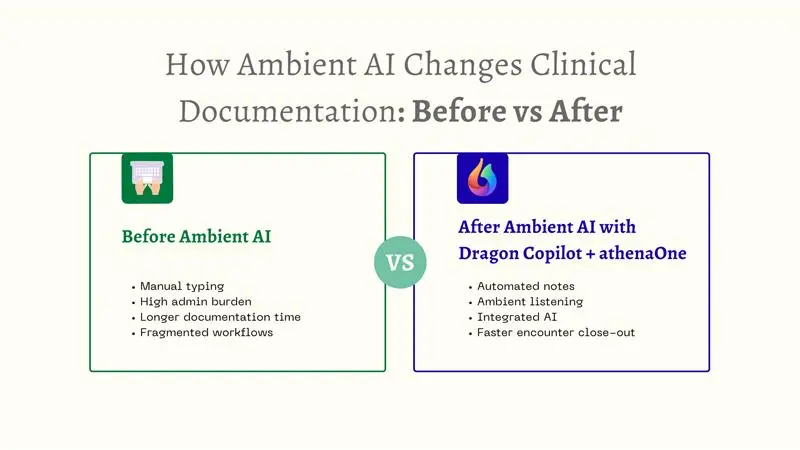 1. Ambient AI Is Becoming a Standard, Not a Novelty
With two major players – Microsoft and athenahealth – uniting to bring ambient AI to ambulatory clinicians, ambient documentation is now clearly crossing into mainstream adoption.
2. Clinician Choice Becomes a Priority
Athena is positioning itself as the only EHR offering modular, choice-driven ambient models. This represents a significant shift toward personalization within EHR workflows.
3. Stronger Focus on Reducing Administrative Burden
The industry-wide goal is unmistakable:
- Reduce clinician burnout by eliminating manual documentation.
- With AI-generated notes and real-time ambient capture, clinicians can regain hours of time per week.
4. Rising Demand for Integrated AI Workflows
Because this isn’t a standalone app, it is embedded inside the EHR workflow – healthcare organizations will increasingly demand native, interoperable AI capabilities.
Technical Perspective: Ambient AI Inside the EHR
Embedding Dragon Copilot directly into athenaOne elevates the expectations for future EHR integrations:
- FHIR-based data exchange
- Real-time note generation models
- Secure audio transcription pipelines
- LLM-driven clinical summarization
- Structured output for ICD-10, CPT, problem lists, and care plans
- Privacy, security, and HIPAA-aligned architecture
With this collaboration, the line between EHR system and AI documentation engine is beginning to blur – and fast.
What the athenahealth–Microsoft Partnership Signals for the Healthcare IT Market
1. EHR Vendors Will Race to Release Native Ambient AI
Expect similar announcements from Epic, Oracle, NextGen, and MEDITECH as demand accelerates.
2. Health Systems Will Prioritize Ambient AI in 2026 Tech Roadmaps
With clinical burnout still high, AI note generation is moving to top-of-budget discussions.
3. Digital Health Startups Will Need AI-Ready Integrations
Companies building RPM, telehealth, virtual care, care coordination, or specialty workflows will now be expected to integrate ambient-style automation.
What This Means for AI, LLMs, and the Future of Clinical Documentation
The athenahealth–Microsoft partnership confirms several trends:
1. Voice + LLM = The New Documentation Standard
LLMs combined with ambient listening will become the most efficient documentation model.
2. Real-Time Clinical Note Drafting will Become Universal
Seconds-level note creation will be a competitive requirement.
3. Ambient AI will Expand Beyond SOAP Notes
Soon, models will generate:
- Diagnostic suggestions
- Care plan summaries
- Billing-ready structured outputs
- Coding support
- Patient instructions
4. EHRs will Increasingly Become AI Platforms
Choosing an EHR will be as much about AI capabilities as traditional functionality.
How Fortunesoft Can Help Healthcare Organizations Harness Ambient AI
The integration of Microsoft Dragon Copilot into athenaOne highlights a growing trend: ambient AI is becoming an essential part of modern EHR workflows. For healthcare organizations, adopting this technology requires not only access to AI tools but also expertise in integration, compliance, and workflow optimization.
As an EHR Software Development Company, Fortunesoft partners with healthcare organizations to turn AI-powered documentation into real, production-ready solutions. Here’s how we help:
1. Seamless Ambient AI Integration
Fortunesoft helps embed AI-powered note generation into any EHR platform, including athenaOne, Epic, Cerner, and NextGen. Whether you’re looking to adopt Microsoft Dragon Copilot or custom ambient AI solutions, we ensure your clinicians experience smooth, fully integrated workflows without disrupting patient care.
2. Custom AI Documentation Solutions
No two practices are the same. Fortunesoft develops LLM-powered documentation tools tailored to your specialty, telehealth platform, or digital health app. Our solutions help reduce administrative burden, improve accuracy, and let clinicians focus on what matters most – patients.
3. Interoperability, Security, and Compliance
As AI becomes embedded in EHRs, data must flow securely and reliably. Fortunesoft ensures all ambient AI implementations are HIPAA-compliant, FHIR- and HL7-enabled, and aligned with industry standards, so your organization can adopt innovation confidently.
4. Accelerating Digital Health Innovation
Startups and health systems building RPM, telehealth, or care coordination apps increasingly expect AI-driven documentation. Fortunesoft helps design, build, and integrate these capabilities into enterprise and startup platforms, turning emerging technologies into operational reality.
Partnering with Fortunesoft ensures your organization can adopt ambient AI efficiently, maintain secure and compliant workflows, and stay ahead in the evolving landscape of AI-powered clinical documentation.
Final Thoughts
The athenahealth EHR integration of Microsoft Dragon Copilot integration into athenaOne sets a new benchmark for clinical documentation. This move demonstrates that it is the clearest signal yet that ambient clinical documentation will define the next era of EHR innovation. As major players unify around LLM-driven documentation, the industry moves closer to a future where clinicians spend less time typing and more time caring for patients.
FAQs
1. What is ambient AI in healthcare?
Ambient AI in healthcare refers to AI systems that listen to clinical conversations in real time and automatically generate structured medical documentation without interrupting clinician–patient interactions.
2. What did athenahealth announce about Microsoft Dragon Copilot?
athenahealth announced the integration of Microsoft Dragon Copilot into athenaOne, enabling AI-powered ambient clinical documentation directly within the EHR, with availability planned for the first half of 2026.
3. How does Microsoft Dragon Copilot work inside athenaOne?
Dragon Copilot captures doctor–patient conversations during visits, applies AI and LLMs to understand clinical context, and generates draft clinical notes inside athenaOne for clinician review and approval.
4. Why is this integration important for clinicians?
The integration reduces manual documentation, helps clinicians focus more on patient care, and significantly cuts the time spent on post-visit charting, helping reduce burnout.
5. Why is this partnership significant for healthcare IT?
This partnership signals that ambient AI is becoming a core EHR capability, accelerating the shift toward AI-native, workflow-integrated healthcare platforms across the industry.
6. How can Fortunesoft help organizations adopt ambient AI?
Fortunesoft helps healthcare organizations design, build, and integrate AI-powered documentation solutions across EHRs, telehealth platforms, and digital health products, ensuring secure, compliant, and workflow-ready implementations.
7. What role do LLMs play in ambient clinical documentation?
LLMs enable AI systems to understand clinical conversations, summarize encounters, and generate structured, context-aware medical documentation in real time, making ambient documentation scalable and accurate.
8. How should healthcare organizations prepare for ambient AI adoption?
Healthcare leaders should evaluate EHR workflows, interoperability readiness, compliance requirements, and clinician change management to ensure ambient AI tools can be adopted securely and effectively.
Sources
Author Bio



Related Blog







 Start Chat