AI Longevity Science: From Lifespan to Healthspan
Are you trying to figure out where AI fits into your preventive health or aging strategy?
Many healthcare and digital health leaders are asking this as they face rising chronic conditions, aging populations, and pressure to shift from reactive care to earlier intervention. In this context, AI and Longevity is emerging as a practical pathway - not a theoretical idea. Because it connects continuous health data with insights that help delay decline and maintain long-term vitality.
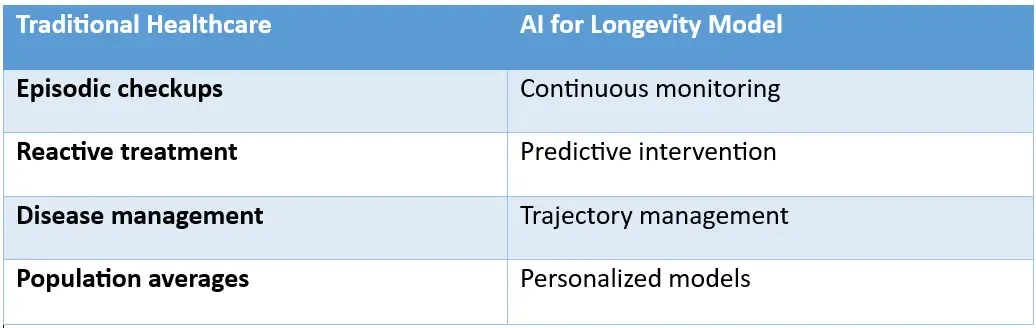
Rather than treating aging as an inevitable decline, AI now enables businesses to understand how aging is progressing simultaneously. This shift allows preventive decisions to happen earlier, supported by continuous data instead of episodic checkups.
Regions like Singapore are accelerating this transformation with strong digital health infrastructure and a national emphasis on healthy aging. As longevity moves from research into operational practice, organizations are looking for partners with deep experience in digital health and AI-enabled platforms to support this transition.
Healthspan Extension (Strategic Definition)
Healthspan extension refers to the application of data, analytics, and clinical insights to reduce functional decline, mitigate chronic disease risk, and maintain productive capacity longer in the lifespan. AI strengthens this model in three ways:
- Earlier detection of deviations in aging trajectories
- Higher precision in risk stratification and intervention planning
- Continuous data-driven feedback loops across the aging process
For B2B operators, this translates into reduced health system burden, improved workforce vitality, and the emergence of new preventive service models.
The AI Longevity Model
Modern longevity biotechnology and AI for longevity frameworks operate across three interconnected layers:
- Phenotypic layer: AI detects measurable physiological features (mobility patterns, sleep architecture, cardiorespiratory trends).
- Molecular layer: Analytics interpret signals from biomarkers, inflammatory markers, and metabolic indicators.
- Predictive layer: Machine learning creates aging-rate models, personalized health trajectories, and intervention recommendations.
This layered approach is what makes AI-driven longevity fundamentally different from traditional screenings: it integrates continuous data over episodic care.
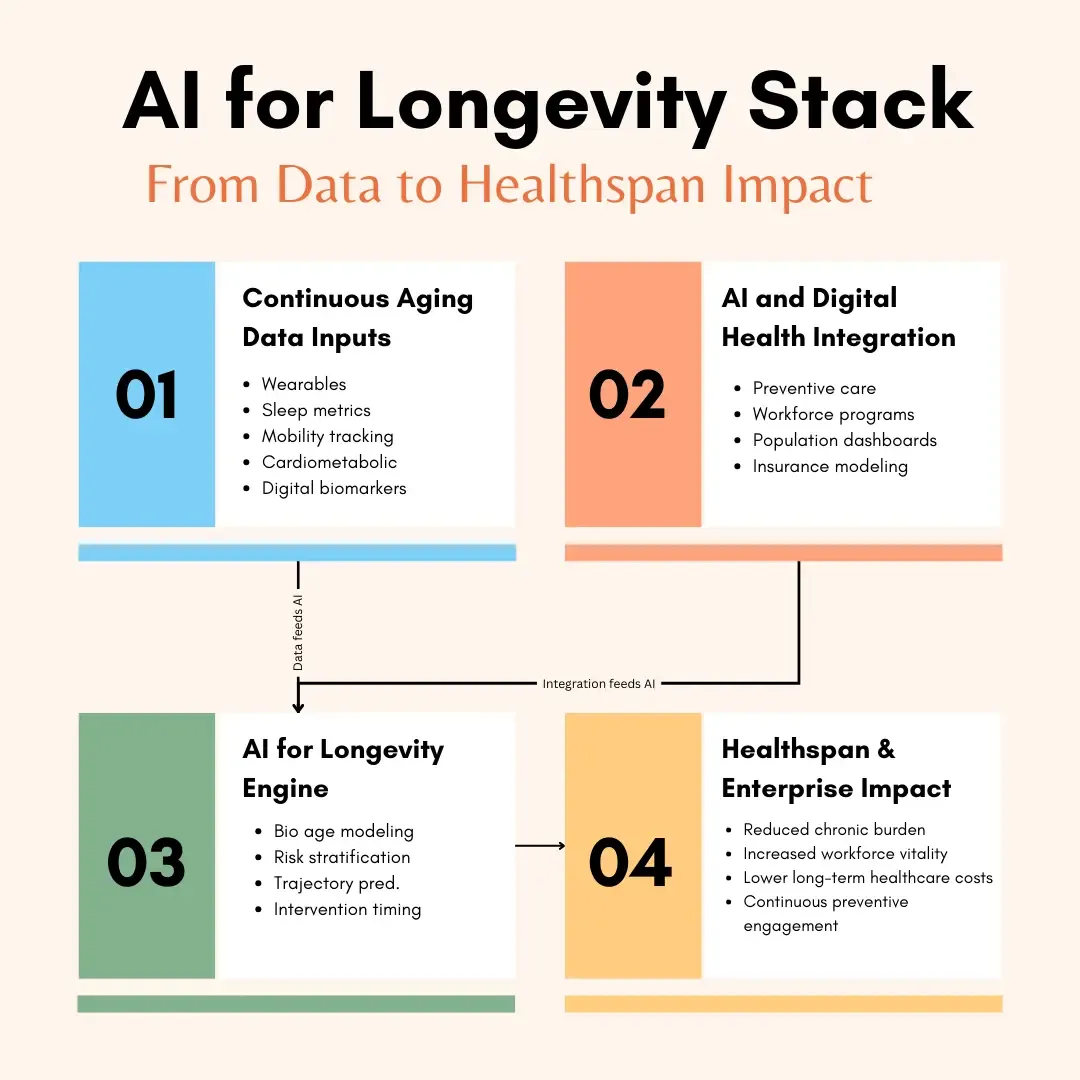
The AI for Longevity Stack demonstrates how modern preventive health systems transform raw biological and behavioural data into measurable healthspan impact. At the foundation, continuous inputs such as wearables, mobility signals, sleep architecture, and cardiometabolic markers provide evidence-based visibility into aging dynamics. These signals feed into an AI intelligence layer that models biological age, predicts trajectory shifts, and identifies early risk deviations. Through AI and Digital Health integration, insights are translated into preventive care pathways, workforce health optimization programs, and scalable population health strategies. This structured stack approach enables organizations to shift from episodic care toward continuous, predictive health management.
Digital Health Aging: AI Preventive Care Tools
The convergence of AI and Digital Health has transformed basic monitoring into integrated predictive systems. Within this shift, AI for longevity is enabling continuous risk modelling, personalized intervention pathways, and scalable preventive care strategies across aging populations.
The foundation is continuous data capture - wearables, sensors, imaging modalities, and self-reported behavioural data. AI systems convert these inputs into aging-relevant insights, enabling preventive care strategies before clinical symptoms manifest.
2.1 AI in Preventive Care
AI preventive care tools address three core B2B challenges:
- Predicting risk earlier than conventional assessments
- Scaling personalized insights without expanding clinical manpower
- Lowering the cost per risk-detection event across large populations
AI models identify emerging patterns such as metabolic slowdown, reduced recovery capacity, inflammation dynamics, and gradual functional decline. These patterns often precede diagnosable disease by years.
For employers, insurers, and healthcare operators, this opens a strategic window: shift from “treating illness” to “managing trajectory.”
2.2 Digital Health Aging Framework
A digital health aging framework typically includes:
- Digital biomarkers: quantifiable physiological signals detected through digital devices.
- AI risk engines: models that translate signals into biological age estimates, health trends, and risk probabilities.
- Intervention pathways: structured recommendations tied to modifiable risk factors.
This framework creates the conditions for population-scale longevity programs that are both cost-efficient and clinically defensible.
2.3 Extending Healthspan Through Digital Health
Healthspan extension via digital health is a systems-level transformation:
- Preventive interventions become continuous rather than episodic.
- Biological aging becomes visible and measurable.
- Health recommendations become personalized and adaptive.
For B2B stakeholders, the business case is direct: higher productivity, lower claims, fewer late-stage interventions, and stronger health outcomes across populations.
Compliance and Ethical Requirements for AI and Longevity Solutions
AI and Longevity platforms handle sensitive physiological and behavioural data. To deploy these systems safely across digital health ecosystems, enterprises must meet strict compliance, privacy, and ethical AI standards.
Data Privacy & Security
AI longevity models rely on continuous data streams, such as, biomarkers, mobility signals, sleep patterns, and metabolic indicators. These require:
- HIPAA-aligned data protection
- GDPR/PDPA-ready consent and transparency
- Encryption, access controls, and Zero Trust security
This ensures aging-related data stays protected across all digital health aging workflows.
Clinical Validation of AI Models
AI for longevity tools must be clinically defensible. That means:
- Validation of biological age models
- Bias testing across diverse populations
- Continuous monitoring for model drift
This protects organizations from deploying unverified or non-actionable insights.
Explainable & Ethical AI
For preventive care and healthspan extension use cases, leaders need clear, auditable reasoning behind each AI output.
Compliance-ready systems require:
- Explainable AI (XAI)
- Traceable prediction logic
- Documented governance policies
This strengthens trust and supports safe adoption across insurers, employers, and digital health providers.
Why Consider Fortunesoft for AI and Longevity Initiatives in Singapore?
Healthcare leaders in Singapore prioritise compliance, reliability, and measurable outcomes. With 17+ years of digital health and AI engineering experience, Fortunesoft provides the technical depth and regulatory alignment needed to operationalise AI longevity solutions.
What makes us relevant:
Proven digital health expertise: We’ve built secure, PDPA-aligned platforms involving biomarkers, predictive models, and continuous monitoring. Our work across Custom Healthcare Mobile App Development ensures mobile-first, patient-centric adoption suited to Singapore’s digital health maturity.
Singapore-ready compliance: Our systems follow MOH guidelines, strong data governance, and audit-friendly architectures.
End-to-end delivery: From AI models to full platform build, we handle execution, not just advisory.
Operational impact: Enables earlier risk detection, lower costs, and scalable preventive programs across aging populations.
If you're exploring AI and longevity initiatives in Singapore, Fortunesoft brings the experience and technical capability to build solutions that are safe, compliant, and deployment-ready.
Future of AI Longevity and Healthspan Extension
The next decade of AI-driven longevity will be shaped by five directional forces.
4.1 Shift from Episodic to Continuous Health Models
AI-driven aging models will operate continuously, providing ongoing insight instead of annual snapshots. This will reshape patient engagement models, care pathways, and insurance underwriting.
4.2 Emergence of Predictive Health Infrastructure
Predictive health infrastructure will use AI to:
- Forecast aging trajectories
- Identify modifiable lifestyle and environmental risks
- Optimize timing and dosage of preventive interventions
This creates a pathway toward operationalized longevity at scale.
4.3 Integration of Physical, Digital, and Biological Data
Future AI systems will merge:
- physiological data
- cognitive performance metrics
- metabolic indicators
- lifestyle profiles
The integration will enable highly personalized healthspan interventions, tailored to individual trajectories rather than population averages.
4.4 AI-Guided Workforce Healthspan Strategy
Enterprises will adopt AI longevity tools to:
- reduce absenteeism
- optimize workforce resilience
- maintain cognitive and physical performance
- manage long-term healthcare costs
This reframes longevity as a business productivity lever.
4.5 Longevity as a Core Pillar of National Health Strategy
Cities and nations will build longevity frameworks aimed at healthy aging, integrating AI risk engines into public health strategies.
Singapore is positioned as one of the early adopters due to its strategic healthcare approach and innovation capacity.
Conclusion
AI is redefining the concept of longevity by shifting focus from lifespan to healthspan and enabling preventive, personalized, continuous care. Digital health ecosystems - supported by strong data infrastructure and AI capabilities, are unlocking new ways to detect aging trajectories early and intervene before decline accelerates. For B2B operators, this represents a strategic opportunity: reduce healthcare costs, strengthen workforce vitality, and participate in the emerging longevity economy. As predictive health models mature, AI-driven longevity will transition from niche research to a scalable operating model that reshapes enterprises, health systems, and population-level outcomes.