An effective aged care app is built by understanding real clinical, caregiver, and operational workflows – then designing a secure, compliant digital solution that reduces workload and improves quality of care. The key is to build around user needs, not just features.
When healthcare providers look to enhance resident safety, streamline workflows, and improve staff efficiency, aged care app development offers a practical solution. By designing digital tools tailored to real caregiving scenarios, organizations can reduce manual tasks, ensure compliance, and provide timely insights to staff and families. Companies with experience in this field, like Fortunesoft IT, help facilities transform these challenges into actionable solutions without disrupting daily operations.
What makes an aged care app truly effective?
An effective aged care app solves fundamental operational gaps – such as care coordination, medication safety, fall risk alerts, workload management, and family communication – while remaining compliant, intuitive, and scalable for caregivers and administrators.
In aged care, technology often fails because it focuses on features instead of real-life care scenarios. C-suites want predictable outcomes: reduced errors, improved compliance reporting, staff efficiency, and better resident outcomes.
An effective app must be:
- Caregiver-first, reducing manual and repetitive tasks
- Clinically aligned, supporting assessments, vitals, ADLs, and incident reports
- Operationally meaningful, improving staff allocation and oversight
- Family-inclusive, enabling transparency and communication
- Regulatory-ready, supporting HIPAA, CMS, Aged Care Quality Standards, and NDIS documentation
- Interoperable, working with EHRs, facility software, and monitoring devices
- WCAG-compliant and screen-reader accessible, ensuring blind and low-vision users can navigate and interact with the app independently
This is what separates a “nice-to-have app” from a mission-critical aged care platform.
What problems should healthcare leaders solve with digital care tools?
It should solve care coordination gaps, manual documentation burdens, medication errors, lack of visibility into resident health, and communication challenges between caregivers, clinicians, and families.
Core operational problems it must address:
- Fragmented workflows → staff switching between paper, spreadsheets, and outdated systems
- Medication and vitals tracking errors
- No real-time resident health insights
- Slow incident reporting
- Poor handover communication
- Burdened staff with low digital support
- Families having no clarity on care updates
- Compliance documentation delays
When the app addresses these, it becomes indispensable – not optional.
What features should every app for elderly care include?
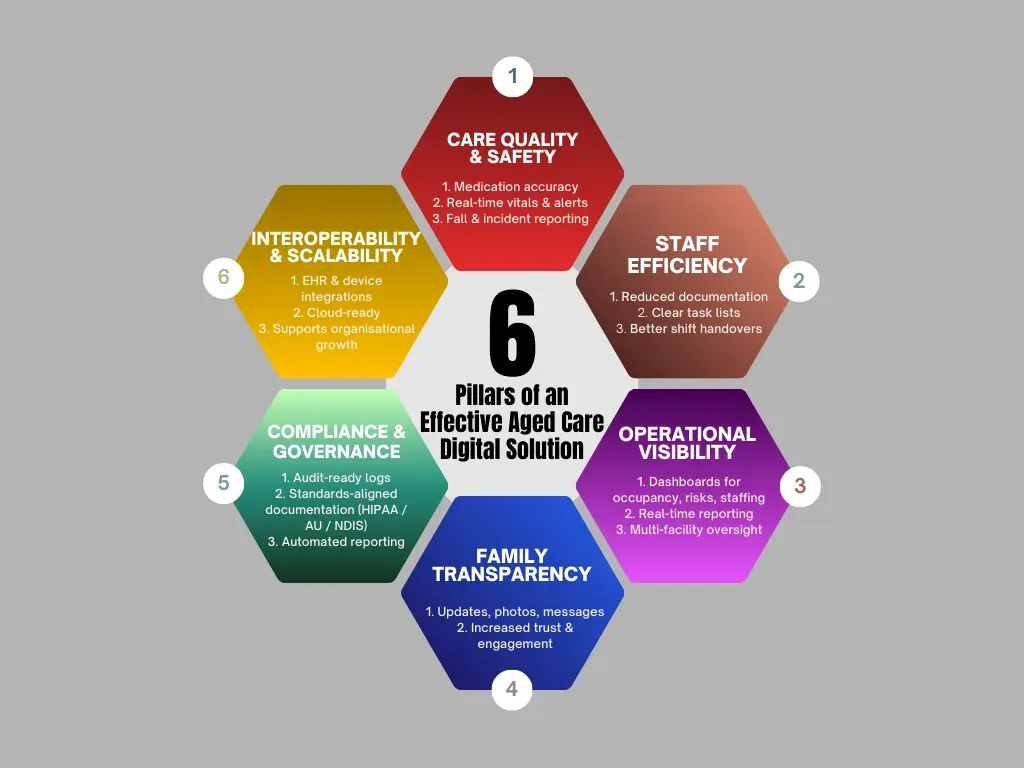
The core features revolve around resident care, caregiver efficiency, safety monitoring, communication, and compliance.
Essential features:
- Resident Profile & Care Plan Management – Care plans, assessments, ADLs, medications, allergies, risk scores.
- Medication Management – Administration logs, reminders, safety checks, alerts.
- Vitals & Health Monitoring – Vitals capture, trends, red-flag alerts, device integrations (BP, glucometer, wearables).
- Incident & Fall Reporting – Fast reporting, photo uploads, automated compliance logs.
- Staff Task & Shift Management – Care task lists, shift handovers, workload distribution.
- Family Communication Portal – Updates, photos, messaging, transparency.
- Facility Operations Dashboard – Occupancy, staff utilization, care risk alerts, compliance metrics.
- Integrations (EHR, monitoring devices) – To ensure the app isn’t isolated from other systems.
- Compliance Documentation – Progress notes, audit logs, reporting – mapped to HIPAA, CMS, Aged Care Quality Standards, NDIS.
How do you create digital tools caregivers will actually use?
You involve caregivers from day one – observing real shifts, workflows, challenges, and documenting-based processes before writing a single line of code.
Many aged care apps fail because they are built top-down. CIOs buy them. Caregivers avoid them.
A successful build involves:
- Shadowing caregivers – Watching real workflows: medication prep, ADLs, shift change, incident response.
- Mapping decisions, not just tasks – What decisions do they make under pressure? What information do they need instantly?
- Designing for “zero training needed” – Large buttons, offline mode, voice notes, auto-fill, minimal typing.
- Rapid prototypes tested inside the facility – Iterating based on real usage — not assumptions.
- Removing digital fatigue – Reduce screens, reduce clicks, automate repetition.
This is the difference between adoption and abandonment.
How to ensure compliance and data security in elderly care software?
Compliance is ensured by embedding data privacy, audit trails, secure access, and documentation workflows aligned with HIPAA, CMS, Aged Care Quality Standards, and NDIS guidelines.
Compliance checklist:
- Role-based access & MFA
- Audit logs for every user action
- Encrypted data at rest & in transit
- Secure communication channels
- Digital documentation workflows
- Automated reporting templates
- Alerts for high-risk conditions
- Data retention policies
- Vendor agreements for HIPAA (USA)
- Standards-aligned care documentation (AU)
What is the development process for apps for elderly care?
The process involves discovery, workflow mapping, UX prototyping, development, integration, testing in real care settings, and ongoing optimization.
Step-by-step process:
- Discovery & Workflow Study – Shadow caregivers, facility walkthroughs, mapping gaps.
- Requirements & Solution Blueprint – User journeys, feature sets, compliance needs, integration scope.
- UX Prototyping – Low-fidelity → high-fidelity prototypes tested with caregivers.
- Development – Modular, scalable build with priority features first.
- Integrations – EHRs, wearables, safety devices, facility systems.
- Pilot Deployment – Small unit or limited staff trial for real-world feedback.
- Full Rollout – Training, onboarding, and adoption monitoring.
- Continuous Improvement – Updates based on audits, feedback, and new compliance changes.
What benefits can executives achieve with effective digital care tools?
It should reduce staff workload, improve resident safety, enhance documentation accuracy, and give leadership real-time visibility into care quality.
Business outcomes healthcare executives expect:
- 30-40% reduction in manual documentation
- Lower medication and incident errors
- Higher caregiver satisfaction
- Better family trust & transparency
- Stronger compliance readiness
- Operational efficiency & reduced costs
- Centralized oversight across facilities
This is what justifies the investment.
How to know when it’s time to invest in custom aged care software?
When current systems don’t align with workflows, cause staff fatigue, or cannot scale with operational complexity.
Triggers that indicate the need for a custom solution:
- Reliance on WhatsApp, paper, or spreadsheets
- Existing apps are too generic
- Lack of integrations
- Painful compliance reporting
- Multi-site operations
- Need for custom workflows (falls, dementia care, chronic care)
- Low staff adoption of current tools
Building Trusted Aged Care Solutions with Fortunesoft IT
Effective aged care app development requires more than code – it demands healthcare expertise, compliance, and practical design. Fortunesoft IT helps healthcare providers turn operational challenges into secure, scalable, and user-friendly digital solutions that streamline workflows, improve care quality, and support staff and families.
With 17+ years of healthcare software experience, we combine agile delivery, compliance expertise (HIPAA, Aged Care Quality Standards, NDIS), and intuitive design to ensure your solution is adopted, reliable, and future-ready.
Why Fortunesoft IT is the preferred partner for aged care digital solutions:
- Consultative approach: We start with your workflows and care goals to balance innovation and compliance.
- Compliance by design: Secure architecture, audit-ready logs, and adherence to regulatory standards.
- Faster deployment: Agile methods, reusable components, and cross-functional teams reduce development timelines.
- Future-ready scalability: Cloud-native and API-driven solutions ensure long-term performance and flexibility.
Partner with Fortunesoft IT for aged care app development that enhances safety, operational efficiency, and trust with residents, families, and staff.

Conclusion: Transform care, don’t just digitize it
An aged care app becomes successful when it solves real operational bottlenecks and supports caregivers in delivering safe, timely, person-centered care.
For healthcare leaders, the decision isn’t about the app; it’s about building a reliable, compliant, scalable system that drives quality and operational excellence.
When built correctly, aged care software becomes a strategic asset, improving safety, reducing manual work, boosting compliance, and strengthening resident and family trust.