
 Facebook
 Whatsapp
 LinkedIn
 Pinterest
What is Ambient AI in Healthcare? How it is Improving Patient Care
Introduction
Ambient AI in healthcare is rapidly becoming one of the most transformative forces in modern clinical environments. Unlike traditional AI systems that require manual inputs or explicit triggers, ambient AI works silently in the background-continuously observing, interpreting, and assisting without disrupting clinical workflows. For healthcare providers, this shift is more than technological evolution; it represents a redefinition of how care is delivered, documented, and optimized.
As hospitals look to reduce clinician burnout, increase operational efficiency, and improve patient outcomes, ambient AI for patient care is emerging as a critical enabler. From real-time clinical documentation to proactive risk detection, its role is expanding across inpatient, outpatient, and remote-care settings.
This blog provides a clear, evidence-backed understanding of what ambient AI is, how it differs from traditional AI, and why it is fast becoming a foundational capability for data-driven healthcare systems.
What is Ambient AI?
Ambient AI refers to context-aware artificial intelligence that operates continuously and unobtrusively within a physical or digital environment. In healthcare, ambient AI systems use a combination of:
- Machine learning models
- Large language models (LLMs) such as GPT
- Natural language processing (NLP)
- Passive sensing devices (audio, optical, contextual data)
- EHR-integrated automation
This allows the system to interpret clinical activities, capture data, and provide intelligent assistance – without requiring deliberate human interaction.
In simpler terms:
Ambient AI is an artificial intelligence that works around clinicians and patients-not on a screen, not behind a login, but embedded in the care environment itself.
Common forms today include ambient clinical documentation tools, smart patient rooms, virtual nursing systems, and real-time risk prediction engines.
Characteristics of Ambient AI
Healthcare ambient intelligence systems share five fundamental characteristics that distinguish them from other healthcare technologies:
- Invisibility: The technology recedes into the background, allowing clinicians to maintain natural patient interactions without technological interference
- Contextual Intelligence: Systems understand medical terminology, clinical workflows, and specialty-specific documentation requirements automatically
- Continuous Learning: Ambient AI adapts to individual physician documentation styles and organizational preferences over time
- Multi-Modal Processing: These systems integrate voice recognition, natural language understanding, and structured data extraction simultaneously
- Workflow Integration: Seamless connection with electronic health records (EHRs), billing systems, and clinical decision support tools ensures comprehensive automation.
These characteristics position ambient AI as one of the most transformative forms of clinical AI, particularly for improving patient experience and reducing clinician burden.
How Ambient AI Is Transforming Patient Care Today
Ambient AI for patient care is revolutionizing clinical delivery across multiple dimensions. Physicians report spending 2-3 additional hours daily on direct patient interaction after implementing ambient listening technology, time previously consumed by documentation. This increased face-to-face engagement strengthens the therapeutic relationship, improves diagnostic accuracy through better history-taking, and enhances patient satisfaction scores significantly.
Clinical quality metrics also improve as ambient systems ensure comprehensive documentation of all discussed symptoms, treatment plans, and patient instructions. The technology reduces medical errors by capturing complete, accurate records of clinical encounters, including medication discussions and patient education that might otherwise be incompletely documented. Furthermore, patient care automation through ambient AI enables same-day documentation completion, eliminating the common practice of physicians completing notes hours or days after encounters when memory details fade.
The Future of Ambient AI in Healthcare Delivery
| Trend | What It Means | Impact on Healthcare Delivery |
| Predictive Care Environments | Patient rooms continuously monitor multimodal signals to detect early signs of sepsis, respiratory decline, delirium, or post-operative complications before symptoms are visible. | Earlier interventions, reduced adverse events, lower ICU transfers, and improved patient safety outcomes. |
| Virtual Nursing & Autonomous Tasking | Ambient AI automates routine nursing and administrative tasks such as medication reminders, vitals documentation, hourly rounding, and discharge readiness checks. | Reduced clinician workload, improved care consistency, and more time for nurses to focus on high-acuity patient care. |
| Intelligent Hospital Flow Management | AI optimizes ED inflow, bed allocation, staffing levels, and diagnostic queues using real-time and predictive data. | Improved throughput, reduced wait times, higher bed utilization, and more resilient hospital operations. |
| Ambient Digital Twins | Continuously updated AI-generated digital replicas of patients, units, or entire hospitals enable scenario modeling and decision support. | Faster, data-driven decision-making, improved capacity planning, and proactive risk mitigation. |
| Multimodal Clinical Assistants | LLM-powered assistants respond to voice commands, summarize rounds, surface relevant guidelines, and provide real-time, evidence-based recommendations. | Enhanced clinical decision support, reduced cognitive load, and more standardized, evidence-aligned care. |
Risk Associated with AI
Even with transformative potential, Ambient AI in healthcare brings risks that organizations must anticipate and mitigate.
1. Data Privacy & Security Vulnerabilities
Always-on listening and contextual capture increase exposure of:
- PHI (Protected Health Information)
- personally identifiable data
- sensitive patient–provider conversations
Without strong governance, these systems can become attack surfaces.
2. Bias and Model Drift
LLMs may:
- misinterpret accents,
- skew toward majority-language datasets,
- or behave inconsistently over time unless retrained.
This affects fairness and clinical reliability.
3. Overreliance on Automated Outputs
If clinicians begin trusting AI-generated notes or summaries blindly, it can introduce:
- inaccuracies,
- incomplete documentation,
- or clinically harmful assumptions.
Human validation must remain mandatory.
4. Ambiguity in AI Accountability
When an ambient system misinterprets clinical dialogue, it’s not always clear who is responsible:
- the vendor,
- the hospital,
- the clinician,
- or the model owner?
This makes incident handling complex.
5. Noise, Multi-Speaker Confusion & Signal Integrity
Real-world clinical environments include:
- alarms,
- multiple speakers,
- overlapping conversations,
- emergency situations.
Ambient AI may misconstrue context without robust disambiguation mechanisms.
Legal and Ethical Considerations
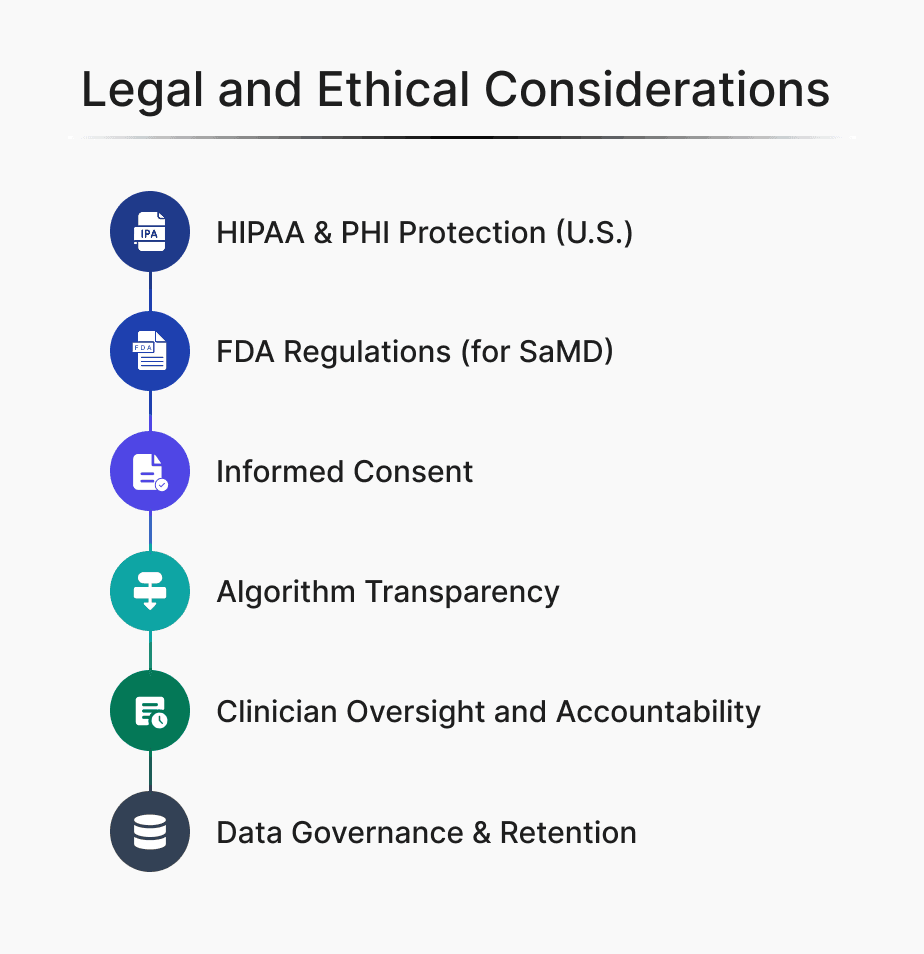
Healthcare is a highly regulated sector, and ambient AI must comply with strict ethical and legal frameworks.
1. HIPAA & PHI Protection (U.S.)
Any system capturing audio, video, or behavior must adhere to HIPAA guidelines, ensuring PHI is encrypted, access-controlled, and audit-trailed.
2. FDA Regulations (for SaMD)
If ambient AI influences clinical decision-making, it may fall under “Software as a Medical Device (SaMD)” requiring FDA clearance or monitoring.
3. Informed Consent
Patients must be aware when ambient sensing or documentation tools are present, especially in inpatient settings.
4. Algorithm Transparency
Healthcare organizations must be able to audit and explain how AI models use data, produce outputs, and support decisions.
5. Clinician Oversight and Accountability
Even with automation, clinical responsibility cannot be delegated to AI.
Providers must maintain final authority over all clinical documentation and recommendations.
6. Data Governance & Retention
Clear policies are required for how long ambient audio, sensor data, and derived insights are stored – and who can review or delete them.
These guardrails ensure ambient AI is deployed ethically, safely, and in alignment with patient rights and regulatory expectations.
Best Practices and Compliance Recommendations
Healthcare organizations implementing ambient AI should follow these evidence-based practices:
- Comprehensive Training: Ensure all clinical staff receive thorough education on system capabilities, limitations, and proper usage protocols.
- Mandatory Review Processes: Implement policies requiring physician verification of all AI-generated documentation before signing.
- Patient Notification: Display clear signage and provide verbal notification when ambient recording technology is active
- Regular Audits: Conduct periodic reviews of documentation quality, system accuracy, and compliance with organizational policies.
- Vendor Due Diligence: Carefully evaluate ambient AI vendors for security certifications, HIPAA compliance, and clinical validation studies.
- Change Management: Develop structured implementation plans addressing workflow redesign, stakeholder engagement, and gradual rollout strategies.
Practical Use Cases of Ambient AI in Healthcare
Real-world implementations demonstrate ambient AI’s versatility across clinical settings:
Primary Care Documentation
Family medicine practices use ambient AI to automatically generate comprehensive SOAP notes, capturing chief complaints, review of systems, physical examination findings, assessments, and treatment plans. The technology reduces documentation time from 15-20 minutes per patient to 2-3 minutes of physician review time.
Emergency Department Efficiency
Emergency rooms leverage context-aware AI in medical settings to document high-acuity encounters while physicians focus on critical interventions. The technology captures rapid-fire clinical decision-making, consultant discussions, and time-stamped event documentation crucial for medicolegal purposes.
Specialty Care Enhancement
Cardiologists, orthopedists, and other specialists benefit from intelligent ambient documentation that understands complex medical terminology, procedure descriptions, and specialty-specific documentation requirements. This ensures billing accuracy and comprehensive clinical records.
Telemedicine Integration
Virtual care platforms incorporate ambient AI to document remote consultations, ensuring telehealth visits receive the same documentation quality as in-person encounters while maintaining natural video interactions between patients and providers.
The Business Impact and Return on Investment of Ambient AI
Ambient AI already produces measurable return on investment for hospitals and care networks.
1. 60–70% Reduction in Clerical Workload
Clinicians regain hours per week previously spent on documentation.
2. Improved Throughput & Revenue
Faster documentation → more patients seen per day → higher billable encounters.
3. Lower Burnout and Turnover Costs
Reduced cognitive load improves provider satisfaction and retention.
4. Higher Documentation Quality
Ambient systems generate complete, compliant, and audit-ready notes, reducing:
- claim denials,
- audit risks,
- compliance exposure.
5. Stronger Patient Experience
More face-to-face time with providers increases satisfaction scores and trust.
Why Consider Fortunesoft for Your Ambient AI Journey?
Fortunesoft helps healthcare organizations adopt Ambient AI for Patient Care as part of its broader Healthcare Technology Solutions offering, with a strong focus on regulatory compliance, clinical safety, and enterprise-grade engineering.
1. Deep Healthcare Expertise
Our team specializes in:
- clinical workflows,
- medical data standards (HL7, FHIR, DICOM),
- EHR integrations,
- secure cloud-native engineering.
2. Tailored Ambient AI Solutions
We build and integrate:
- ambient clinical documentation tools,
- intelligent monitoring systems,
- voice-driven care workflows,
- predictive and contextual AI models.
3. Compliance-First Architecture
All implementations align with:
- HIPAA
- GDPR
- HITECH
- ISO27001
- SOC2
- FDA-aligned AI/ML guidelines
4. Proven Delivery Model
From discovery to deployment, we ensure:
- rapid integration,
- minimal workflow disruption,
- high adoption rates,
- continuous optimization.
Fortunesoft brings technical depth, regulatory clarity, and healthcare-specific experience needed to deploy Ambient AI safely and at scale.
Conclusion
Ambient AI represents the next leap in intelligent care delivery. By operating silently in the background, it frees clinicians from clerical burden, strengthens decision-making, improves patient engagement, and builds a safer, more responsive healthcare environment.
As healthcare pivots toward automation, organizations that invest now will gain a significant advantage – operationally, clinically, and financially. Partnering with an experienced technology provider ensures Ambient AI adoption is safe, compliant, and aligned with long-term strategic goals.
FAQs
1. What is Ambient AI in Healthcare?
Ambient AI enables passive, context-aware intelligence that listens, observes, and processes clinical interactions to automate documentation, support decisions, and improve patient care.
2. How is Ambient AI different from traditional AI?
Traditional AI needs active input. Ambient AI operates continuously in the background, capturing real-world context – not just structured data.
3. Is Ambient AI safe for patient privacy?
Yes, when implemented with encryption, controlled access, and strict HIPAA/GDPR-aligned workflows.
4. What are the top use cases?
Ambient clinical documentation, patient safety monitoring, smart hospital rooms, voice-based clinical support, and hands-free workflows.
5. Can Ambient AI reduce clinician burnout?
Absolutely. It eliminates repetitive documentation tasks, enabling more patient-facing time.
6. Does Ambient AI require EHR integration?
Yes. EHR interoperability (HL7, FHIR, APIs) is essential for real-time note syncing and workflow automation.
7. Does Ambient AI replace clinicians?
No. It augments them. Final decisions remain with human providers.
8. How long does implementation take?
Depending on complexity: 8–16 weeks for integration, testing, and workflow alignment.
9. What infrastructure is required?
Secure cloud environments, compliant APIs, ambient-enabled devices/sensors, and integration with clinical systems.
10. Why choose Fortunesoft?
We combine deep healthcare engineering expertise with regulatory-grade AI implementation – ensuring safe, compliant, high-ROI Ambient AI deployment.
Source
Author Bio



Related Blog




min read



 Start Chat