
 Facebook
 Whatsapp
 LinkedIn
 Pinterest
AI in Telemedicine: How Custom Virtual Care Solutions Are Changing Healthcare
The healthcare industry is undergoing a rapid digital shift, and AI-powered telemedicine is leading that transformation. From predictive monitoring to automated clinical workflows, AI is enabling faster, more accurate, and more personalised virtual care. But adopting AI in telehealth isn’t just a technology decision—it also involves seamless system integration, regulatory alignment, and strong governance.
This guide breaks down how custom AI-driven virtual care solutions use IoT and advanced analytics to enhance patient outcomes, streamline operations, and support smarter clinical decision-making. You’ll also learn about implementation costs, challenges, and what to look for in the right technology partner.
Telehealth usage in Australia continues to rise, with more than 118 million services delivered to 18 million patients between 2020 and 2022 [5]. ABS data further shows that 22.5% of Australians accessed at least one telehealth consultation in 2024–25 [7] – clear evidence of the country’s shift toward scalable, AI-enabled virtual care.
AI in Telemedicine
AI in telemedicine uses artificial intelligence to enable virtual healthcare services, improving diagnosis, patient monitoring, and operational efficiency.
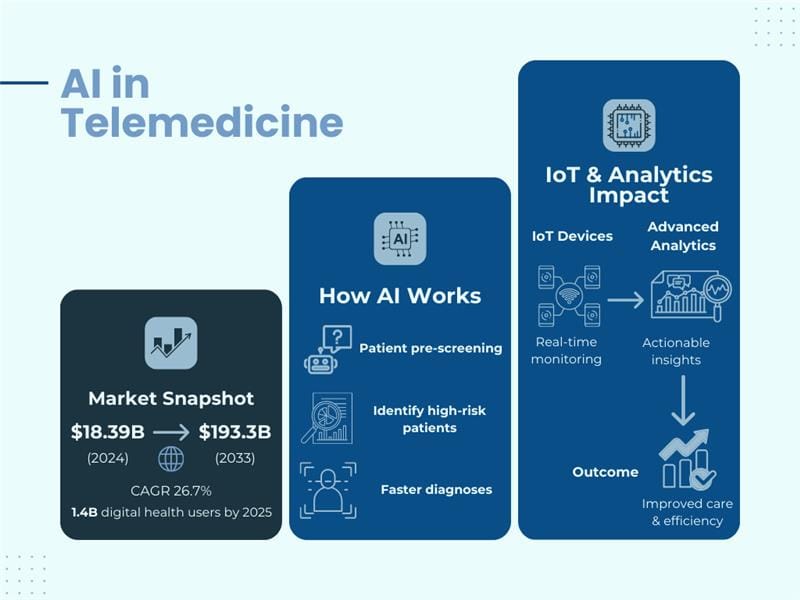
AI in telemedicine applies artificial intelligence technologies such as machine learning, natural language processing, and computer vision to enable virtual healthcare services that improve diagnosis, patient monitoring, and operational efficiency. Custom telemedicine solutions leverage AI to automate routine tasks, predict patient risks, and support clinical decisions. For example, AI-driven chatbots can pre-screen patients, while algorithms analyse medical images or patient data to provide faster, more accurate diagnoses.
These capabilities are especially valuable in digital health platforms, where efficiency and precision directly influence patient outcomes. The AI in the telemedicine market is growing rapidly, with an estimated value of $18.39 billion in 2024 and projected to reach approximately $193.3 billion by 2033, representing a CAGR of 26.7% [2]. This explosive growth underscores the accelerating adoption of AI-driven virtual care solutions by healthcare providers worldwide. As illustrated in the infographic above, AI in telemedicine is transforming patient care through predictive analytics, chatbots, and IoT-enabled monitoring.
How Does AI Improve Virtual Care and Digital Health?
AI enhances virtual care by providing predictive analytics, automating routine tasks, and enabling remote patient monitoring through digital health platforms.
AI in digital health transforms virtual care by reducing clinician workload and enhancing patient engagement. Predictive analytics can identify high-risk patients, allowing early interventions. AI-powered applications, including chatbots and virtual assistants, guide patients through symptom checking and follow-ups. Integration with IoT devices ensures continuous monitoring of vital signs and adherence to treatment plans, while advanced analytics provide clinicians with actionable insights from the data.
AI-powered telehealth platforms in Australia are increasingly supporting diverse patient demographics. For instance, in 2023, ~890,000 Australians aged 55–64 used telehealth services over a 12-month period, demonstrating adoption among older adults who benefit from remote monitoring and virtual consultations [6].
What Are the Key Benefits of AI-Powered Telemedicine Solutions?
AI-powered telemedicine improves consultation accuracy, patient engagement, and operational efficiency for healthcare providers.
Key benefits include:
- Enhanced patient communication: AI apps, such as chatbots and symptom checkers, provide instant guidance and pre-screening.
- Remote patient monitoring (RPM): IoT-enabled devices track vital signs in real time, helping manage chronic conditions and post-discharge care.
- Operational efficiency: AI streamlines workflows, reduces errors, and automates administrative tasks.
- Data-driven decisions: Advanced analytics generate actionable insights for better treatment planning.
Digital health services, including telemedicine, are projected to be used by more than 1.4 billion people globally in 2025, as the overall digital health market surpasses $198 billion [1]. This demonstrates the growing demand for AI-powered telemedicine platforms to deliver scalable and efficient virtual care. Australia reflects this trend, with 1 in 5 Australians reporting a telehealth visit in the past year and sustained usage across both urban and rural regions. This consistent adoption highlights growing readiness for AI-enhanced virtual care.
Many healthcare providers in Australia are increasingly adopting AI-powered virtual care platforms to improve patient outcomes while optimising operational costs.
How is AI Used in Telemedicine Across Specialties?
AI in telemedicine supports multiple specialties, including emergency care, mental health, dermatology, and chronic disease management.
Specialty applications include:
- Emergency medicine: AI algorithms assist triage, prioritising patients based on severity (AI in emergency medicine).
- Mental health: AI chatbots provide initial counselling, mood tracking, and follow-up prompts.
- Dermatology: AI image recognition helps diagnose skin conditions during teleconsultations.
- Chronic disease management: IoT devices and predictive analytics monitor conditions like diabetes or heart disease.
By addressing multiple specialties, AI-enabled telemedicine platforms improve access and care quality across diverse clinical areas.
How Can IoT and Advanced Analytics Enhance AI Telemedicine Software?
IoT devices and analytics improve AI telemedicine software by enabling real-time monitoring and actionable predictive insights for clinicians.
IoT devices, such as wearables and smart sensors, continuously collect patient data. This information is processed by AI algorithms and visualised through advanced analytics dashboards. Clinicians can detect anomalies early, track treatment adherence, and adjust care plans dynamically. Integration with EMR/EHR systems ensures that historical data is combined with real-time monitoring, providing a holistic view of patient health.
What is the Cost of Implementing AI in Telemedicine?
Implementing AI in telemedicine requires investment in AI models, IoT devices, cloud infrastructure, and compliance measures.
Costs vary depending on the complexity of AI algorithms, the number of IoT devices, and the level of analytics integration. Considerations include software development, cloud storage, EMR/EHR integration, security compliance (HIPAA, GDPR), and ongoing maintenance. While initial investment may be significant, AI telemedicine platforms often deliver ROI through improved patient outcomes, reduced readmissions, and operational efficiency.
The AI in the telemedicine market is forecasted to expand by over $31 billion between 2024 and 2029, growing at a CAGR of 25% [4], underscoring the strategic importance of investing in AI-enabled telemedicine solutions for healthcare providers looking to enhance patient care and operational efficiency.
What Challenges Should Healthcare Providers Expect with AI Telemedicine?
Australian healthcare providers face several challenges when adopting AI-enabled telehealth, including compliance with national regulations, integration with existing digital health systems, cost barriers, and algorithmic transparency. Ensuring adherence to Australian Privacy Principles (APPs), My Health Record standards, and other regional guidelines is critical. Integrating AI tools with existing EMR/EHR platforms, IoT devices, and clinical workflows can be technically demanding, while upfront investment and ongoing optimisation costs must be weighed against the long-term value.
In addition to operational hurdles, providers must address the ethical and governance dimensions of AI in healthcare. Ensuring explainability and transparency of AI-driven recommendations helps clinicians trust automated insights, while validating models against diverse patient populations minimises bias. Compliance with evolving AI governance standards and regional regulations further strengthens the reliability and safety of AI-powered telemedicine solutions.
Why Choose Fortunesoft for Custom AI Telemedicine Software?
Fortunesoft is a leading partner for Australian healthcare organizations, delivering AI-powered telemedicine solutions that seamlessly integrate IoT and advanced analytics. Our custom virtual care platforms enhance patient engagement, streamline workflows, and ensure full compliance with Australian healthcare regulations.
With deep expertise in AI-driven telemedicine and digital health software, we specialize in integrating EMR/EHR systems, IoT-enabled monitoring devices, and predictive analytics dashboards. Our case studies demonstrate measurable improvements in operational efficiency, remote patient monitoring, and clinical outcomes across Australian healthcare providers.
By combining technical expertise with local regulatory knowledge, Fortunesoft enables healthcare organizations to deploy secure, scalable, and future-ready telemedicine solutions. Explore our Telemedicine App Development services to transform virtual care delivery in Australia and achieve tangible results.
What Does the Future Hold for AI in Telemedicine?
The future includes predictive virtual care, GenAI-assisted workflows, and enhanced patient engagement through IoT and advanced analytics.
Looking ahead:
- Autonomous virtual care workflows powered by AI.
- Predictive analytics for early detection of health risks.
- Personalised patient engagement using AI chatbots and digital health apps.
- Greater adoption of AI-powered telehealth across Australia is improving care access for rural communities, reducing wait times, and enhancing decision support for clinicians.
With continued investment in digital health infrastructure and rising telehealth utilisation rates, Australia is positioned to be one of the fastest adopters of AI-driven virtual care in the Asia-Pacific region.
Conclusion
AI in telemedicine is no longer just a futuristic concept-it’s a transformative force reshaping how healthcare is delivered. By combining artificial intelligence, IoT-enabled devices, and advanced analytics, healthcare providers can offer faster diagnoses, more personalised care, and proactive patient monitoring. From emergency care to chronic disease management, AI-powered virtual care solutions are improving outcomes while optimising operational efficiency.
For Australian healthcare organisations aiming to modernise care delivery, the right technology partner is essential. Fortunesoft specialises in building custom AI-driven telehealth platforms that integrate seamlessly with EMR/EHR systems, IoT devices, and analytics tools, while ensuring full compliance with Australian data privacy laws, My Health Record standards, and clinical best practices. Whether the goal is to improve patient engagement, streamline clinician workflows, or deploy predictive monitoring, these solutions are engineered to deliver measurable outcomes for Australian healthcare providers.
FAQs
What are the main benefits of AI in telemedicine for healthcare providers?
AI improves diagnosis accuracy, patient engagement, and operational efficiency.
How does IoT integration improve patient monitoring in virtual care?
IoT devices provide real-time vital signs data, enabling predictive care and early interventions.
What is the cost of implementing AI-driven telemedicine software?
Costs include AI model development, IoT devices, cloud infrastructure, and compliance measures.
Can AI telemedicine solutions be adapted for multiple regions like Australia?
Yes, AI telehealth solutions can be tailored to meet the regulatory, clinical, and operational requirements of different regions. In Australia, this includes aligning with APPs, My Health Record, Medicare guidelines, and region-specific digital health frameworks.

Sources
- Statista – Digital Health Market Overview
- OpenPR – AI in Telemedicine Market Forecast 2033
- NCBI – Applications of AI in Telemedicine
- ScienceDirect – AI and IoT in Remote Patient Monitoring
- AIHW – Australia’s Digital Health Overview
- Statista – Telehealth Users by Age in Australia
- ABS – Patient Experiences with Health Services 2024–25
Author Bio










 Start Chat