
 Facebook
 Whatsapp
 LinkedIn
 Pinterest
AI Solutions for Healthcare: A 2026 Digital Transformation Guide for Healthcare Leaders
Table of Contents
- Introduction
- Key AI Solutions for Healthcare
- Custom AI Healthcare Platforms
- Benefits of Enterprise AI Healthcare Solutions
- AI Healthcare Implementation Challenges
- 2026 Healthcare AI Implementation Roadmap (LSI)
- Why Choose Fortunesoft for Enterprise Healthcare AI Solutions
Introduction
Healthcare faces unprecedented pressures – rising costs, clinician burnout, and growing patient expectations for personalized care. AI solutions for healthcare deliver the transformative capabilities organizations need to thrive in 2026’s value-based care landscape. By leveraging modern healthcare technology solutions, providers can integrate advanced AI platforms with Epic, Cerner, and other legacy systems to improve clinical outcomes, streamline operations, and drive measurable ROI.
This blog delves into the key AI solutions transforming healthcare, explores enterprise platforms and implementation challenges, and outlines a 2026 roadmap for successful digital transformation.
Key AI Solutions for Healthcare
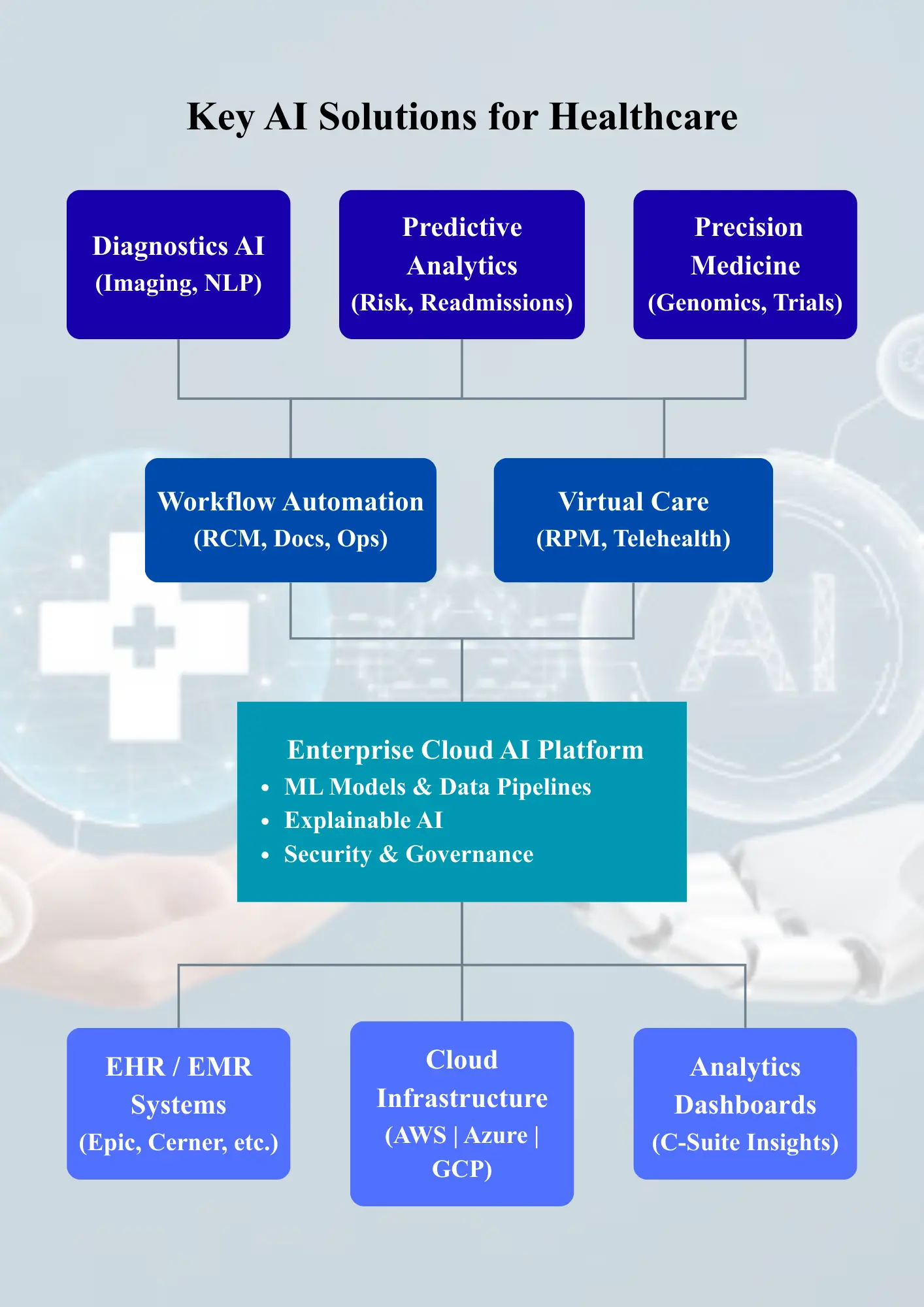
This architecture illustrates how core AI solutions – diagnostics, predictive analytics, precision medicine, workflow automation, and virtual care, are unified through cloud-based AI platforms and EHR/EMR integrations. It highlights how healthcare organizations deploy scalable, compliant AI capabilities across clinical, operational, and patient engagement workflows.
Healthcare organizations need scalable AI that delivers immediate value across clinical, operational, and patient engagement domains. HIPAA-compliant platforms today focus on five high-impact areas, each engineered for rapid deployment and operational efficiency gains of 20–30%:
Custom Diagnostics Platforms
AI-powered imaging analysis processes X-rays, MRIs, and CT scans in real-time, detecting tumors with 95% accuracy and cutting radiologist review times by 40%. Services include FDA-ready model training, PACS/RIS integrations, and performance monitoring. Result: ER triage drops from days to minutes.
Predictive Risk Engines
ML models analyze EHR, wearables, and claims data to forecast readmissions and sepsis with 90%+ precision. Full-stack development includes custom algorithms, API connectivity, and C-suite dashboards. Delivers 15-25% cost reductions through optimized bed utilization.
Precision Medicine Frameworks
Platforms analyze genomics and clinical data for personalized cancer therapies and trial matching. Features secure data lakes, federated learning, and explainable AI outputs. Achieves 22% better treatment efficacy and faster R&D cycles.
Intelligent Workflow Automation
AI agents handle ambient documentation, claims processing, and revenue cycle management – automating 70% of repetitive tasks. Low-code customization and multi-EHR interoperability boost clinician productivity by 25%. Generates 10-15% revenue uplift.
Virtual Care Ecosystems
Edge AI enables remote monitoring wearables and FHIR-compliant telehealth platforms. IoT integrations and population health analytics cut readmissions by 20%. Perfect for underserved markets and hybrid care models.
Custom AI Healthcare Platforms
It differentiates through full-stack ownership, from data pipelines to production deployment. Every platform features:
- Scalable cloud architecture (AWS, Azure, GCP)
- Interoperable APIs (FHIR, HL7, SMART on FHIR)
- Governance frameworks (FDA, HIPAA, GDPR)
- Executive dashboards with real-time ROI tracking
Benefits of Enterprise AI Healthcare Solutions
C-suite leaders prioritize measurable outcomes. AI delivers:
| Metric | Before AI | After AI | Impact |
| Diagnostic accuracy | 78% | 95% | +22% |
| Radiologist productivity | 24 cases/hour | 40 cases/hour | +67% |
| Readmission rates | 18% | 12% | -33% |
| Clinician admin time | 2 hours/day | 35 min/day | -72% |
| Revenue cycle days | 45 days | 32 days | -29% |
- Enhanced Clinical Accuracy: AI assists in early detection and improves treatment precision.
- Operational Efficiency: Automates repetitive workflows, reducing administrative burden.
- Predictive Insights: Anticipates patient needs, improving care delivery and outcomes.
- Cost Optimization: Reduces unnecessary procedures and streamlines resource allocation.
- Patient Engagement: AI-driven tools offer personalized communication, improving satisfaction and adherence.
AI Healthcare Implementation Challenges
- Data Privacy and Compliance: Ensuring AI meets HIPAA, GDPR, and local healthcare regulations.
- Integration Challenges: Connecting AI tools to legacy EHR systems and IT infrastructure.
- Model Bias and Accuracy: AI requires diverse datasets to avoid errors in clinical recommendations.
- Change Management: Training staff to adopt and trust AI-driven workflows.
- Cost of Implementation: High initial investment and resource allocation for development and deployment.
2026 Healthcare AI Implementation Roadmap
Modern AI solutions for healthcare are most successful when implemented through a structured, enterprise-ready roadmap rather than rigid timelines. In 2026, healthcare organizations prioritize flexibility, interoperability, and measurable ROI to support value-based care models and evolving regulatory requirements.
A proven healthcare AI implementation framework includes the following phases:
1. Discovery & AI Use Case Prioritization
Healthcare leaders identify high-impact opportunities such as AI diagnostics, predictive analytics, and workflow automation. Use cases are prioritized based on clinical outcomes, operational efficiency, and return on investment.
2. Data Foundation & Interoperability Enablement
Secure data pipelines are established across EHR/EMR systems, medical imaging, claims, wearables, and IoT devices. Standards such as FHIR, HL7, and SMART on FHIR ensure interoperability across enterprise healthcare ecosystems.
3. AI Model Development & Validation
Machine learning models are trained and validated using diverse healthcare datasets, with a focus on accuracy, explainability, and bias mitigation. Governance frameworks align with HIPAA, GDPR, and FDA compliance requirements.
4. Clinical Pilot & Workflow Integration
AI solutions are embedded into real clinical and operational workflows, supported by clinician training and continuous feedback to drive adoption and trust.
5. Enterprise Rollout & Optimization
Validated AI platforms are scaled across departments, with ongoing performance monitoring, optimization, and cost-efficiency improvements.
6. Governance, Monitoring & Executive Visibility
Long-term success is supported through AI governance, auditability, and executive dashboards that track clinical outcomes, operational metrics, and financial impact.
Healthcare organizations typically begin with high-ROI AI initiatives, such as diagnostics or revenue cycle automation; before expanding into predictive population health management and virtual care solutions as AI maturity increases.
Why Choose Fortunesoft for Enterprise Healthcare AI Solutions
Building AI solutions for healthcare requires more than advanced algorithms; it demands production-ready platforms engineered for compliance, interoperability, and real-world clinical adoption. At Fortunesoft, we deliver AI solutions for healthcare as part of our broader Healthcare Technology Solutions, enabling providers to achieve scalable, secure, and measurable digital transformation.
Our approach begins with clinical and operational discovery, supported by ROI modeling to identify high-impact use cases such as diagnostics, predictive risk scoring, and workflow automation. We then design secure data pipelines that unify EHR/EMR, imaging, claims, and IoT data, ensuring seamless interoperability through FHIR, HL7, and SMART on FHIR standards.
AI models are developed with explainability, bias mitigation, and regulatory readiness at the core, aligned with HIPAA, GDPR, and FDA guidelines. Deployment is handled on a scalable cloud infrastructure and tightly integrated into existing clinician workflows, enabling faster adoption with minimal disruption.
With Fortunesoft, healthcare organizations can:
- Enhance clinical decision-making through accurate, explainable AI insights
- Streamline operations by automating administrative and revenue workflows
- Deliver personalized patient care using real-time, data-driven intelligence
- Ensure security and compliance across the entire AI lifecycle
By combining healthcare domain expertise with full-stack AI delivery, Fortunesoft enables providers and enterprises to operationalize AI at scale – driving sustainable digital transformation and long-term competitive advantage.
Conclusion
AI solutions for healthcare have moved from innovation to necessity. In 2026, organizations that lead with AI-powered diagnostics, predictive analytics, precision medicine, and virtual care will deliver better outcomes while controlling costs and clinician workload.
The real advantage comes from enterprise AI platforms that integrate seamlessly with existing EHR systems, meet strict regulatory requirements, and deliver measurable ROI. When implemented with a clear roadmap, AI enables faster decisions, smarter operations, and more personalized patient care.
Healthcare leaders who act now – starting with high-impact, fast-payback AI initiatives-will be best positioned to scale innovation, improve value-based care performance, and stay competitive in an increasingly digital healthcare ecosystem.
Sources
FAQs
1. What’s the fastest AI solution to implement in healthcare?
Diagnostics platforms are typically the quickest to deploy. They integrate with existing EHR/EMR systems and can deliver measurable ROI within months, improving accuracy and workflow efficiency from day one.
2. How can AI improve clinical outcomes?
AI solutions analyze patient data, imaging, and genomics to support early diagnosis, risk prediction, and personalized treatment plans. This reduces errors, improves treatment precision, and enhances patient safety.
3. Can AI integrate with legacy healthcare systems like Epic or Cerner?
Yes. Modern AI platforms are built for interoperability using standards such as FHIR, HL7, and SMART on FHIR, enabling seamless integration with existing EHR, PACS, and claims systems without disrupting workflows.
4. How does AI help reduce operational costs?
AI automates repetitive administrative tasks, optimizes staffing, and improves revenue cycle management. This reduces clinician administrative time, cuts unnecessary procedures, and accelerates financial processes.
5. Is AI safe and compliant with regulations?
All enterprise healthcare AI solutions follow strict compliance frameworks, including HIPAA, GDPR, and FDA guidelines. Data security, privacy, and explainability are embedded throughout the AI lifecycle.
6. Which areas of healthcare deliver the highest ROI with AI?
High-impact areas include diagnostics, predictive risk scoring, workflow automation, virtual care, and revenue cycle management. Starting with these enables faster adoption and measurable operational and clinical improvements.
7. How do organizations measure AI success?
Success is measured through clinical metrics (diagnostic accuracy, readmission rates), operational efficiency (clinician productivity, admin time), financial metrics (revenue cycle days, cost savings), and patient engagement indicators.
Author Bio



Related Blog

min read
Digital Surgery in 2026: How AI and Robotics Are Re-Engineering Surgical Performance and Hospital ROI





 Start Chat