
 Facebook
 Whatsapp
 LinkedIn
 Pinterest
Digital Surgery in 2026: How AI and Robotics Are Re-Engineering Surgical Performance and Hospital ROI
Introduction
As 2026 approaches, operating theatres in Australia are rapidly becoming digital environments that generate rich data streams and demand smarter analysis. The shift from manual, workflow-heavy theatres to data-driven surgical ecosystems is shaping how clinicians make decisions and how hospitals plan operations, supported increasingly by healthcare data analytics that enhance visibility and precision. This shift represents the maturing era of digital surgery in Australia, where human skill is augmented by real-time intelligence.
At the same time, Australia’s health system is under pressure. Elective surgery waitlists remain high, theatre utilisation is uneven, and workforce shortages, particularly in regional areas, continue to strain capacity. Hospital leaders are demanding technologies that deliver measurable performance improvements.
Surgeons also expect greater precision, guidance and real-time insights, similar to the support athletes and pilots receive. These factors are accelerating the adoption of AI, robotics and integrated theatre platforms that improve efficiency, enhance safety and strengthen financial performance.
Below is what is changing inside Australian theatres in 2026 and why hospitals implementing intelligent surgical platforms are seeing measurable ROI.
Why 2026 Is a Turning Point for Digital Surgery in Australia?
Australia’s surgical ecosystem is moving through a turning point due to several converging factors:
Growing demand for elective procedures
The ageing population and expanding chronic disease burden mean more Australians require surgical care, placing pressure on already stretched public theatres.
Workforce shortages
Regional hospitals face limitations in specialist availability. Technology that supports decision-making and reduces manual workload is becoming essential.
Regulatory clarity
The Therapeutic Goods Administration (TGA) and the Australian Commission on Safety and Quality in Health Care (ACSQHC) are formalising guidance on safe AI use. Clearer frameworks are unlocking greater adoption.
State digital health programs
Initiatives from NSW Health, Queensland Health and VIC Health are accelerating digital transformation within theatres.
These forces are shaping a new model of perioperative excellence.
How AI Is Re-Engineering Surgical Performance and Patient Safety
AI’s impact is most evident where variability has historically been highest, during the procedure itself.
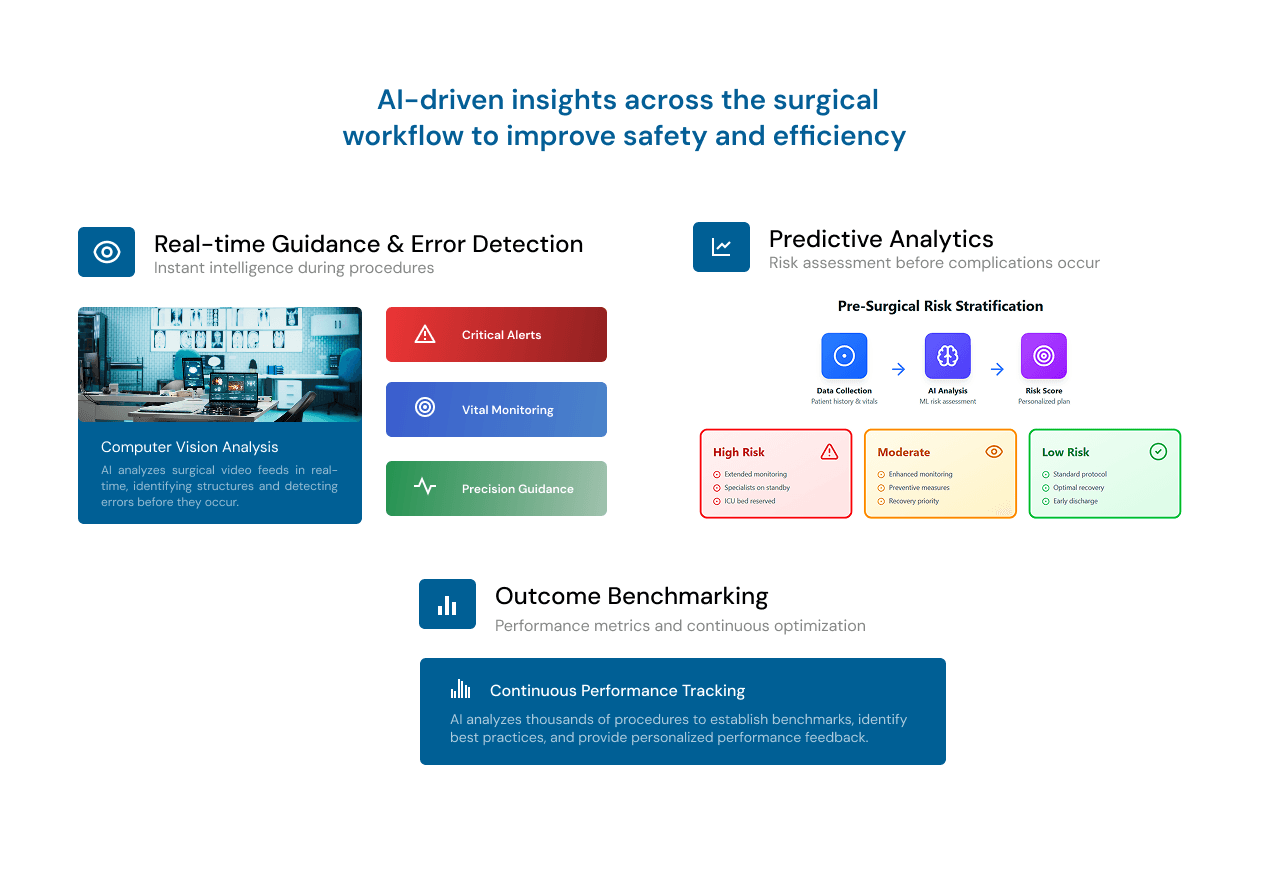
Real-time guidance and error detection
Computer vision and workflow recognition tools provide intraoperative insights that help standardise technique and reduce variation. All AI systems must follow TGA requirements for clinical decision support and demonstrate safety through strict governance.
Predictive analytics
Hospitals can use AI-driven forecasting to anticipate complications, plan theatre allocations and model case durations with greater accuracy.
Outcome benchmarking
Surgeons and perioperative teams gain a clearer understanding of performance trends, enabling targeted training and improved quality assurance.
AI augments clinician judgement. It does not replace it. Its strength lies in reducing avoidable variation and supporting clinical consistency. Hospitals are increasingly leveraging digital healthcare solutions to connect AI-driven insights with theatre operations and broader clinical systems.
Robotics That Improve Efficiency, Throughput, and Team Workflows
Robotic surgery adoption in Australia is expanding, particularly within private health networks such as Ramsay and Healthscope. Public hospitals are adopting robotics more cautiously due to capital investment cycles, although uptake is growing in high-volume centres.
Reduction of fatigue-driven errors
Robotic arms with enhanced dexterity and stability reduce surgeon strain and improve accuracy during long or complex cases.
Automation of repetitive steps
Suturing, camera positioning, and other time-consuming tasks can now be supported or automated, freeing teams to focus on higher-value activities.
Throughput and workflow improvements
Hospitals adopting next-gen robotic systems are seeing:
- More predictable block times
- Reduced OR turnover delays
- Less dependence on large perioperative teams
These improvements directly translate to better scheduling and revenue capture.
The ROI Case: Why Hospitals Are Accelerating Adoption
Australian hospitals evaluate technology through the lens of safety, theatre efficiency and Activity Based Funding (ABF). Key ROI drivers include:
- Reduced waitlist pressure: More predictable theatre schedules help public hospitals manage increasing demand.
- Lower agency staffing costs: Automation reduces the reliance on temporary theatre staff and helps stabilise rosters.
- Higher productivity per session: AI and robotics minimise delays, streamline turnovers and reduce unplanned cancellations.
- Strengthened competitiveness for private hospitals: Robotics and AI-enhanced theatres attract both surgeons and patients, particularly in orthopaedics, urology and general surgery.
Investment decisions are no longer based solely on capital cost. They are grounded in operational impact and long-term sustainability.
Interoperable and Intelligent Theatre Ecosystems
Hospitals are moving toward connected surgical environments that integrate data, devices and workflows. An intelligent theatre ecosystem in Australia typically includes:
EHR and PAS integration
Epic, Cerner and other platforms are widely used across Australian states. Integration ensures seamless perioperative documentation.
My Health Record connectivity
Supports continuity of care across the public and private sectors.
In-theatre visualisation and data capture
Real-time imaging, instrument tracking and digital case logging enhance surgical accuracy and training.
Vendor-neutral interoperability
Hospitals require systems that connect with diverse equipment and align with state digital standards.
This interconnected model reduces friction, reduces manual processes and enhances situational awareness inside the theatre.
Digital Surgery Compliance in Australia: What Hospitals Must Consider
As digital surgery expands across Australia, compliance has become a core requirement for safe adoption. Hospitals must ensure that every AI, robotic or decision-support solution adheres to established national frameworks that protect clinical safety, data privacy and patient outcomes.
TGA classification and software regulation
Digital surgery tools, including AI-assisted decision systems, fall under the Therapeutic Goods Administration’s Software as a Medical Device (SaMD) guidance. This includes evidence of clinical safety, algorithmic transparency and post-market surveillance.
ACSQHC safety and quality governance
The Australian Commission on Safety and Quality in Health Care requires hospitals to demonstrate robust clinical governance when implementing AI-enabled technologies. This includes validation, risk assessment, bias mitigation and continuous monitoring of performance.
Data privacy and cybersecurity
Digital surgery platforms must comply with the Privacy Act 1988 and the Australian Cyber Security Centre’s Essential Eight, ensuring secure handling of imaging, video, telemetry and intraoperative analytics.
RACS and procedure-specific standards
The Royal Australasian College of Surgeons provides guidance on credentialling, training and safe adoption of robotic and AI-enhanced surgical tools. Compliance is essential for surgeon accreditation and medico-legal assurance.
State-level digital health alignment
NSW Health, Queensland Health and VIC Health all require alignment with their digital health frameworks, especially for integrations involving EHR, PACS and intelligent theatre systems.
All AI-guided surgical tools deployed in Australia must comply with TGA’s SaMD regulations and ACSQHC clinical governance standards, ensuring safety from development through to bedside use.
Together, these requirements ensure that digital surgery solutions improve outcomes while meeting Australia’s strict safety and governance expectations.
Why Choose Fortunesoft for Digital Surgery Innovation
Choosing the right technology partner is critical. Fortunesoft supports Australian hospitals by delivering compliant, scalable and clinically aligned digital surgery solutions.
- Familiarity with Australian regulatory requirements: Solutions are developed with TGA, ACSQHC and RACS-aligned standards in mind.
- Deep expertise in theatre workflows: We understand the operational realities of both public and private hospitals.
- Proven capability with EHR and theatre system integrations: Including Epic, Cerner and state-led digital health frameworks, and our capabilities as a hospital management software development company in Australia.
- Advanced engineering for AI, robotics, digital surgery platforms and real-time analytics: We build platforms that support safety, interoperability and clinical reliability.
Fortunesoft works with hospitals to future-proof their surgical ecosystem while maintaining local compliance and clinical governance.
Conclusion
Australia’s surgical landscape is evolving. AI, robotics and intelligent theatre integration are reshaping how perioperative teams plan, operate and collaborate. Both public and private hospitals are moving toward data-driven, safe and efficient surgical environments that can meet rising demand.
Hospitals that invest now will be better positioned to reduce waitlists, improve outcomes and support their surgical workforce. Digital theatre transformation is no longer optional. It is becoming a strategic imperative.
FAQs
1. What exactly is digital surgery in 2026?
A connected ecosystem of AI, robotics, advanced imaging, and data analytics is improving surgical precision, workflow efficiency, and outcomes.
2. How does AI help surgeons during procedures?
AI provides real-time guidance, detects deviations, analyses anatomy, and supports more consistent surgical performance.
3. What ROI can hospitals expect from digital surgery?
Hospitals typically see faster OR times, fewer complications, higher throughput, and lower total cost of care.
4. How quickly can hospitals integrate AI-driven surgical tools?
Most solutions can be integrated progressively, starting with imaging and analytics, then scaling into robotics and real-time guidance.
5. Are AI and robotic systems approved for use in Australian hospitals?
Yes, but they must be registered or classified through the TGA and comply with the ACSQHC clinical governance frameworks.
6. Will this technology replace surgeons?
No. AI and robotics support decision-making and precision, but clinician judgement remains central.
7. How quickly can a hospital adopt these solutions?
Private hospitals can move faster, while public hospitals follow structured procurement and state digital health guidelines.
8. Are these systems compatible with my current theatre equipment?
Most modern platforms are designed to be vendor-neutral and integrate with existing theatre infrastructure.
Sources
- https://www.sciencedirect.com/science/article/pii/S2468900925000222
- https://pubmed.ncbi.nlm.nih.gov/38180541/
- https://pmc.ncbi.nlm.nih.gov/articles/PMC12181090/#:~:text=Introduction,increasingly%20augmented%20by%20intelligent%20automation.
- https://www.sciencedirect.com/science/article/abs/pii/S2173507724001352
Author Bio




Related Blog






 Start Chat