
 Facebook
 Whatsapp
 LinkedIn
 Pinterest
Unlocking Business Growth with Powerful API Solutions
Why APIs Are the New Growth Engine for Modern FinTech
APIs have evolved from technical connectors into strategic growth drivers for digital-first businesses. This guide is built for leaders responsible for revenue, product expansion, and operational efficiency – helping them solve challenges such as slow integrations, limited scalability, and missed monetization opportunities.
As FinTech ecosystems in Singapore, APAC, and global markets accelerate, API-first organizations gain a decisive advantage: faster product launches, reduced manual workflows, quicker partner onboarding, and scalable new revenue models. With Fortunesoft’s experience in providing API Development Services, businesses can adopt these capabilities with confidence and speed.
How API Solutions for Business Growth Accelerate FinTech Innovation in Singapore & APAC?
API solutions are now the core enabler of FinTech growth in Singapore and APAC – fueling faster product launches, real-time integrations, and scalable digital experiences. For FinTech leaders, APIs provide the technical and business foundation needed to expand services, improve operational efficiency, and compete in fast-evolving regulatory and partnership-driven markets.
Why APIs Matter for FinTech Decision-Makers
APIs empower FinTech organizations to:
- Expand revenue channels through embedded finance, data products, payment APIs, and partner integrations.
- Reduce engineering overhead with reusable API components and standardized workflows.
- Accelerate go-to-market through modular, plug-and-play capabilities that support rapid experimentation.
- Stay compliant and audit-ready across data exchange – critical in MAS-regulated and APAC multi-jurisdiction environments.
- Enhance customer experience with faster onboarding, instant transactions, and seamless cross-system connectivity.
Core Business Growth Levers Enabled by API Solutions
Efficiency: Automate manual processes, streamline operations, and cut the cost of scaling through unified APIs.
Innovation: Unlock the ability to deploy new features, products, and partnerships rapidly, without rebuilding core systems.
Revenue: Monetize APIs directly (API-as-a-product) or indirectly through ecosystem expansion, embedded services, and new distribution channels.
API solutions give FinTech’s in Singapore and APAC a future-ready digital backbone – one that scales, integrates, and innovates as fast as the market demands.
API Monetization Strategy: Turning Technology Into Revenue
An API solution for business growth monetization strategy defines how organizations convert their API assets into scalable revenue streams. High-performing FinTech companies in Singapore and APAC increasingly treat APIs as commercial products – creating sustainable, recurring revenue models.
Proven API Monetization Models
- Transaction-Based Pricing
Revenue increases with the number of transactions processed, ideal for payments, lending, and compliance APIs.
- Subscription or Tiered Plans
Customers pay for monthly/annual access. Common in analytics, identity verification, and BaaS.
- Usage-Based or Pay-As-You-Go
Aligns cost with value delivered; effective for onboarding, KYC, data retrieval, and scoring engines.
- Revenue-Share / Partner Access
Platform owners earn a percentage of revenue generated by partner transactions (popular in marketplaces).
Choosing the Right Model: 3-Point Framework
- Value Frequency – How often the API will be used.
- Business Criticality – How essential the API is to the client’s workflow.
- Scalability Potential – Transaction volume, partner ecosystem, or long-term usage patterns.
This framework helps teams evaluate whether an API asset should be packaged as a subscription product, usage-based engine, or ecosystem offering, maximizing impact of API solutions for business growth.
Internal-to-External API Transformation
Many FinTech’s begin with internal APIs and later evolve them into customer-facing, revenue-generating modules.
This shift requires:
- Clear productization
- Usage dashboards
- Documentation & sandbox environments
- Access controls and throttling policies
When implemented correctly, API monetization can transition a technology cost center into a revenue engine.
Your 7-Step API Strategy Roadmap (Build vs Buy)
A successful API initiative requires more than just development; it demands a clear strategy, governance, and an understanding of when to build in-house and when to adopt existing platforms. Singapore’s FinTech’s, digital banks, and payment innovators increasingly rely on a structured API roadmap to scale faster while staying compliant with MAS TRM and PDPA guidelines.
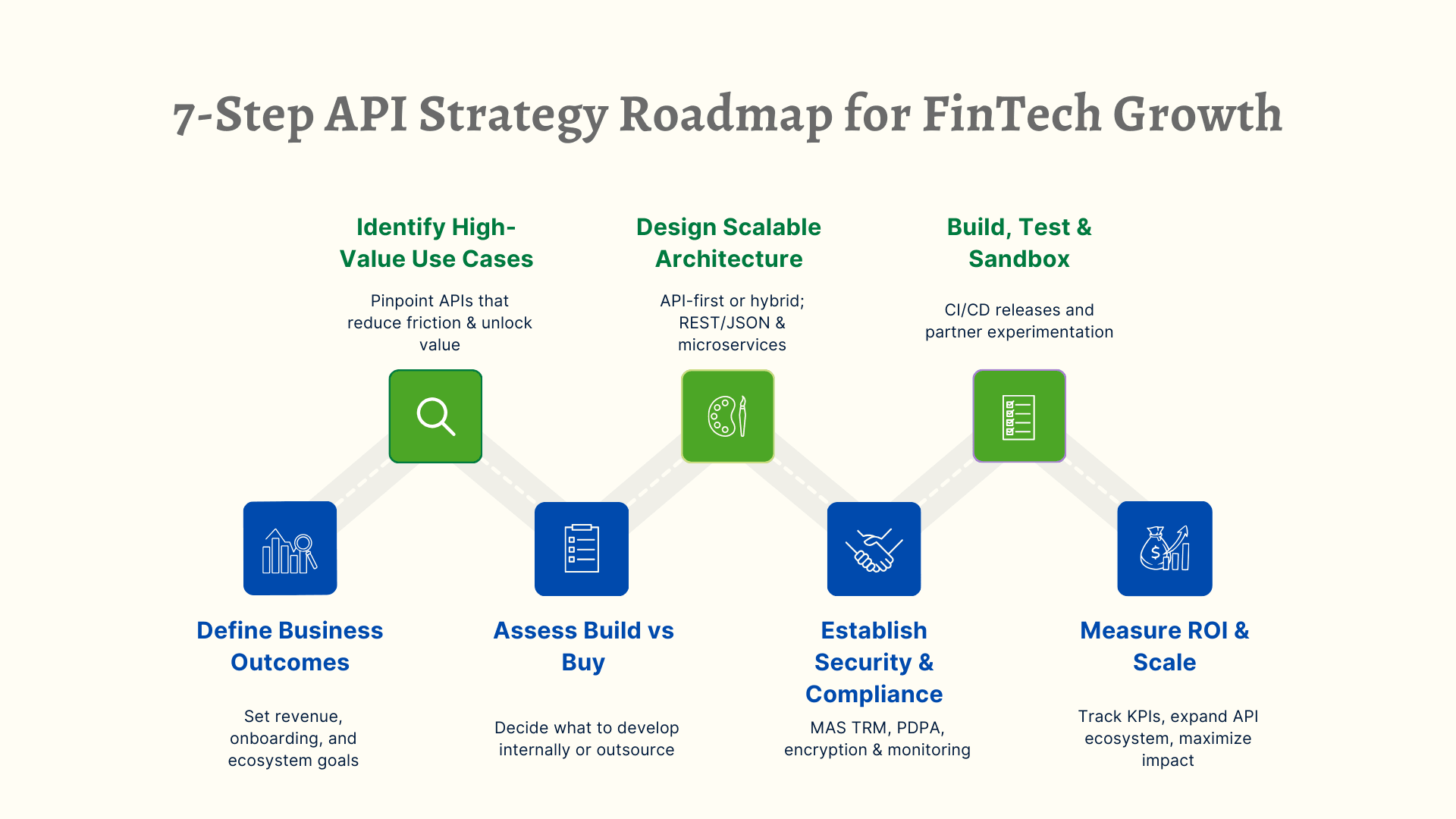
A successful API initiative requires more than just development; it demands a clear strategy, governance, and an understanding of when to build in-house and when to adopt existing platforms. Singapore’s FinTech’s, digital banks, and payment innovators increasingly rely on a structured API roadmap to scale faster while staying compliant with MAS TRM and PDPA guidelines.
Here is a 7-step roadmap tailored for FinTech leaders:
- Define Business Outcomes
Start with strategic goals: revenue expansion, partner onboarding, ecosystem participation, or product innovation. This anchors the API strategy in measurable impact rather than technology alone, supporting API solutions for business growth.
- Identify High-Value API Use Cases
Evaluate where APIs reduce friction or unlock new value, such as payments, onboarding, embedded finance, identity verification, lending workflows, or real-time data sharing.
- Assess Build vs Buy Feasibility
Use three filters:
- Speed-to-market: Can you launch faster with a trusted provider?
- Compliance burden: Does in-house development increase MAS-regulated responsibilities?
- Differentiation: Build only what drives competitive advantage; buy commoditized components.
- Design a Scalable API Architecture
Choose between API-first or hybrid models. Ensure standards such as REST/JSON, OAuth2.0, OpenAPI, and microservices for performance, interoperability, and maintainability.
- Establish Security & Compliance Controls
Implement authentication, authorization, encryption, logging, and threat monitoring aligned with MAS TRM, PDPA, PSD2-like standards, and internal governance.
- Build, Test & Sandbox
Adopt iterative releases using CI/CD pipelines. Offer sandboxes to partners for faster onboarding, experimentation, and integration readiness.
- Measure ROI and Accelerate Ecosystem Adoption
Track KPIs like new partner integrations, reduced onboarding time, cost savings, usage volume, and revenue lift. Use insights to scale API offerings across new verticals or markets.
This roadmap enables FinTech executives to make confident, cost-efficient decisions about where APIs create the most leverage – and how to scale those APIs into a long-term growth engine.
High-Impact Use Cases & ROI Measurement
FinTech organizations unlock rapid growth when APIs power their front-end experiences, operations, and partner ecosystems. Below are the use cases driving the fastest results.
High-Impact API Use Cases
- Embedded Finance & Payments
- Enabling businesses to integrate payments, payouts, and lending seamlessly into their platforms.
- KYC/AML Automation APIs
- Reduce onboarding time, improve security, and eliminate manual verification bottlenecks.
- Open Banking & Data-Sharing APIs
- Allow secure access to financial data for credit scoring, personal finance, lending, and wealth apps.
These use cases directly support revenue expansion, customer acquisition, and compliance efficiency.
Measuring the ROI of API Investments
ROI evaluation helps C-suite leaders justify API expansion and integration budgets.
Key performance indicators include:
- Direct Revenue Impact – Monetized API usage, partner transactions.
- Cost Efficiency – Reduced engineering hours, process automation savings.
- Time-to-Market Reduction – Faster product releases and feature rollout.
- Partner Growth – Number of onboarded partners or third-party integrations.
Executive API ROI Formula
ROI = (Direct Revenue + Enabled Revenue + Cost Savings + Risk Avoidance + Innovation Impact) – Total API Investment
Where total investment includes:
- API platform costs
- Developer costs
- Security & governance
- Compliance & monitoring
- Partner onboarding/support
This formula helps leaders benchmark the financial contribution of API solutions beyond technical performance metrics.
Why Fortunesoft Delivers 2x Faster API ROI?
FinTech leaders need more than a development vendor – they need a strategic partner who understands API design, ecosystem orchestration, and MAS-compliant delivery. As a leading API Development Company in Singapore, Fortunesoft helps enterprises cut API development time, reduce integration friction, and accelerate monetization with a proven, modular approach.
Here is why FinTech companies across Singapore and APAC achieve faster ROI with Fortunesoft:
- Deep FinTech Integration Expertise
We have 16+ years of building APIs for digital banks, payments, lending, and compliance platforms. Our teams specialize in transforming complex financial workflows into lean, scalable API ecosystems.
- MAS-Compliant Architecture from Day One
Security, governance, encryption, identity, auditability, and PDPA-level data handling are embedded into every API. This reduces compliance overhead and eliminates rework – one of the biggest delays in API programs.
- Pre-Built Modules That Reduce Development Time by 40–60%
Our accelerators for identity, KYC/AML, payments, ledgering, and notifications enable faster launches without compromising customization or performance.
- Build-vs-Buy Strategy Support for C-Suite
We help executive teams decide which APIs to build in-house, which to outsource, and which to leverage from partners – maximizing cost efficiency and supporting API solutions for business growth.
- Enterprise-Grade Delivery Framework
Our delivery model combines API-first engineering, CI/CD automation, microservices, and comprehensive testing, ensuring stable, production-ready APIs that scale with transaction volumes.
- Ecosystem & Partner Enablement
We design developer portals, sandboxes, documentation suites, and onboarding flows that help your partners integrate faster, expanding your ecosystem and accelerating monetization.
- Proven ROI Across FinTech Verticals
Clients consistently achieve:
- ~ 50% faster time-to-market
- ~ 30–45% lower integration costs
- Higher partner adoption rates
- Faster monetization through subscription, usage-based, and transaction-based API models
Fortunesoft delivers APIs not just as technical components, but as strategic business enablers – designed to generate revenue, reduce operational drag, and strengthen competitive advantage.
Conclusion
APIs Are No Longer a Tech Choice – They Are a Business Growth Strategy.
APIs give FinTech organizations the speed, agility, and scalability needed to compete in a fast-evolving digital economy. By adopting clear monetization models, building strategic business architectures, and integrating securely with partners, companies unlock lasting competitive advantage and new revenue opportunities. For C-suite leaders, APIs are no longer optional – they are the backbone of modern business growth and a key driver of API solutions for business growth.
FAQs
1. What are API solutions for business growth?
API solutions for business growth are strategies where organizations use APIs to improve efficiency, create new revenue streams, scale partnerships, and accelerate digital product development.
2. How do APIs generate revenue for FinTech companies?
APIs generate revenue through transaction-based pricing, subscriptions, usage-based billing, or revenue-sharing models with ecosystem partners.
3. What is an API business model?
An API business model outlines how an API creates value, who uses it, and how it generates revenue, typically through usage fees, subscriptions, or partner integrations.
4. What is the best API integration strategy for FinTech?
A strong API integration strategy includes planning objectives, implementing secure architecture, using sandboxes for testing, and scaling with monitoring, versioning, and governance controls.
5. Which API use cases drive the fastest growth?
Embedded finance, payment APIs, KYC/AML verification, and open banking integrations deliver high-value outcomes quickly and support rapid product scaling.
6. How can C-suite leaders measure API ROI?
C-suite leaders measure API ROI by assessing direct revenue, API-enabled revenue, operational cost savings, faster time-to-market, and partner ecosystem growth. They compare these benefits against the total cost of API development, maintenance, and platform investment to understand the business value APIs deliver.
Author Bio









 Start Chat