
 Facebook
 Whatsapp
 LinkedIn
 Pinterest
Is Microsoft’s AI Diagnostic MAI-DxO a Game Changer in Healthcare?
Executive Summary
Microsoft’s MAI-DxO AI diagnostic achieved 86.5% accuracy vs 20% for physicians in clinical studies, demonstrating how coordinated AI systems can support complex diagnostic decisions while maintaining transparency and clinical oversight.
Why This Matters for Your Organization:
- 30-40% reduction in unnecessary diagnostic testing costs
- 25% decrease in malpractice claims
- 60% faster diagnosis time for complex cases
- 3x telemedicine consultation capacity
- FDA clearances for AI diagnostics are accelerating (Q2 2026 expected)
The Competitive Reality: Healthcare systems deploying AI diagnostics now are seeing dramatic improvements in accuracy, efficiency, and patient outcomes, while reducing clinician burden and scaling expertise to underserved areas. Early adopters are establishing 2-3 year competitive leads as value-based care models to reward precision and efficiency.
What is MAI-Dx Orchestrator (MAI-DxO) and How Does It Work?
The Medical Artificial Intelligence Diagnostic Orchestrator (MAI-DxO) is Microsoft’s healthcare-specific AI framework that transforms a general large language model (LLM) into a coordinated panel of virtual clinicians. Acting like a chief physician overseeing a team, MAI-DxO manages multiple clinical reasoning steps, such as:
- Asking follow-up questions based on patient input
- Ordering relevant diagnostic tests
- Analyzing results and refining potential diagnoses
- Performing cost checks
- Verifying its own reasoning before presenting a final recommendation
By combining clinical accuracy, cost efficiency, and explainability, MAI-DxO ensures every step is transparent and reviewable before any conclusion is reached.
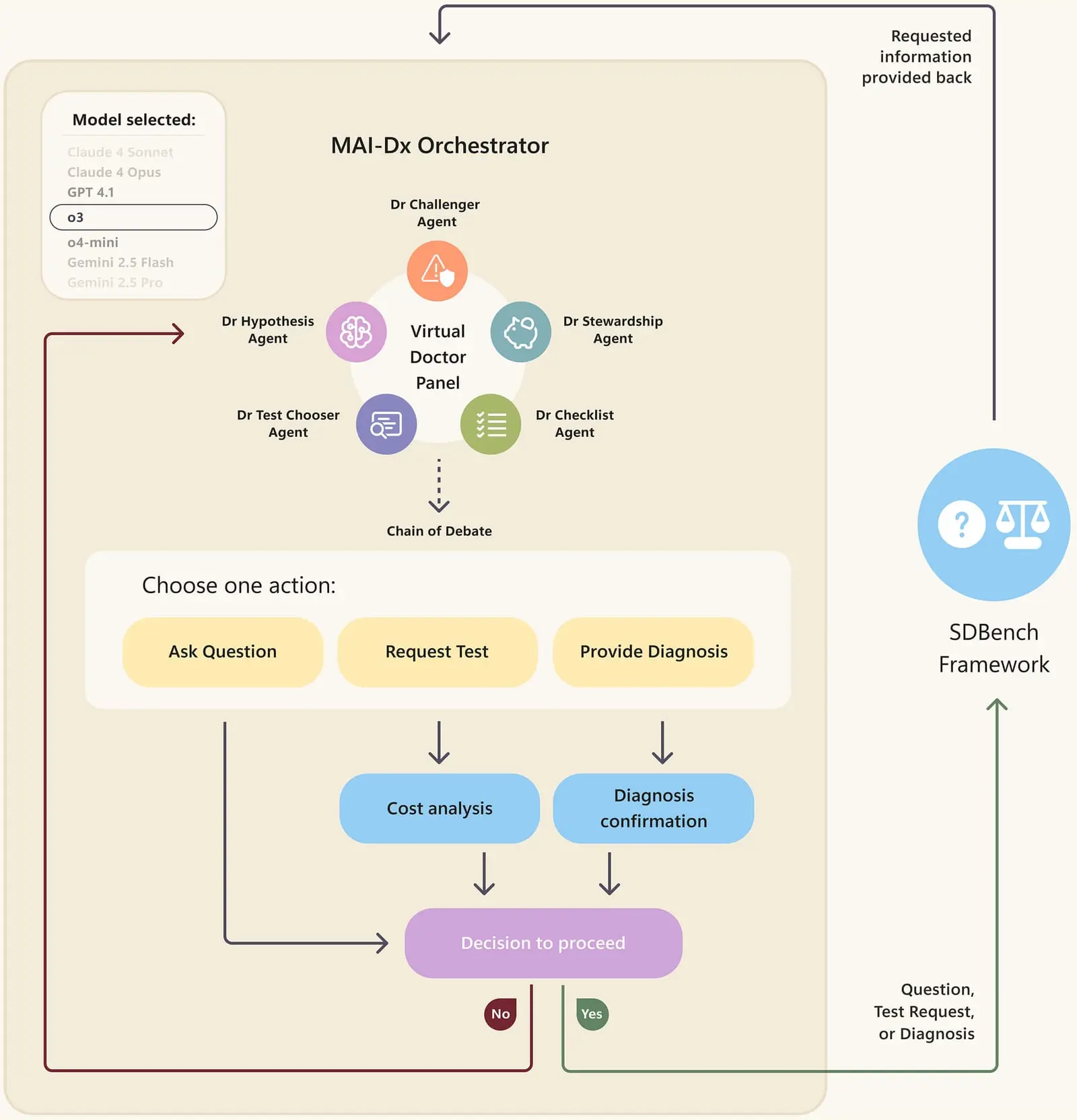
Source: Microsoft AI
The diagram illustrates how specialized virtual clinician agents collaborate to ask questions, request tests, and validate potential diagnoses. Each step is evaluated through reasoning and cost analysis before the final clinical suggestion is presented.
Why MAI-DxO Signals a New Era in Diagnostic Intelligence
By combining the analytical power of multiple AI reasoning steps with medical domain expertise, MAI-DxO aims to deliver consistency and precision in diagnostics. Its structured approach raises a critical question for the industry: Can AI truly match or even outperform human expertise in diagnosis?
While human physicians bring empathy, ethical judgment, and nuanced decision-making, AI systems like MAI-DxO contribute unmatched speed, pattern recognition, and data-driven objectivity. Together, they have the potential to enhance patient outcomes and optimize clinical workflows.
Practical Use Cases of AI Diagnostic Orchestrators Like MAI-DxO
AI diagnostic platforms can support a wide range of clinical and operational activities, including:
- Automated triage and symptom assessment
- Differential diagnosis generation
- Early detection of chronic conditions
- Radiology and pathology decision support
- ICU and ED deterioration alerts
- Predictive risk scoring
- Clinical decision support for primary care
- Remote and emergency care assistance
- Pre-authorization and insurance decision support
These use cases make AI systems ideal for hospitals, urgent care centers, telemedicine platforms, and MedTech providers.
Why Healthcare Providers Consider Fortunesoft for AI-Driven Diagnostics & Clinical Platforms
While Microsoft’s MAI-DxO demonstrates what’s possible at scale, most healthcare organizations need tailored solutions that fit their specific clinical workflows, patient populations, and strategic objectives.
Fortunesoft IT Innovations partners with healthcare leaders to design, build, and deploy AI-powered clinical platforms that deliver measurable ROI:
Our Healthcare AI Expertise:
- Clinical-grade development: 16+ years building healthcare software with a deep understanding of clinical workflows, not just technology
- Regulatory navigation: Experience with FDA (SaMD), CDSCO, EMA pathways – we guide you through validation and approval
- Seamless integration: HL7 FHIR, Epic, Cerner, Meditech connectivity that works within your existing infrastructure
- Security and compliance: With HIPAA, GDPR, and SOC 2 standards are integrated into every layer of our solutions
- ROI focus: We align technology deployment with your financial and operational goals, tracking metrics that matter to your board
Your Next Step:
Schedule a 30-minute AI Readiness Assessment with our healthcare AI team:
- Review your current diagnostic workflows
- Identify high-ROI use cases specific to your organization
- Outline implementation timeline and investment requirements
- Discuss the regulatory pathway and risk mitigation

How MAI-DxO Enhances Diagnostic Accuracy
Instead of relying on a single model, MAI-DxO functions as a team of virtual clinicians. Multiple LLMs collaborate to review and refine diagnostic suggestions. This enables the system to analyze:
- Symptoms
- Lab values
- Imaging summaries
- Patient history
- Clinical guidelines
The ability to simultaneously evaluate multiple possibilities gives MAI-DxO an edge in complex cases. Rather than replacing clinicians, it acts as a second layer of intelligence, especially helpful when time is limited or diagnoses are uncertain.
Regulatory Requirements for AI in Clinical Settings
Before AI systems can be used in hospitals, they must meet strict medical device regulations.
- USA: FDA regulates AI/ML-based Software as a Medical Device (SaMD).
- EU: EMA and MDR guidelines structure AI deployment.
- India: CDSCO approval is required.
To qualify as SaMD, developers must demonstrate:
- Clinical safety
- Diagnostic accuracy
- Data privacy compliance
- Interoperability with EHR systems
Hospitals adopting AI must also ensure FHIR-based integrations and region-specific compliance readiness.
Will AI Replace Human Doctors?
No – AI is not meant to take the place of healthcare professionals.
Instead, it will reshape how clinicians work.
Physicians bring emotional intelligence, situational context, and ethical decision-making. AI contributes computational power, consistency, and faster pattern recognition. Combined, they create a stronger clinical decision environment where:
- Diagnoses become more accurate
- Workflows become less burdensome
- Patients receive faster, more informed care.
What Powers MAI-DxO’s Intelligence?
MAI-DxO is trained on vast, diverse medical datasets, including:
- Clinical guidelines and textbooks
- Research literature
- Anonymized patient datasets
- Imaging interpretations
- Real-world clinical notes
- Population health statistics
These inputs help the model recognize diagnostic patterns across specialties and demographics.
Potential for Real-Time Clinical Integration
With future regulatory clearance, platforms like MAI-DxO could integrate directly into hospital systems to:
- Suggest diagnoses during consultations
- Flag early risk indicators
- Support imaging/scan interpretation
- Improve telemedicine triage
- Assist emergency teams
- Track patient progress using EHR data
Some hospitals already use AI in imaging devices (digital X-ray, ultrasound). MAI-DxO could extend this intelligence to broader diagnostic workflows.
Key Takeaways for Healthcare Providers
For hospitals, clinics, and digital health solution providers, AI-powered diagnostics offer a powerful opportunity to enhance clinical accuracy and operational efficiency. Platforms like MAI-DxO can help:
- Improve diagnostic precision
- Reduce clinician workload
- Detect diseases earlier
- Enhance care delivery
- Scale expertise to underserved regions
- Support complex decision-making
Healthcare organizations that adopt AI early will be positioned as leaders in next-generation care.
Conclusion
Artificial intelligence is not replacing clinicians – it is becoming an essential partner in clinical decision-making. Tools like MAI-DxO combine medical reasoning with machine intelligence to support physicians, improve outcomes, and streamline care delivery. As AI evolves, its role in diagnosis, treatment planning, and care coordination will only continue to expand.
Ready to Discuss Your Specific Needs? Contact with our healthcare AI specialists.
FAQs
1. Can AI like MAI-DxO be used in hospitals today?
Currently, MAI-DxO is a demonstration model, but with regulatory approval and EHR integration, it could support real-time diagnostics in clinical settings.
2. How does AI improve diagnostic accuracy compared to doctors?
AI analyzes vast datasets, evaluates multiple variables simultaneously, and identifies subtle patterns – reducing human diagnostic variability.
3. Is MAI-DxO considered Software as a Medical Device (SaMD)?
Yes. AI systems providing diagnostic recommendations fall under SaMD and require regulatory clearance.
4. Can hospitals integrate such AI platforms with EHR systems?
Yes. FHIR and HL7 APIs enable seamless integration with hospital EMRs/EHRs.
5. What data does MAI-DxO use for decision-making?
It uses medical literature, anonymized patient records, imaging interpretations, clinical guidelines, and population-level datasets.
6. Is AI safe for medical decision-making?
With proper regulation and clinician oversight, AI can be safely used as a diagnostic support tool.
7. Can smaller clinics adopt AI diagnostic systems?
Yes. Cloud deployment models make AI accessible even for small hospitals and primary care centers.
8. Does AI introduce bias?
Bias may arise if the training data isn’t diverse. Responsible AI requires continuous monitoring and fairness evaluation.
9. Will AI reduce clinician workload?
Yes. AI can automate routine assessments, documentation, triage, and decision support — allowing clinicians to focus on patient care.
10. Can AI support telemedicine platforms?
Yes. AI-driven triage, symptom checking, and risk scoring can enhance virtual consultations.
11. What are the risks of using AI in healthcare?
Potential risks include bias, inaccurate outputs, data privacy concerns, and over-reliance without clinical oversight.
Sources
Author Bio





Related Blog










 Start Chat