
 Facebook
 Whatsapp
 LinkedIn
 Pinterest
Telemedicine App Development: A Simplified Guide
Telemedicine has evolved from a simple virtual-visit tool into a core part of digital care delivery. For healthcare leaders, the priority is no longer adoption. The real focus is building a platform that fits seamlessly into clinical workflows, supports reimbursement, enhances accessibility, and meets rising patient expectations for smooth digital experiences.
This guide provides a leadership-level overview of the strategic, technical, and compliance components required to build a telemedicine solution that is secure, future-ready, and aligned with operational and financial goals.
Table of Content
- What Telemedicine App Development Involves
- Key Considerations Before Building Your Telemedicine Platform
- Must-Have Features for a Successful Telemedicine App
- Important Integrations That Power a Telemedicine Platform
- Compliance and Security Made Simple for Telemedicine Apps
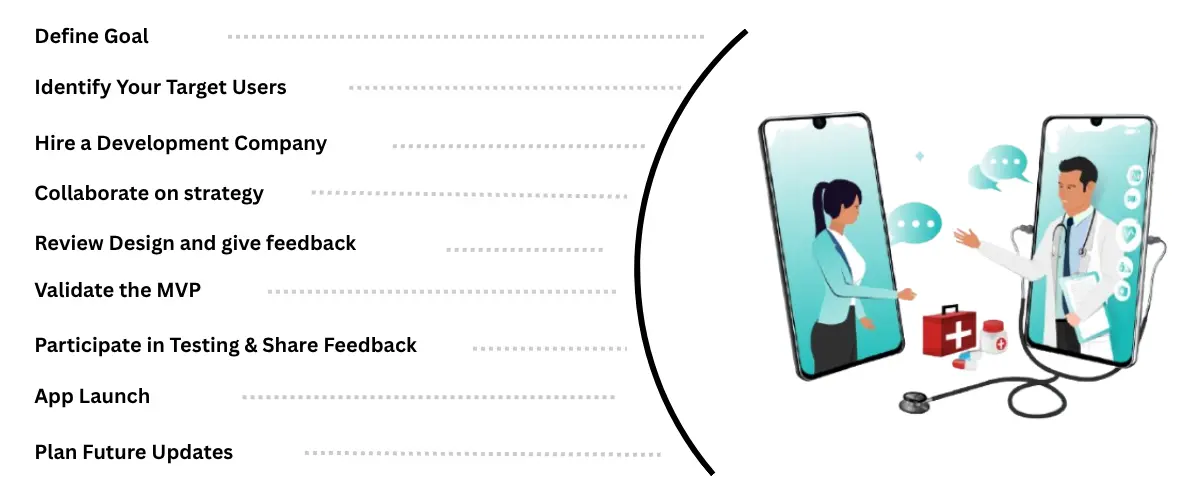
- 9-Step Roadmap for Telemedicine App Development
What Telemedicine App Development Involves?
Telemedicine app development focuses on building secure and intuitive software that allows patients and providers to connect virtually. It includes creating smooth video consultations, easy appointment scheduling, digital prescription workflows, real-time chat, and reliable integrations with hospital systems and wearable devices. The goal is to offer a simple and safe experience that supports everyday clinical workflows.
Key Considerations Before Building Your Telemedicine Platform
Healthcare leaders already understand what telemedicine is — but building a high-performing platform requires clarity in areas often overlooked:
1. Telemedicine is now a workflow platform, not a video tool
Success depends on provider experience, documentation automation, scheduling flows, and integrated charting—not just virtual visits.
2. Integration is the real differentiator
EHR/EMR interoperability, device connectivity, and billing system integrations determine adoption, clinical efficiency, and revenue capture.
3. Compliance shapes architecture decisions
HIPAA, PDPA, GDPR, and regional telehealth policies affect hosting, consent models, data residency, audit trails, and vendor choices.
4. Patient expectations have changed
Patients expect frictionless onboarding, fast consultations, digital prescriptions, and unified care experiences across devices.
5. Revenue models vary
Subscription, per-visit billing, chronic care RPM programs, and payer partnerships all require different features and analytics.
6. AI and RPM are no longer optional
Future-ready telemedicine platforms must be capable of pulling data from wearables, running triage workflows, and supporting predictive analytics.
These are the considerations that guide the rest of the development process.
Must-Have Features for a Successful Telemedicine App
A high-performing telemedicine app must support seamless care delivery, provider efficiency, compliance, and long-term scalability.
Each feature below includes strategic value and a suggested KPI for leaders.
1. User Profiles & Role-Based Access
Value: Secure access and clear workflow separation for patients, providers, and administrators.
KPI: Authentication errors / role-based access violations.
2. Secure Video & Audio Consultations
Value: Reduces no-shows and expands patient access.
KPI: Visit completion rate, no-show reduction.
3. Integrated Scheduling & Calendar Sync
Value: Streamlines appointment management and reduces admin burden.
KPI: Scheduling accuracy, provider utilization rate.
4. E-Prescriptions & Pharmacy Connectivity
Value: Improves adherence and creates a smoother clinical workflow.
KPI: Prescription turnaround time.
5. Real-Time Chat & Messaging
Value: Enhances patient engagement and reduces unnecessary follow-up calls.
KPI: Chat response time and satisfaction scores.
6. EHR/EMR Integration (FHIR/HL7)
Value: Eliminates duplicate charting and improves care continuity.
KPI: Minutes saved per consult/claim error reduction.
7. Payment Processing
Value: Enables cash-pay models, subscription programs, and faster collections.
KPI: Days to payment.
8. RPM (Remote Patient Monitoring) Compatibility
Value: Supports chronic care programs and recurring revenue.
KPI: Device-connected patient rate/readmission change.
9. Notifications & Alerts
Value: Increases visit adherence and refill compliance.
KPI: Notification engagement rate.
10. Multi-Device Accessibility
Value: Improves usability and adoption across patient populations.
KPI: Device-specific user satisfaction.
11. Admin Dashboard & Analytics
Value: Provides operational visibility and performance insights.
KPI: Care efficiency metrics / operational KPIs.
12. HIPAA/GDPR-Compliant Security Architecture
Value: Ensures legal protection, patient trust, and safe scaling.
KPI: Security incidents/audit findings.
Important Integrations That Power a Telemedicine Platform
Integrations enable end-to-end care delivery and determine whether the platform will scale or stall.
Each integration includes value and a leadership risk to manage.
1. EHR/EMR Integration
Value: Unified patient history and automated charting.
Risk: Long integration cycles without FHIR-ready APIs.
2. Video Conferencing APIs
Value: High-quality synchronous care.
Risk: Latency or SDK limitations that disrupt provider workflow.
3. Payment Gateways
Value: Simplifies billing for patients and providers.
Risk: Compliance and refund-handling issues.
4. Pharmacy & E-Prescription
Value: Instant prescribing improves adherence.
Risk: Drug-check and state policy variations.
5. Lab & Diagnostic System Integration
Value: Seamless ordering and result tracking.
Risk: Data mapping inconsistencies.
6. Insurance & Claims Integration
Value: Clean billing and faster reimbursement.
Risk: Coding mismatches → payment delays.
7. RPM Device Integration
Value: Chronic care programs and continuous monitoring.
Risk: Device data quality and connectivity issues.
8. Secure Messaging APIs
Value: Encrypted communication aligned with HIPAA/GDPR.
Risk: Third-party breaches.
9. Identity Verification
Value: Prevents fraud and protects access.
Risk: Failures lead to user drop-off or compliance risk.
10. Notification Services
Value: Improves adherence and reduces missed visits.
Risk: Regulatory issues in SMS/email delivery regions.
Compliance & Security Requirements
A telemedicine platform must operate within strict regulatory boundaries. Compliance requirements vary by geography but carry similar expectations:
Core Requirements
- HIPAA compliance (U.S.)
- GDPR compliance (EU)
- PDPA compliance (APAC regions)
- Data encryption (in-transit & at-rest)
- Audit trails & activity logs
- Role-based access & MFA
- Secure cloud hosting (SOC 2 / ISO 27001 providers)
- Consent & data retention management
- Incident response & breach notification processes
Compliance is not a development step — it’s built into the architecture from the start.
9-Step Guide to Telemedicine App Development
Building a telemedicine platform today requires more than coding. It demands a strategic, compliant, and scalable approach that aligns clinical workflows, patient behaviour, and health system goals.
This roadmap gives healthcare leaders a clear structure to plan, build, launch, and scale a telemedicine app that delivers measurable value across your organization.
1. Set the Vision & Define Clear Business Goals
Every successful telemedicine initiative starts with clarity at the leadership level.
Questions leaders must answer:
- What clinical problem are we solving?
- What organizational goal does telemedicine support?
- What outcomes do we expect in the first 6–12 months?
Examples of measurable goals:
- Reduce outpatient footfall by 20%
- Increase virtual consultations by 25–40%
- Improve provider utilization rates
- Reduce appointment no-shows
- Improve patient satisfaction scores (e.g., +1 point increase in CAHPS or internal NPS)
A clear vision ensures that every feature, integration, and workflow supports real-world outcomes — not just an app build.
2. Identify Target Users & Map Their Real Needs
Telemedicine succeeds only when it fits the workflow of patients, providers, and administrators.
Patient priorities:
- Fast access to care
- Flexible scheduling
- Seamless video quality
- Ability to share vitals, symptoms, or reports easily
Provider priorities:
- Efficient charting
- EHR-integrated workflows
- Minimal administrative burden
- Reliable video + stable data capture
- Easy follow-up & documentation
Administrator priorities:
- Billing + reimbursement
- Compliance reporting
- Analytics dashboards
- Operational visibility
Use interviews, journey mapping, competitor analysis, and user testing to uncover real pain points before finalizing the app scope.
3. Hire the Right Telemedicine App Development Partner
Choosing the right development partner is one of the most important decisions in your telemedicine journey. Clinical workflows, compliance, integrations, and user adoption all depend on the partner’s expertise, not just technology.
Look for a partner with:
- Proven experience in healthcare and telemedicine
- Deep understanding of HIPAA, GDPR, PDPA, and telehealth regulations
- Strong integration capabilities (EHR/EMR, pharmacy, labs, RPM devices)
- A user-centric design approach for both patients and providers
- A clear, agile process with long-term support
The right telemedicine app development company reduces compliance risks, accelerates development, and ensures your platform is scalable, secure, and adoption-ready.
4. Collaborate on the App Strategy, Features & Compliance Blueprint
This is where leadership engages deeply with the development team.
During this stage, you define:
- Core care model: urgent care, specialty care, chronic care, hybrid clinic, RPM
- Core features to prioritize
- Data flow architecture
- Security framework Compliance documentation
- Integration roadmap (EHR, labs, pharmacies, claims systems)
Leadership deliverables:
- Align legal + compliance early
- Finalize clinical protocols for virtual visits
- Define documentation and billing requirements
- Set technical constraints and performance expectations
- Confirm patient privacy standards
Avoid last-minute compliance fixes — they are costly and slow down the launch.
5. Review UX/UI Designs & Validate Workflows Early
Telemedicine apps fail when users struggle with the interface.
Leadership must verify:
- Zero-friction onboarding
- Clinician-centric workflows
- Accessibility (WCAG standards)
- Age-friendly and multilingual UI
- Clear navigation for video, vitals, and messaging
- Minimum clicks for providers
This stage determines adoption.
Even the best feature set fails with poor UX.
6. Validate the MVP With Real Clinical Use Cases
An MVP is not a reduced version of the app — it is the first functional model for real testing.
MVP should include:
- Video consultations
- Scheduling
- Patient profile + vitals upload
- Provider dashboard
- Basic EHR integration
- Messaging or follow-up communication
Leadership priorities:
- Validate clinical safety
- Test workflows with real providers
- Identify usability barriers
- Analyze session performance
- Validate coding + billing workflows
Use MVP learnings to shape the next phase of development.
7. Participate in Testing & Collect Structured User Feedback
Testing in healthcare must go beyond typical QA.
Testing types required:
- Functional testing
- Security testing
- Interoperability testing (HL7, FHIR)
- Performance + load testing
- Clinical workflow testing
- Accessibility testing
Critical step:
Include real users, patients, nurses, physicians, and administrators to validate:
- Usability
- Documentation consistency
- Video quality
- EHR mapping accuracy
- Billing flows
Quality assurance without clinician input results in post-launch adoption issues.
8. Oversee the App Launch & Operational Rollout
The launch is both technical and organizational.
Important leadership actions:
- Provider onboarding and training
- Internal change management
- Marketing + patient education campaigns
- App store readiness (iOS, Android)
- Setting up analytics dashboards
- Monitoring early adoption metrics
A launch is successful when providers confidently use the platform, and patients experience seamless care from day one.
9. Plan Continuous Improvements & Future Enhancements
Telemedicine is evolving rapidly, your app must evolve too.
Post-launch priorities:
- Add RPM modules
- Implement AI-based triage
- Add symptom checkers
- Improve dashboards and analytics
- Expand specialty care modules
- Strengthen interoperability
- Optimize video infrastructure
Leadership metrics to monitor:
- Patient satisfaction
- Provider adoption
- Average call duration
- Drop-off rates
- Appointment completion rates
- Repeat consultation rates
Continuous improvement determines long-term success and competitiveness.
Build Your Telemedicine Platform with Fortunesoft IT Innovations
Telemedicine is now essential for expanding access, improving patient engagement, and supporting hybrid care models. But success requires building the right platform—secure, integrated, compliant, and designed for real clinical workflows.
Fortunesoft IT Innovations brings:
- 16+ years of healthcare technology expertise
- Deep HIPAA, GDPR, and PDPA compliance experience
- Proven EHR/EMR and RPM integration capability
- User-first design and clinician-friendly workflows
- End-to-end development, deployment, and long-term support
If you’re ready to build a scalable, future-ready telemedicine platform, we’re here to help.
Author Bio





Related Blog





 Start Chat