
AI in healthcare is changing how healthcare applications in the UAE are designed, used, and integrated with health systems. From AI-assisted health monitoring to predictive analytics and intelligent patient services, UAE healthcare organisations are increasingly using AI to support more personalised, data-driven care.
The shift is visible across the country's healthcare ecosystem. The UAE Government identifies AI as part of its digital health strategy, while Abu Dhabi and Dubai are advancing AI-enabled healthcare initiatives across clinical, operational and data environments.
How Is AI Changing Healthcare App Development in the UAE?
AI is moving healthcare apps beyond basic appointment booking and record access. Modern applications can use machine learning, computer vision, natural language processing and generative AI to support specific healthcare workflows.
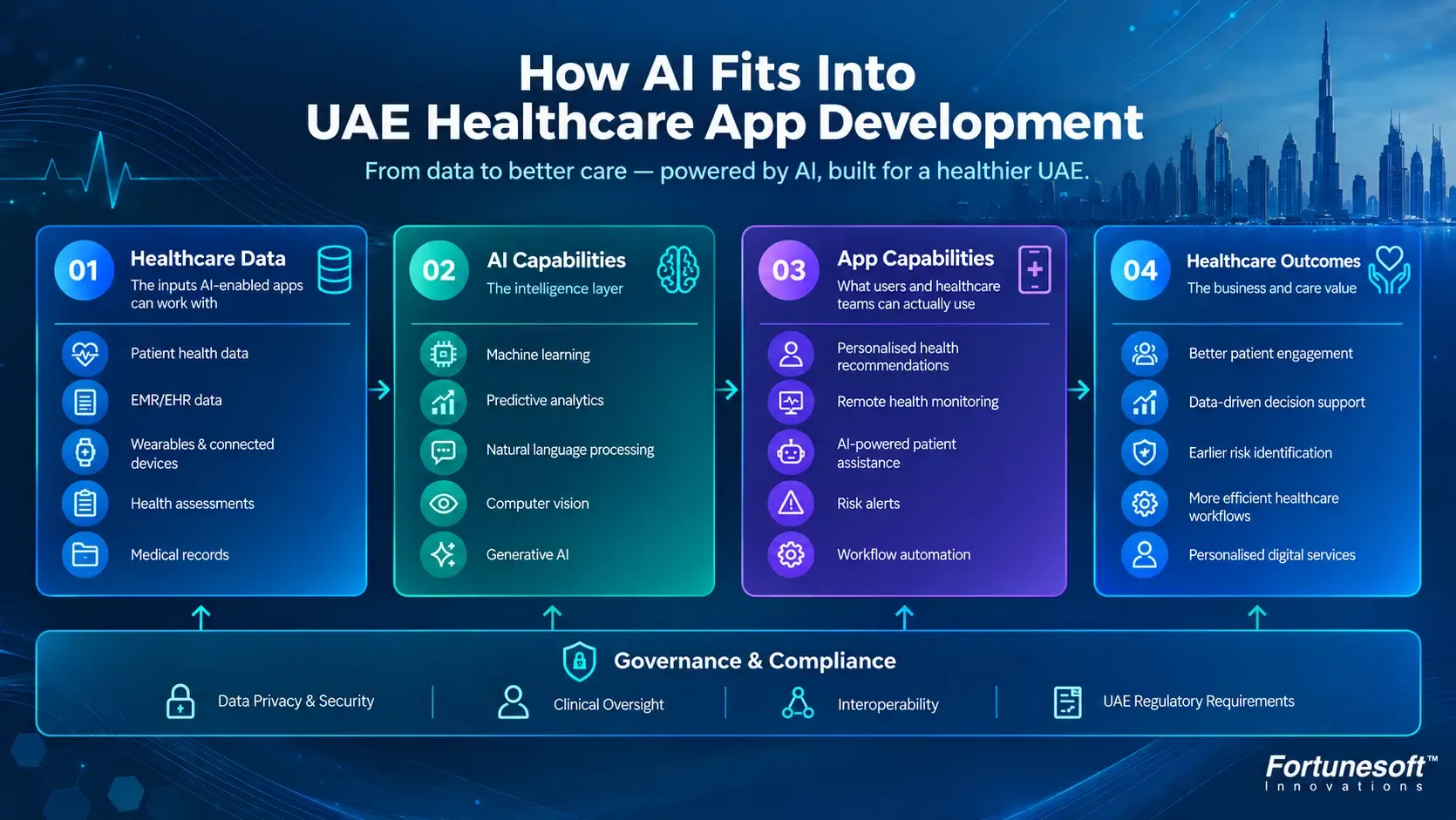
Figure: How AI Fits Into UAE Healthcare App Development
1. Predictive and personalised healthcare
AI can analyse health information to identify patterns, support risk assessment and generate personalised recommendations. Abu Dhabi's Department of Health is developing AI and advanced analytics capabilities for predictive population health, with a stated focus on predicting, preventing and responding to public health challenges.
For healthcare app development, this can translate into features such as:
- Personalised health recommendations
- Risk alerts based on patient data
- Chronic disease monitoring
- Preventive care reminders
- AI-assisted patient assessments
The clinical purpose and level of human oversight should be defined before such features are deployed.
2. AI-powered remote health monitoring
Smartphone cameras, wearables and connected devices can provide healthcare applications with additional sources of patient data.
In January 2025, the UAE Ministry of Health and Prevention introduced Biosigns, an AI-based project designed to use smartphone and tablet cameras to measure health indicators such as blood pressure, pulse and oxygen saturation.
This illustrates where AI in healthcare can influence app architecture: AI models, device integration, data processing and clinical workflows need to work together rather than operate as isolated features.
3. Intelligent patient assistance
AI assistants can help patients find relevant services, understand general health information, prepare for appointments and interact with digital healthcare platforms.
Abu Dhabi's Sahatna Space, integrated into TAMM, already provides digital access to services including appointments, prescriptions, medical records and self-assessments, with AI-powered health assistance and personalised recommendations identified among its planned capabilities.
For healthcare providers, this creates opportunities to build applications around patient engagement while maintaining appropriate clinical boundaries.
4. Smarter healthcare operations
AI can also improve functions behind the patient-facing application.
Potential use cases include:
- Automated document and information processing
- Predictive demand analysis
- Clinical workflow support
- Appointment optimisation
- Patient feedback analysis
- Operational forecasting
MoHAP reported that its 2025 digital transformation initiatives included an AI-powered platform for analysing customer feedback and a Smart Audit project that uses AI to assess healthcare facility architectural plans against applicable standards.
What Compliance Considerations Matter for AI Healthcare Apps in the UAE?
Healthcare applications handle highly sensitive information, so AI functionality must be designed around UAE healthcare and data requirements from the beginning.
Federal Law No. 2 of 2019 concerning the Use of Information and Communication Technology in Health Fields regulates ICT use in healthcare across the UAE, including free zones. It establishes requirements relating to the confidentiality, integrity, security and authorised availability of health data.
Developers also need to consider the Federal Decree-Law No. 45 of 2021 concerning the Protection of Personal Data, alongside applicable emirate-level healthcare requirements.
The regulatory environment also varies by emirate. MoHAP operates at the federal level, while the Department of Health regulates Abu Dhabi and Dubai Health Authority regulates Dubai.
For an AI-enabled healthcare application, compliance should therefore influence architecture, data flows, access controls, consent mechanisms, model governance and auditability from the planning stage.
What Should Healthcare Organisations Consider Before Adding AI?
A successful AI healthcare app requires more than selecting an AI model. Healthcare organisations should evaluate:
| Area | Key consideration |
| Clinical safety | Define where AI can assist and where clinician review is required |
| Data governance | Establish how patient data is collected, processed, stored and accessed |
| Model performance | Validate accuracy for the intended population and use case |
| Privacy | Apply appropriate controls to sensitive health information |
| Integration | Connect AI features with relevant EMR, EHR and health information systems |
| Explainability | Give clinicians sufficient context to understand AI-generated outputs |
| Monitoring | Track model performance and unexpected behaviour after deployment |
Dubai's NABIDH ecosystem demonstrates the importance of interoperability and governed health-data exchange. As of June 2025, the platform contained more than 10.41 million medical records across 1,888 healthcare facilities and 91 EMR systems.
What Is the Future of AI in UAE Healthcare Apps?
The UAE is moving towards healthcare applications that combine AI, connected health data, digital platforms and clinical workflows.
Recent initiatives point towards this direction. Abu Dhabi announced an emirate-wide intelligent surgical network in 2026 to support responsible AI adoption in operating rooms, while Dubai Health Authority has already introduced AI capabilities within NABIDH to strengthen patient data security and privacy.
For healthcare providers and medical technology companies, the opportunity lies in identifying specific clinical or operational problems where AI can produce measurable value and building the surrounding application architecture accordingly.
Why Choose Fortunesoft for Healthcare App Development?
Fortunesoft approaches healthcare application development around the business workflow, technology architecture and regulatory environment involved in each project.
Our approach can support organisations building AI-enabled healthcare applications with capabilities such as patient engagement, remote monitoring, intelligent automation, healthcare integrations and data-driven decision support.
The priority is to define a practical AI use case, establish appropriate data and governance controls, and build an application that can fit into the organisation's existing healthcare ecosystem.
Conclusion
AI in healthcare is becoming an important component of UAE's digital health ecosystem, influencing patient engagement, remote monitoring, predictive analytics and healthcare operations. For organisations investing in healthcare app development, the strongest applications will connect AI capabilities to clearly defined healthcare outcomes while giving equal attention to data governance, clinical oversight, interoperability and UAE compliance requirements.