
Executive Summary
Artificial Intelligence (AI) is redefining clinical trials, bridging long-standing gaps in recruitment, cost, and compliance. According to Fortune Business Insights, the global AI in healthcare market is projected to soar from $39.25 billion in 2025 to over $500 billion by 2032, making AI adoption in clinical trials inevitable.
For pharma sponsors and CROs, AI offers strategic relief from persistent trial inefficiencies, accelerating patient matching, optimizing protocols, enhancing real-time monitoring, and ensuring compliance.
Organizations leveraging AI-powered Clinical Trial Management Software (CTMS) are already achieving measurable gains – from 40% faster recruitment to 70% cost reductions, all while maintaining regulatory confidence and operational transparency. As AI becomes integral to modern clinical research, early adopters are gaining measurable ROI and regulatory agility, setting the standard for the next decade of drug development.
AI isn’t just transforming trials, it’s transforming timelines, budgets, and outcomes.
AI is changing trials. See what it can do for your team, timeline, and bottom line.
Talk to a Clinical AI Specialist
Introduction
If you’re leading clinical operations or overseeing R&D investments, you already know the stakes: ballooning trial costs, recruitment bottlenecks, and increasing regulatory demands. Clinical trials are vital to innovation, yet their traditional models are too slow, costly, and error-prone to sustain competitive growth.
Maybe your organization struggles to recruit the right patients, manage complex protocols, or deliver on time without breaking budgets. You’re not alone, and you’re right to expect smarter solutions.
AI in clinical trials is that solution. It’s not about replacing people but augmenting decision-making with precision, prediction, and speed. From identifying eligible participants to optimizing trial designs, AI has become a strategic enabler of efficiency, compliance, and ROI.
Top Clinical Trial Challenges and AI-Driven Solutions
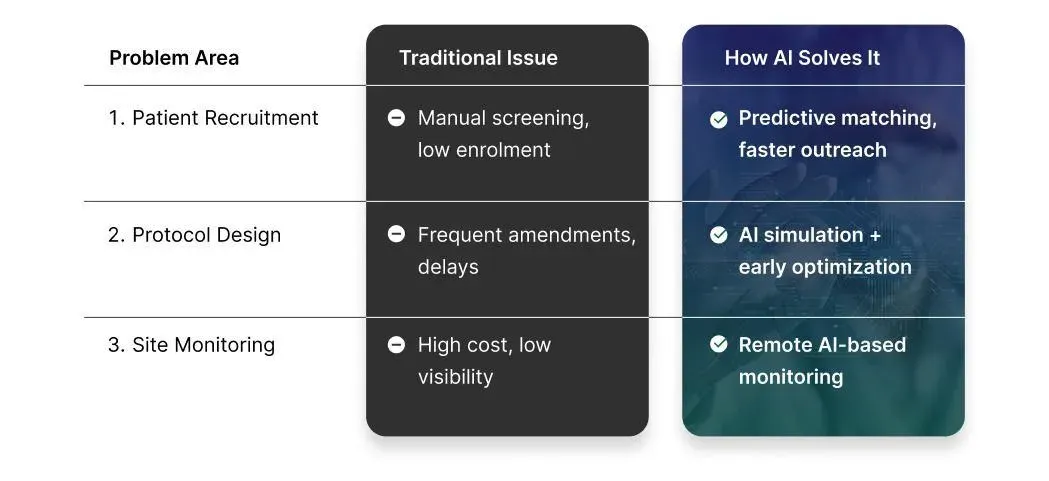
Clinical trials today face significant hurdles that threaten their speed, cost efficiency, and ultimate success.
Three major roadblocks trials face:
- Patient recruitment delays: 80% of trials are delayed due to enrolment issues.
- Protocol complexity: frequent amendments increase cost and non-compliance risk.
- Operational inefficiency: fragmented systems and manual processes reduce data quality and oversight.
These delays carry a steep financial cost. Depending on the therapy area, each day of delay in a clinical trial can translate into $600,000 to $8 million in lost potential revenue, a figure supported by research from Science 37, based on industry data. Operational inefficiencies further compound these losses, eroding competitive advantage and investor confidence.
AI-Powered Solutions:
Each of these challenges compounds cost and risk – but AI is tackling them head-on through intelligent automation and predictive modeling.
- Patient Matching: AI analyzes EHRs and lab data to pinpoint eligible participants, cutting screen failures.
- Protocol Design: Simulates trial scenarios to flag bottlenecks early and avoid mid-study amendments.
- Remote Monitoring: Enhances safety tracking with real-time data analytics across distributed sites.
Together, these capabilities enable faster, compliant, and more cost-effective trials, turning clinical R&D into a competitive advantage.
Ready to See AI in Action?
AI-driven Clinical Trial Management Software Development Services — accelerate trials today!
How AI is Revolutionizing Clinical Trials
AI is not just automating tasks; it is a strategic enabler that reshapes fundamental processes across trial lifecycles:
- Accelerated Patient Recruitment & Retention: AI algorithms analyze de-identified and consented electronic health records (EHR), lab results, and clinical notes to identify eligible participants faster and more precisely. This reduces screen failure rates and enrolment timelines, improving trial success probabilities while honoring HIPAA, GDPR, and GxP compliance frameworks.
- Dynamic Protocol Optimization: AI simulations leverage historical trial data and real-world evidence to forecast bottlenecks and optimize inclusion/exclusion criteria before costly amendments occur. This proactive approach prevents mid-trial deviations and shortens development cycles.
- Enhanced Remote Monitoring & Safety: AI-powered wearables and sensor integrations deliver near-real-time patient data, employing predictive risk modeling and anomaly detection to pre-empt safety events. This improves oversight across sites while easing operational burdens.
Regulatory Compliance & Risk Mitigation
Both FDA and EMA are actively shaping frameworks to support responsible AI innovation, such as the FDA’s Good Machine Learning Practice (GMLP). When integrated responsibly, AI enhances transparency, reproducibility, and fairness, which are essential for regulatory trust and faster approvals.
Best Practices for Compliance:
- Implement AI governance from day one.
- Ensure explainable AI for all predictive models.
- Maintain audit trails and validation protocols.
For sponsors, turning AI compliance into a proactive strategy builds investor confidence and streamlines regulatory review cycles. When compliance is embedded into every AI layer, organizations not only satisfy regulators but also earn their trust.
Measuring ROI: How AI Delivers Tangible Value
Real-world implementations prove that AI’s benefits go beyond theory; they deliver measurable operational and financial impact.
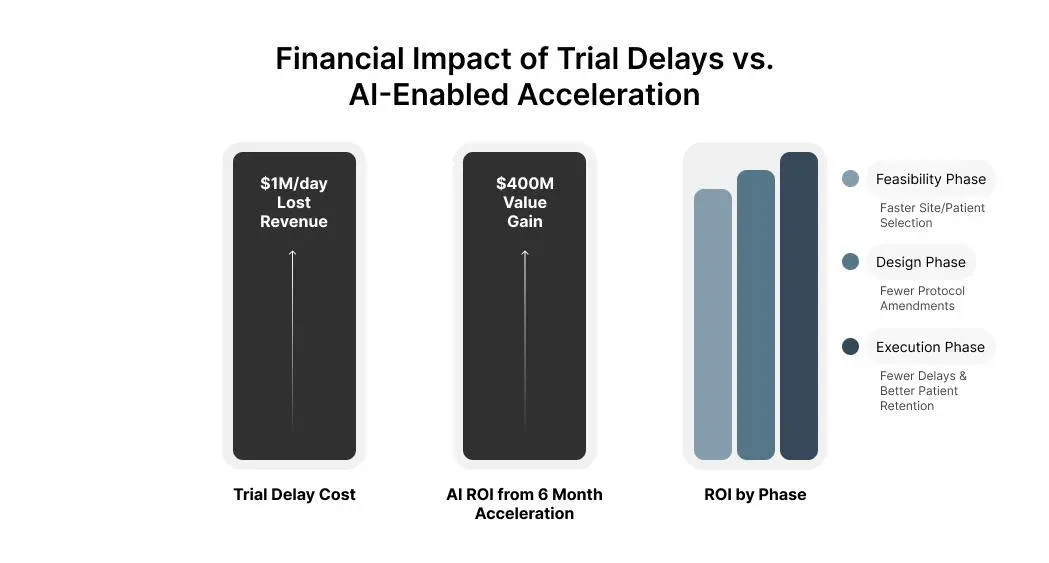
- Cost savings across phases: AI reduces manual data processing and site overhead, enhancing operations from early design to late-stage monitoring.
- Accelerated trial timelines: Predictive analytics and real-time monitoring shorten trial duration, unlocking faster time to market and revenue.
- Improved compliance and risk management: Explainable AI models and proactive governance ensure regulatory approvals proceed more smoothly and with less legal risk.
Case Studies: Real-World Impact
- Leading biopharma firm: Shortened trials by six months through AI-driven recruitment and monitoring, driving millions in cost savings.
- Healthcare firm’s patient recruitment AI: Achieved 15x higher patient identification accuracy, significantly increasing recruitment speed and diversity.
Let’s discuss how AI can cut trial costs and timelines — book a free strategy session today.
Strategic Roadmap to Implement AI for ROI
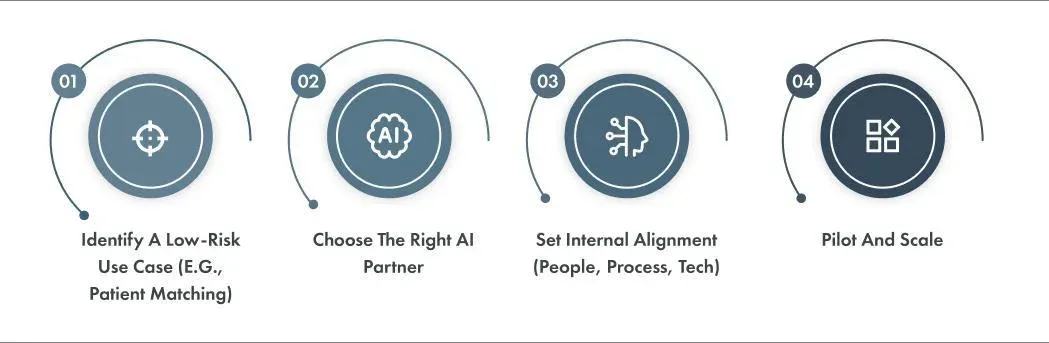
- Start small: pilot patient matching or protocol simulation to demonstrate quick wins.
- Scale with governance: embedded explainability and compliance controls from the start to build trust.
- Align teams: foster collaboration across clinical, regulatory, and IT functions to sustain adoption.
Why This Matters to C-Suite Leaders
For executive leaders, AI in clinical trials is more than a technology investment – it’s a strategic differentiator.
AI transforms how life sciences organizations manage time, cost, and risk. Leaders who act now can:
- Cut trial delays and improve pipeline predictability.
- Strengthen compliance posture with explainable AI.
- Enhance shareholder confidence through data-driven ROI.
Delaying AI integration risks higher operational inefficiencies and lost competitive advantage. Early adopters, on the other hand, are defining the new gold standard for trial innovation.
Why Choose Fortunesoft IT Innovations
At Fortunesoft IT Innovations, we design and deliver AI-powered Clinical Trial Management Software (CTMS) that integrates automation, analytics, and compliance by design.
Our solutions enable sponsors and CROs to:
- Streamline recruitment, monitoring, and reporting workflows.
- Build explainable AI frameworks to meet FDA/EMA standards.
- Gain full visibility across trial sites for faster, safer decisions.
Whether you’re piloting AI for a single study or scaling enterprise-wide, Fortunesoft’s domain expertise ensures your transformation is secure, compliant, and ROI-driven.
Talk to a Clinical AI Specialist today to explore how we can accelerate your trials and future-proof your R&D pipeline.
Conclusion
Clinical trials are no longer just about data collection – they’re about intelligent acceleration. AI is transforming what once took years into months, empowering sponsors and CROs to deliver safer, faster, and more compliant studies. From patient recruitment to regulatory submissions, AI doesn’t just automate; it amplifies precision, foresight, and ROI.
But technology alone isn’t a differentiator; strategy, compliance, and expertise are. That’s where trusted partners like Fortunesoft IT Innovations make the difference. With deep healthcare domain experience and AI-powered Clinical Trial Management Software, we help you move from reactive to predictive, from fragmented to integrated.
The future of clinical research belongs to organizations that act early, govern wisely, and scale responsibly.